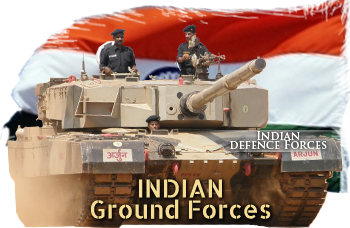
INDIAN ARMOR
About 10,000? armoured vehicles 1947 - today.
From the Origins to WW2
The Creation of the modern Indian Army was related to the independence in 1947 but it not fallen out of the blue. Warfare in India was indeed thousands of years old. Since the Mauryan dynasty that built the first Indian empire (300-200 bc) tactics and formations were known and refined as art since centuries because of constant warfare between various kingdoms of the subcontinent. Since the occupation of Indian by the British East India Company, Indian auxiliaries were seen in the Empire armies all around the world, a tradition passed onto the the British Indian Army, right in ww1 and ww2 from North Africa to Italy against the Germans & Italians and against the Japanese on the Indian border, Singapore, Malaysia and Burma. Since the 1930s, there were already several types of armoured cars and light tanks modified for colonial service, known as the "Indian pattern" and often tropicalized. WW2 saw the only model of armoured vehicle built in India, the Armoured Carrier, Wheeled, India Pattern Mark II/IIA/IIB/IIC built from 1940 to 1944 after a Ford Motor Company of Canada chassis and assembled and completed by the East Indian Railway and Tata Iron & Steel Company. These rear-engined vehicles saw service chiefly against the Japanese.Constitution of the National Army in 1947
Shortly before the partition of India between India and Pakistan (East & West), four of the ten Gurkha regiments were transferred to the British Army, but the rest of the former army was divided between the two new nations. The Punjab Boundary Force which had a mixed composition was disbanded. The first test came immediately over a border dispute in Cashmir and was followed by the Invasion of Hyderabad in 1948, the Portuguese-Indian War of 1961, the Sino-Indian war of 1962, the Indo-Pakistani War of 1965, the Indo-Chinese conflict of 1967, the Naxalites uprising of 1971, the Indo-Pakistani War of 1971 (liberation of Bangladesh), the Siachen conflict in 1984, the Kargil war in 1999, Operation Blue Star and Operation Woodrose against Sikh extremism, counter-insurgency in Jammu and Kashmir and operations of peace keeping in Sri Lanka and elsewhere. Such long history of conflicts saw a fertile ground for building and cultivate tank warfare and tank design.Organization
Due to a shared past with the British Army, the organization and discipline of the Indian Army is closely modelled on this early model, and still remains similar today. The Recruitment is based on voluntary service with a military conscription written in the Indian constitution but never imposed. In 2010 the army which is overwhelmingly professional had a strength of 1,129,900 active and 960,000 reserve personnels. Of the latter, 160,000 were in the Indian Territorial Army, but only 40,000 regularly report for duty. So by any means, this makes the Indian Army the world's largest standing volunteer army.According to the Indian organization of the Indian infantry, regiments are to provide battalions and well trained personnel to the field formations. The troops enlisted within the regiment are loyal and take pride in the regiment's traditions, often based on an old regional history and cultural specificities. Some Infantry regiments selection is indeed based on strict regional, ethnicity, or religion criteria (Assam, Jat Regiment, Sikh Regiments for example). From the Raj, Ladakh, Arunachal and Sikkim Scouts, are specialised in border defense were created after 1947. However, over the years and better mobility and urban development the loyalty towards local regiments had tendencies to be rejected over loyalty over the union of India, contributing to create free Indian regiments like the Brigade of Guards and the Parachute Regiment.
Actual Combat doctrine is partly based on combat experience and partly based on British-inspired traditions. It is a combination of holding formations and strike formations. The holding formations must contain and pin down the enemy while the strike formations had to counter-attack at a chosen spot. It is unique t the Indian Army's size to have such specialized corps affected to the strike role, which is reflected in their training and equipment. Special forces capabilities are also a recent creation. There is no tradition of Marines, but there are currently plans to set up a marine brigade, according to the growing strenght of the Indian navy and the introduction of amphibious capabilities.
There are currently 63 armoured regiments in the Indian Army. The 1st Horse, 2nd Lancers, 3rd Cavalry, 4th Horse, 7th Light Cavalry, 8th Light Cavalry, 9th (Deccan) Horse, 14th (Scinde) Horse, 17th (Poona) Horse, 15th Lancers, 16th Light Cavalry, 18th Cavalry, 20th Lancers, and the 21st (Central India) Horse based on XIXth century units, with extra ones created since Independence. Their equipment, duties and training also reflect the traditions of the cavalry type, like in the British Army. There are currently eight army corps, the New Delhi HQ, Central command at Lucknow, Uttar Pradesh, Eastern command at Kolkata, West Bengal, Northern command at Udhampur, Jammu and Kashmir, South Western Command at Jaipur, Rajhastan, Western command at Chandimandir, Haryana, and the Training command Shimla, Himachal Pradesh.
Indian army military districts.
Tanks and Armoured vehicles
At least until 1960 the bulk of Armoured Vehicles and tanks came from Great Britain. Early equipments included British Armoured cars like the ferret (now discarded), and older ww2 British old stock models, but no modern tanks before the arrival of the Centurion mark 7 main battle tanks in the early 1960s (which saw immediately combat against US-built Pakistani tanks). Centurions were gradually replaced by the Vijayanta MBT in the early to mid-1980s. The next Indian MBT was to be Vickers proposal of a simplified and lighter Centurion to be built in India under licence. About 2200 were built by the Heavy Vehicles Factory until 1986, gradually upgraded, but now placed into the reserve. Shortly after, the development of a new MBT started, known today as the Arjun. This development took thirty years, from 1974 until the first production tanks were out, in 2004. 248 are now in first line service, but only counts for a small portion of the bulk of the Armoured forces equipped after a change of policy with soviet origin tanks.Indeed, 800 T-55s were acquired in the 1960s, followed by PT-76 light tanks, BTR-50, 152, 60 and 80 APCs, BMD-1/2s, PRP-3, Czech OT-64 SKOT, Polish OT-62 TOPAS, BRDM-2s, and co-produced BMP-1 and BMP-2 "Sarath" IFVs, while the bulk of the MBT force is provided by the 2030 T-72 Ajeya co-produced with Poland and Russia and the 1050 T-80/T-80M "Bhishma" with Russia. Ported artillery is provided by 80 FV433 Abbot SPGs, 100 M-46 Catapult (based on the Vijayanta), 110 2S1 Gvozdika, 62 Smerch 9K58 MBRL MRL, 80 Indian-built Pinaka MBRL, and 150 BRM-21 MRLs.
Specialized vehicles are: Future developments includes the Arjun MBT Mk. 2 (Production in 2014), FMBT – The FMBT concept (50 tons), DRDO FICV (Future Infantry Combat Vehicle program) to replace BMP-2s IFV and projects for a new MBT with an active protection system to defeat Fin Stabilized Armor Piercing Discarding Sabot (FSAPDS). .
WORK IN PROGRESS !
Post cold war armoured vehicles
.
.
.
.
Links
The Indian army on WikipediaEquipment of the Indian army (Wikipedia)
Official webpage