9K37 Buk
 SAM System (track vehicles) in service 1978
Development of the BUK
Origin
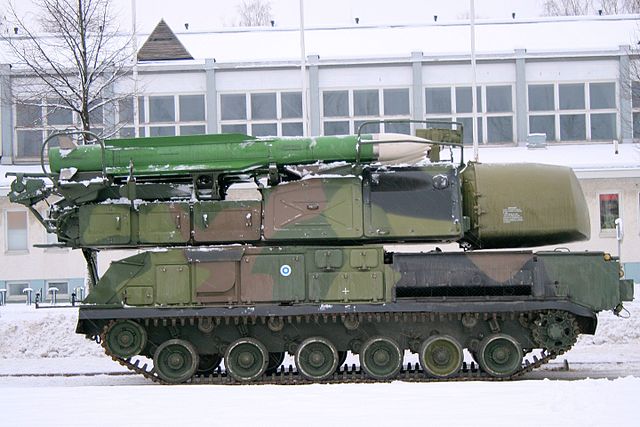
Development of the 9K37 "Buk" weapon system started on 17 January 1972. I was requested by the Central Committee of the USSR, and the development team included many of the same institutions which worked previpusly on the 2K12 "Kub" (NATO "Gainful", SA-6). Notably the Tikhomirov Scientific Research Institute of Instrument Design (NIIP) became lead designer. The Novator design bureau was responsible for the development of the missile itself, and the "Agat" institute developed the radar and dependencies. In addition to this land-based system work started on a marine system, that became the the 3S90 "Uragan" (NATO SA-N-7 "Gadfly").
The "Buk" missile system was a successor of the 2K12 Kub. It was developed as amuch better system on all accounts, as planned by chief designer Ardalion Rastov, which visited Egypt in 1971 to see the "Kub" in operation and was notified about combat reports and users issues. Both the Kub and Buk were deployed on self-propelled launchers developed by Ardalion Rastov. The conclusion was that each Buk transporter erector launcher (TEL) was to be fitted with its own control radar, rather trhan relying on a central radar at battery level. For the first time, the USSR would move from TEL (transporter erector launcher) to "TELAR", same with radar. Each system was able to shoot at multiple targets instead of being vectoring on a single one and each TELAR could be used autonomously to some limit.
In 1974, it was asked to the team that both Kub and Buk systems share some interoperability. This led to the design of the 9K37-1 Buk-1 system. Interoperability between Buk TELAR and Kub TEL increased fire control channels with more missiles operated simultaneoulsy and commonality simplifying the maintenance and supply train as well as making easier to procure Buk components and and earlier entry into service. The Buk-1 was adopted in 1978, after completing state trials and fixes. The complete Buk missile system as a whole was accepted into service in 1980 after state trials in 1977-1979.
Improvements
9K37M1 Buk-M1 (1983)
The Central Committee soon authorised the development of a modernised 9K37 later called 9K37M1 Buk-M1. It was adopted into service in 1983. It focused on the performance of the radar and first kill probability as well as its resistance to electronic countermeasures (ECM). Now a digital target classification system was installed that drew from spectral analysis of returned radar signals. This targeting system was however different from a classic IFF system.9K37M2 Buk-M2 (1992)
Another modification program was started in 1992 until 1997. The Buk-M1-2 entered service in 1998, firing a new missile, the 9M317, offering greater kinetic performance over the previous 9M38, still usable by the Buk-M1-2. There was attached a different GRAU designation, 9K317, used independently for all later systems. The 9K37 Buk series name remained for the complex but the new missile along with other modifications made it capable of intrcepting ballistic missiles and surface targets (like ships and structures) as well pushing the performance and engagement envelope for aircraft and helicopters. The 9K37M1-2 Buk-M1-2 under NATO were reported as the SA-17 Grizzly. The export version of the 9K37M1-2 became the "Ural", concerning also earlier towed and export versions.Buk-M3 (1998+)
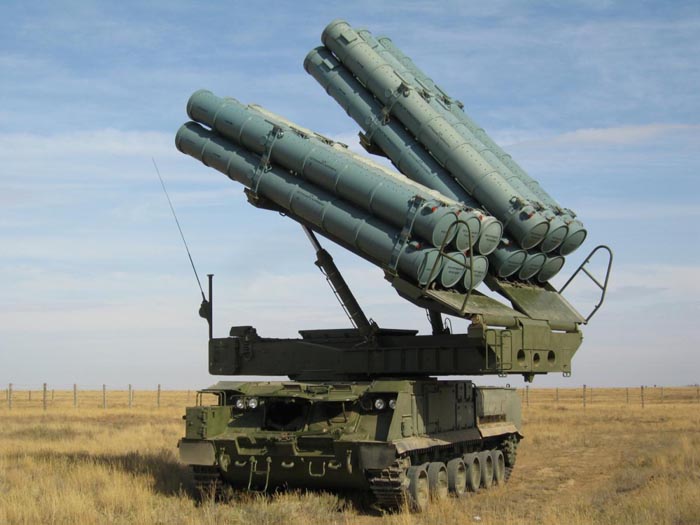
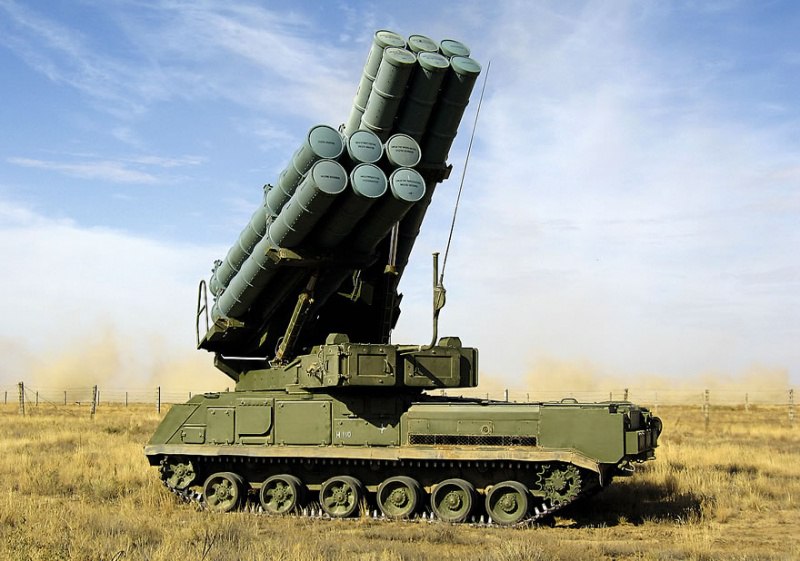
The process was based on a previous advanced developmentents for the 9K317 "Buk-M2" with new msisiles again and a new third-generation phased array fire control radar. It allowed to target up to four targets, while tracking an additional 24. The new radar system had a new fire control radar on a 24 m extending boom, more accurate for low-altitude planes. This Buk new generation was however stalled due to poor economic conditions after the fall of the Soviet Union but it was displayed at the 2007 MAKS Airshow. By October 2007, Russian General Nikolai Frolov of the Ground Forces air defense declared the project was resumed and became the Buk-M3, for a full replacement of the Buk-M1. He stipulated that the M3 would have more advanced electronic components for an entry into service by 2009. The Buk-M3 TELAR notably had a seven wheeled tracked chassis and 6 missiles in launch tubes instead of the four on previous systems.
The full system
A standard Buk battalion consists of the following:- One Command vehicle
- Target acquisition radar (TAR) vehicle
- Six transporter erector launcher and radar (TELAR) vehicles
- Three transporter erector launcher (TEL) vehicles.
The TELAR Tracked Vehicle
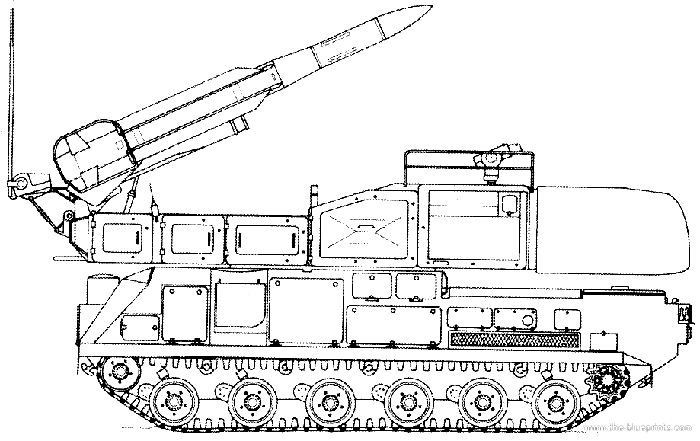
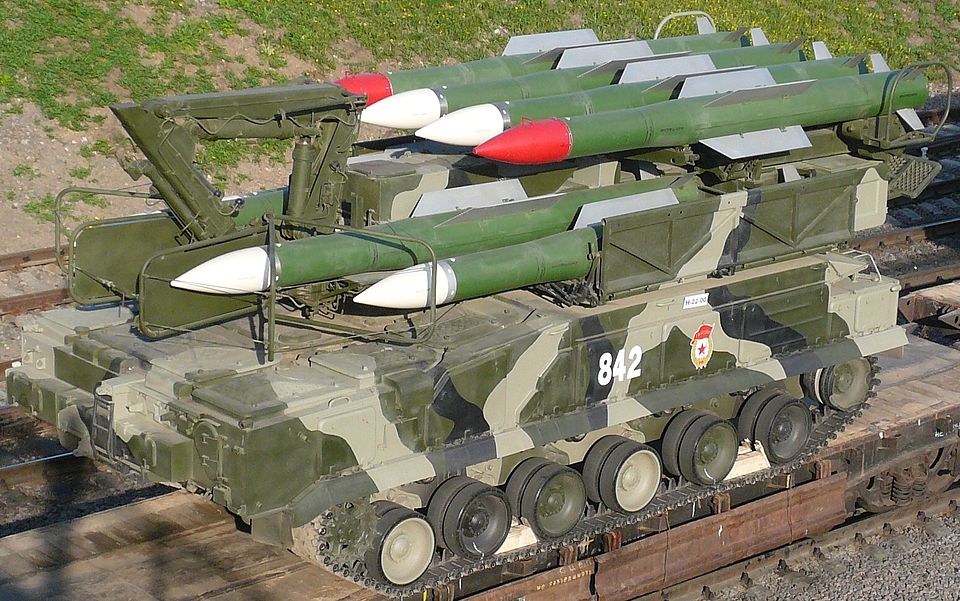
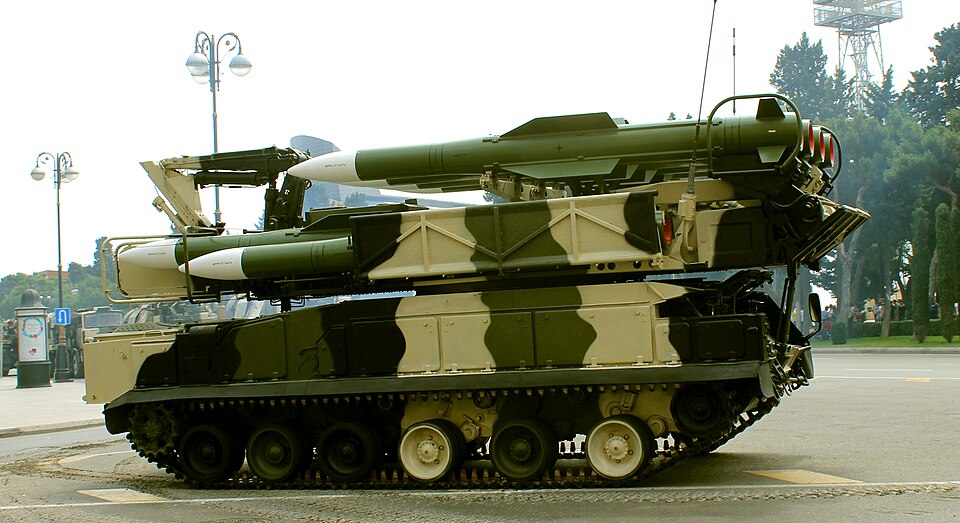
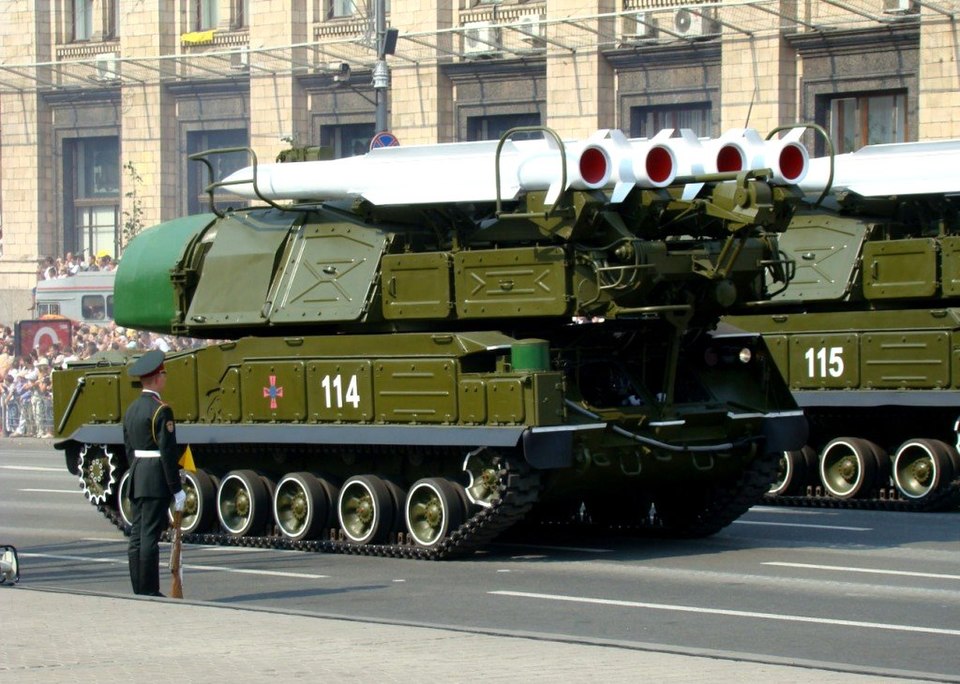
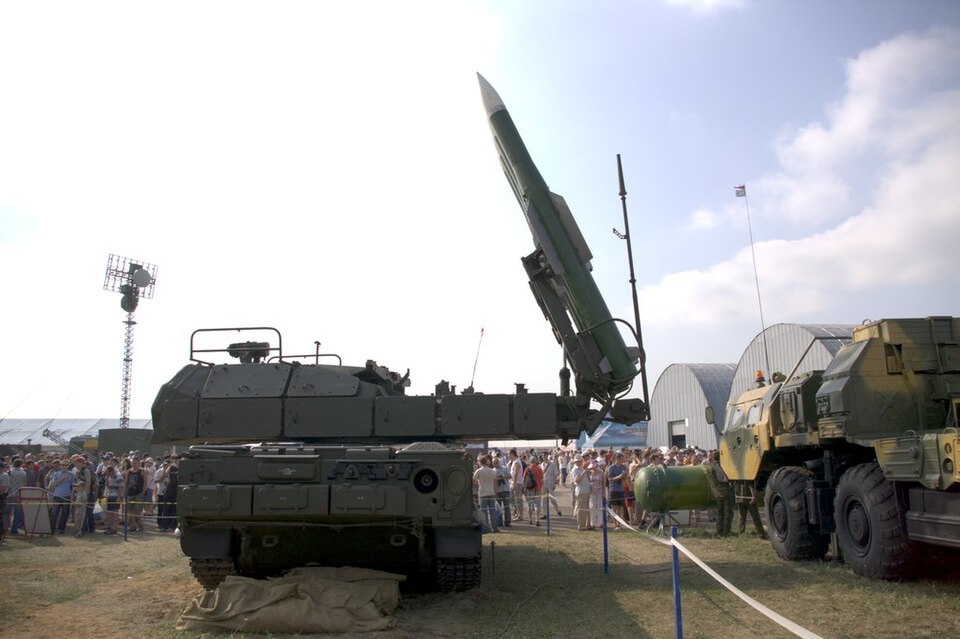
The Buk-M1-2 TELAR uses the GM-569 chassis manufactured by JSC MMZ (Mytishchi) and the tracked chassis is topped by a turret containing the fire control radar forward and launcher aft, with four ready-to-fire missiles on top. Each TELAR had a crew of four (drive and reload operator in the chassis, a commander and radar operator in the turret. The chassis and turret protects its crew from chemical, biological, radiological, and nuclear (CBRN) threats, has automatic fire extinguishers. But the base armour is weak, only 8 mm on all sides of RHA and 13 mm on the front. The combined radar and launcher could guide up to three missiles against a single target. The early Buk had a day radar tracking system 9Sh38 borrowed from the Kub, Tor and Osa less capable. The turret could receve an optional combined optical tracking system with thermal camera and laser rangefinder for passive tracking. The 9K37 could also revert to the same 1S91 Straight Flush 25 kW G/H band continuous wave radar used on the 3M9 "Kub".
The 9S35 radar on the TELAR uses a mechanical scan with Cassegrain antenna reflector. The Buk-M2 TELAR instead uses a PESA for tracking and missile guidance. The missiles are carried by the 9S18 "Купол" (dome) "Tube Arm" or 9S18M1 (NATO Snow Drift) target acquisition radar. It is combined with the 9S35 or 9S35M1 "Fire Dome" H/I band tracking and engagement radar also mounted on each TELAR. The Snow Drift target acquisition radar has a range of 85 km (53 mi) but is limited to plus 100 m (330 ft) altitiude from 35 km (22 mi) away, but it could also detect targets at 10–20 km (6.2–12.4 mi).
The TEL Reload Vehicle
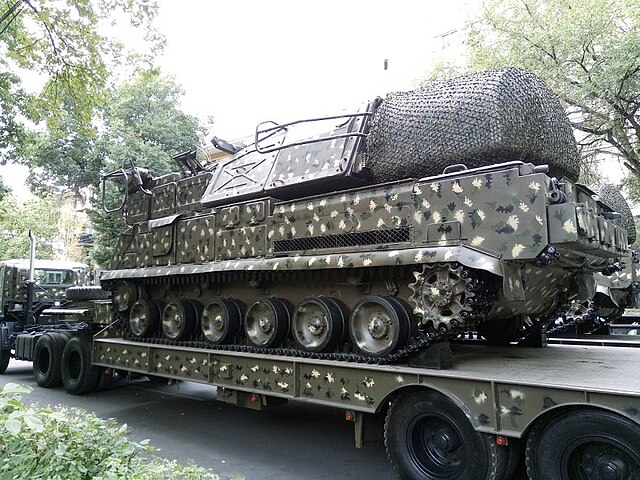
The TEL reload vehicle for the Buk battery has the same chassis as the TELAR, but instead of a radar and turret is given a crane to load missiles. It has cradles in case to directly launch missiles but require datalink cooperation of a Fire Dome-equipped TELAR for guidance. That still an extra missiles if needed in case of saturation attack. The reload vehicle is setup to carry and transfer missiles to a TELAR in 13 minutes and can reload itself from stores in 15 minutes. The latter are brought by supply trucks equipped with carry such missiles. The Buk-M2 TEL is even more potent with a radar atop with telescopic lift and can be used without missiles, as the target acquisition radar (TAR) 9S36. It could operate with two TELs 9A316 to attack up to four targets and capable detection in forested or hilly regions.Both vehicles in the Buk-M1 (Buk-M1-2) system use an Argon-15A computer coupled with a Zaslon radar, first Soviet-made airborne digital computer designed in 1972 by the Research Institute of Computer Engineering (NICEVT, now NII Argon). The Buk-M2 has a slightly upgraded version of Argon-A15K common to ASW defence systems Korshun and Sova, airborne radars for MiG-31 and MiG-33 and the vehicles Tochka, Oka and Volga. For the Buk M3 they are to be replaced by the Baget series of processors by NIIP. The 9K37 combat readiness time is no more than 5 minutes.
The Missiles
Basic specifications:- Target acquisition (by TAR 9S18M1, 9S18M1-1)
- Range: 140 kilometres (87 miles)
- Altitude: 60–25,000 metres (200–82,020 ft)
- Traverse 90° in azimuth, 0–7° and 7–14° in elevation
- Kill probability (by one missile): 90–95%
- Altitude: 15–25,000 metres (49–82,021 ft)
- Range: 3–42 kilometres (2–26 miles)
- Land targets (M2): up to 15 kilometres (9.3 miles)
9М38 and 9М38M1 missile
The 9M38 uses a single-stage X-winged design without detachable parts, externally similar to the US Tartar and Standard series. The commonality with the Navy means its under strict naval dimension limitations to be installed on the M-22 SAM in the Soviet Navy.Specs
Lenght: 5,550 mm (219 in), diameter 330 millimetres (13 in)Weight 690 kg (1,520 lb)
Payload 70 kg (150 lb) warhead triggered by radar proximity fuze with 8000 shrapnel.
Radar semi-active homing 9E50/M1
Engine: 2-mode solid-fuel rocket engine, burn time 15 seconds
Life: Readiness without inspection for 10 years.
Delivery by 9Ya266 (9Я266) transport container.
9M317 missile
It was developed as a common missile for the Russian Ground Force's Air Defence Forces for the Buk-M1-2 and ship-based for the Russian Navy as "Ezh". It looks somewhat like the Vympel R-37 AA missile. It has an unified multi-functional 9M317 (export designation 9M317E) anti-air, anti-ballistic, anti-surface, land and sea. It was designed by OJSC Dolgoprudny Scientific Production Plant (DNPP) and could reach Mach 3.49 with an preimary acceleration of 24G. First used with Buk-M1-2 and as the Shtil-1 in the Navy. Differences includes a larger engagement bubble of 45 km, 25 km altitude and larger target classification. Externally it has a smaller wing chord. Guidance now uses an inertial correction control system with semi-active radar homing 9E420 and 9E50M1 for the 9M38M1. Active homing is only used when approaching the target to avoid detection.9M317M and 9M317A missiles
Modernised versions ordered, along with the active radar homing 9M317A/9M317MAE. NIIP is the lead developer. It reported testing the 9M317A within Buk-M1-2A "OKR Vskhod" in 2005. The range is extended to 50 km (31 mi), and maximum altitude of 25 km (82,000 ft), maximum target speed Mach 4. The missile weight went to 720 kg (1,590 lb). Its development program was completed in 2011. In 2011, Dolgoprudny NPP completed trials of the OKR Pensne developed from earlier missiles. This led to the export version 9M317M(E) missile 5.18 m long for 0.36 m diameter and weighting 581 kg (-62 kg blast fragmentation warhead) with dual-mode radar proximity fuze. Range is from 2.5 to 32 km, altitude from 15 m up to 15 km and 10 m-10 km against other missiles. Each could be fired at 2-second intervals and be ready to fire in 10 s. It also uses inertial guidance, radio control mid-course update, terminal semi-active radar homing with a maximum speed of Mach 4.5.9M318 missile
The 9M318 was developed in Belarus for the Buk-MB2 and Buk-MB3K around 2010 by OKB TSP in Minsk. First displayed at MILEX, Minsk 2019. Reported range 70 kilometres, engage targets from 15 metres to 25 kilometres. Under testing since 2020. Demonstrated in life fire at ADEX-2022 in Baku. Designed to operate in a heavy ECM environment and capable of ballistic missile interception, tactical ballistic missiles and surface targets up to 60 km, with active jamming. 815 kgs, speed 1350 m/s, active radar homing seeker for 10 cm accuracy.Operations, Exports and Combat
The Buk was designed as a mobile, radar-guided SAM missile system with four main components, the acquisition and targeting radars, command element, missile launchers, logistical element all mounted on different tracked vehicles to move with other tracked forces and able to relocate rapidly, making them more difficult target than fixed SAM system (the early Buk M1 was towed).- The acquisition radar component (several variants have differing capabilities) allows the system to identify, track and target selected targets.
- The command component is intended to discern "friendly" military aircraft from foes (IFF), prioritise multiple targets, and pass radar targeting information to the missile launchers.
- The missile launcher component can carry a variety of missiles (as listed below) and may be able to engage more than one target simultaneously.
- The logistics component carries additional (reload) missiles and provides other supplies and parts for the system and the operators.
specifications Buk M2 GM5955 chassis | |
| Dimensions (L-w-h) | 9.2 x 32.5 x 3.8m |
| Total weight, battle ready | 34 tons oa (GM-569 chassis 24t), ground pressure 0.8 kg/cm2 |
| Crew | 4 |
| Propulsion | Multi-fuel liquid-cooled diesel 840 hp |
| Speed | 65 km/h |
| Range (on flat) | 500km |
| Armament | See notes: 4 SAM |
| Armor | 12-8 mm RHA armour |
| Total production | Unknown |
Combat Service
Georgia:
The Buk was deployed during the War in Abkhazia (1992–1993), with Russian forces operated the latter, for the Abkhaz separatist forces, against the Georgian government. On 10 January 1993, an Abkhaz Aero L-39 was shot down by a Russian Buk in a friendly-fire, killing the commander of the Abkhaz separatist air force. Abkhaz authorities claimed a Buk shot down four Georgian drones on May 2008. The Russians claimed three Sukhoi Su-25 and a Tupolev Tu-22M bomber in the 2008 South Ossetia war. U.S. officials said a these losses by a Georgian Buk-1M was probably true and that apparently Russian RCM were unable to jam and suppress these. Georgia bought more of these from Ukraine.2014 Russo-Ukrainian War
A Buk M2 was famously used to shoot down the Boeing 777-200ER Malaysia Airlines Flight 17 on 17 July 2014, in eastern Ukraine, killing 298. Evidence included missile fragments found on site and those stuck in the wreckage plus serial number remnants even fragments in bodies of the flight crew. On 7 August 2014, pro-Russian separatist forces shot down a Ukrainian Air Force Mikoyan MiG-29 near Yenakievo but the pilot managed to eject.Middle East
On 14 April 2018 NATO forces launched 105 air-to-surface and cruise missiles on eight sites in Syria. The Russian MoD claimed twenty-nine Buk-M2E missiles were launched, destroyed twenty-four missiles. The Syrian Air Defense Force claimed also 65 missiles, while the US DoD denied these claims. On 19 July 202 four Israeli Air Force F-16 which entered Syria's airspace southeast of Aleppo had seven missiles launched, parly from Buk-M2 of the Syrian Air Defense Forces., claiming all shot down.2022 Russian invasion of Ukraine
Ukraine's S-300 systems proven effective at medium and long ranges, and forced them low enough for MANPADS engagement distances. Ukraine also had many Buk systems, and adapted them to fire Sea Sparrow missiles, integrated by Wojskowe Zakłady Uzbrojenia S.A. These missiles are now surplus in the USN inventory however a variant of the RIM-162 is still in production. On 27 February 2022, a Ukrainian TB2 Bayraktar drone destroyed a Russian Buk TELAR and a TEL near Malin, northwest of Kyiv. On 23 February 2024 two Russian Buk-M3 were reported destroyed. On 11 May 2024, a Russian drone destroyed a Ukrainian Buk-M1 carrying RIM-7 Sea Sparrow. On 11 June 2024 a Switchblade struck a Russian Buk in Sarabash, Donetsk. On 30 December 2024, another Russian Buk-M1-2 was claimed in Zaporizhzhia. On 7 April 2025, Ukrainian drones destroyed 3 Buk in Kursk, a Buk-M2 and two Buk-M3s. On 7 October 2025, Ukrainian forces destroyed a Buk-M2 or Buk-M3 with a drone. On 10 October 2025, Russia claimed intercepting two Flamingo missiles with a Buk.Illustrations
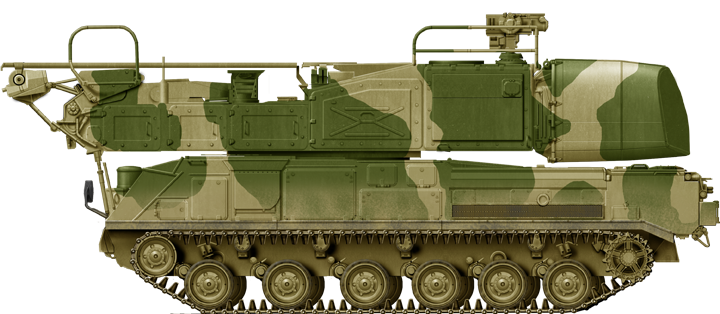 Syrian Buk M1-2 in 2018
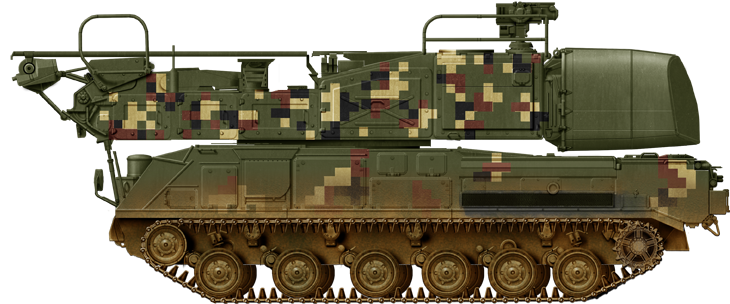 Ukrainian 9K37 Buk M1
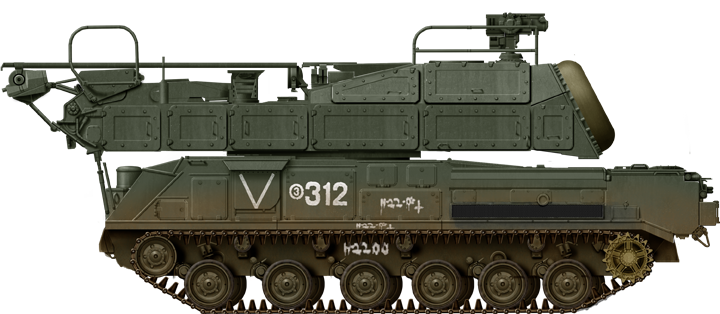 Russian Buk M2, green livery
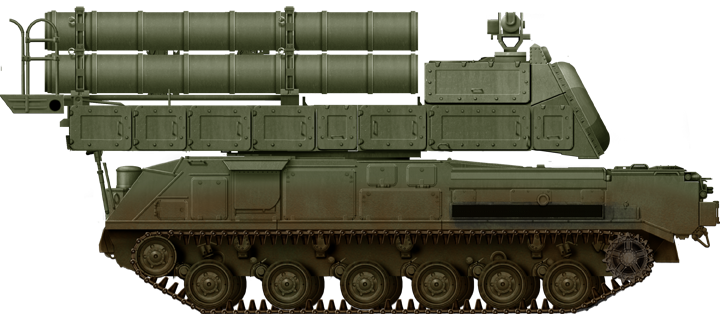 Russian Buk M3 in Ukraine 2023
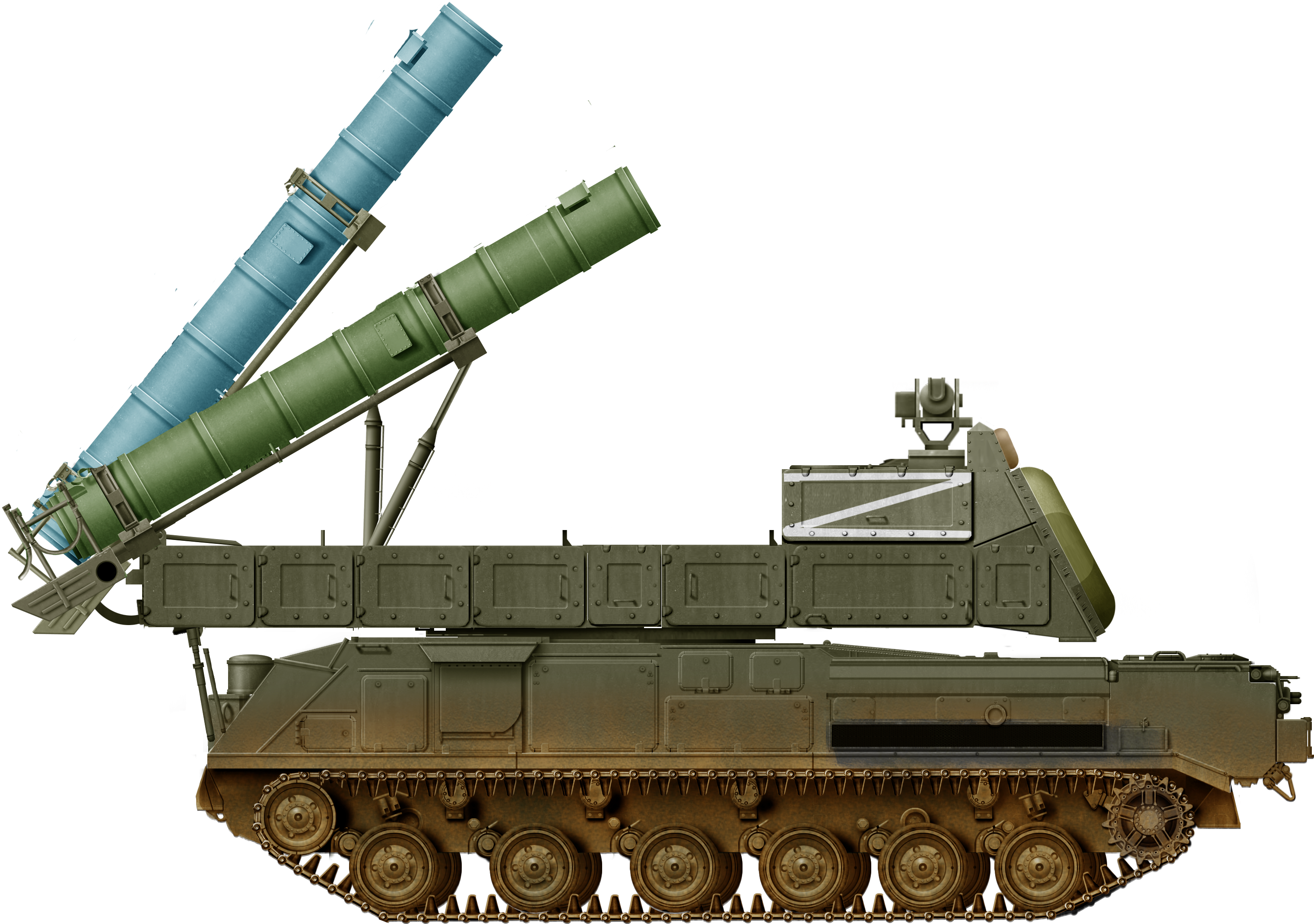 Russian Buk M3 in Ukraine 2024
Gallery
Related links
armyrecognition.com/en.missilery.info
en.wikipedia.org
odin.tradoc.army.mil M2
odin.tradoc.army.mil M1
forum.guns.ru
armyrecognition.com
army-technology.com

Cold War Tanks


Cold war tanks posters
Cold War Main Battle Tanks
Cold War Soviet Army
Museums, Movies, Books & Games
The Tanks and Armor in pop culture
Tanks and armored vehicles in general are only really grasped when seen first person: The mass, the scale, it's all there. Explore also the way tanks were covered in the movie industry, in books and in video games.Movies:
Best tanks movie on warhistoryonline.com
On imdb.com
On bestsimilar.com/
miltours.com
liveabout.com/
watchmojo.com
Video Games:
pcgamesn.com
historyhit.com
levvvel.com
vg247.com/best-tank-games
mmobomb.com/
alienwarearena.com