M33 Prime Mover
 109 converted 1943-44.
Development of the M33 PMV
Moving artillery pieces to and on the battlefield always had been an issue for belligerents. In the Napoleonic era, the tried and tested old system of horse-drawn carriages was pushed further in terms of speed, with more horses and better suited carriages. Gradually it was understood artillery could be moved on the battlefield at cavalry, instead of infantry pace, leding to the co,cept of "flying artillery". In WWI, horse((drawn carriage was still the norm, but the mechanization of the army was in ful swing. Especially moving howitzer and heavy ordnance over a cratered, muddy ground was too much for horses and dedicated tracked tractors proved more capable than wheeled vehicles, especially on the northwestern French front and in flanders. Animal traction just could not compete with artillery pieces now far too heavy.
Plus the logistics and fragility of animals were a reason by 1918 all belligerents saw full mechanization as the way forward. More robust, powerful and reliable vehicles were tested in the interwar and so in the Second World War, horses for traction fell to the rear lines and reserves. The US army, despite its massive shrinkage after the 1929 financial crisis, was stepping up in 1937-39 towards more mechanization, of the cavalry and artillery. Militarized agricultural tractors and heavy trucks with full traction became the norm. But to simplify logistics, a key obsession in the US, for good reasons, the use existing tracked vehicles became a preferred option. So as the production of the M4 Sherman ramped up in 1942 as the new American medium tankl standard, this pushed aside the previous standard, the M3 Medium. By mid-1942, the M3 Lee/Grant now appeared outdated and was declined into a multiple serie of variants. (It also soldiered on with the Aussies until 1945 in the Pacific).
Variants of the M3 were the M31 Tank Recovery Vehicle (Grant ARV I), M31B1 and B3 based on more recent versions of the M3, but also the 105 mm Howitzer Motor Carriage M7 Priest and 155 mm Gun Motor Carriage M12 for US variants alone. The M33 was seen as a derivative of the M32 ARV without winch and crane, solely dedicated to heavy artillery towing. The M33 prime mover was the first US effort to produce an artillery prime mover, based on the M3 medium tank. Development started with the T16 heavy cargo tractor prototype based on the M3A5 chassis. It was relatively promising, but its lack of storage space and poor crew protection led to a new serie of improved prototypes. Series production was cancelled for the T16. Notably the crew was very exposed to the weather, without any cover except for a stretched tarpaulin. It however had a powerful Gar Wood 18.000 Kg winch in the rear for self-unditching or salvage other tanks.
Baldwin meanwhile converted 805 surplus M3s, M3A3s and M3A5s in the T2 Tank Recovery Vehicle which was standardized as the M31 and the latter design had a strng influence on a successor to the T16. The military continued to see potential for the stockpiled M3s, and with the arrival of the M32 TRV based in M4 Sherman chassis even more efficient than the T2 (M31), it was simply decided not to reivent the wheel but simply to start with the the T2 (M31) TRV now gradually replaced by the M32 TRV as artillery prime mover. This was believed to be an interim as a serie of newly developed and fully dedicated fast speed heavy tractors were in development.
The T2 (M31) TRV presented many strong advantages and the M33 could take advantage of these, like an excellent winch, better storage and better crew protection. Converting it essentially as a simpler vehicle would take less timle and resources for an interim solution, it just made sense. It was understood these converted M31s would soleley be dedicated for towing heavy guns. In the end it was decided to select 109 of the radial engine T2 or M31s from the last 3 months of Baldwin's production to be reconverted as prime movers. The task was given to Ford Motor Co. factory in Chester (Pennsylvania), Chester Tank Depot wit supervision by the Army Ordnance Department. The production line ths started from December 1943 to February 1944, a short time given the job was relatively easy.
The test phase was also pretty reduced as azll was done already for the T2 years ago, and modifications were limited. The new vehicle was officially the "Full-track Prime Mover M33" in US ordnance.
Design

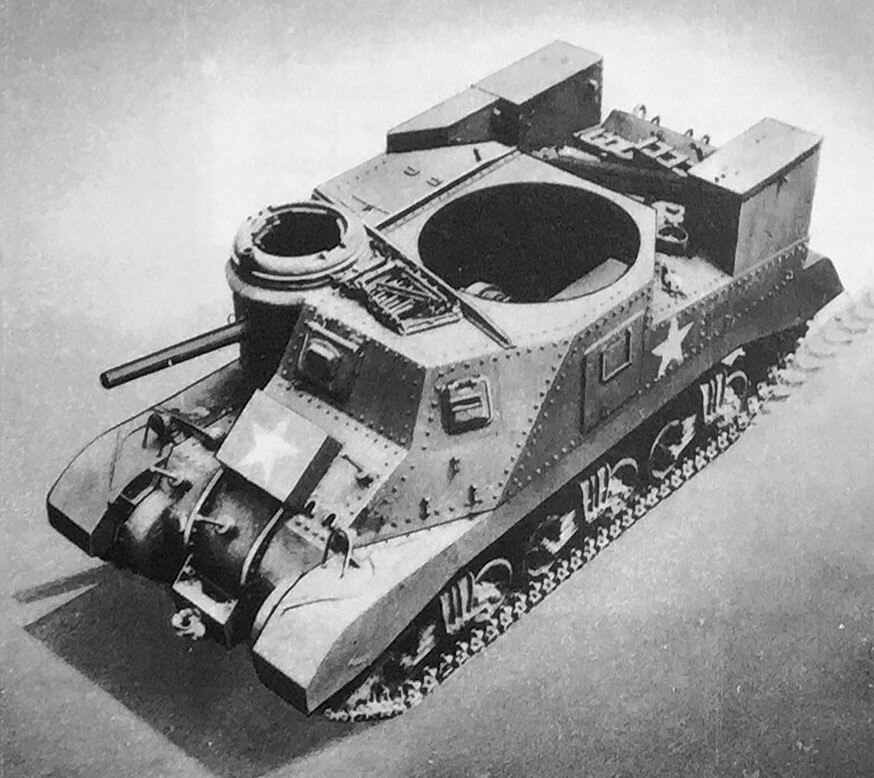
The M33 presented most similarities with the T2/M31 TRV and also mixed elements from the "Heavy Tractor Cargo, T16" previously considered unsuitable as prime mover, but delays in production of the M6 High Speed Tractor, caused some pause and reevaluation of the strict criteria for the M33, always dubbed an "interim" heavy tractor vehicle in documentation. The M33 unlike the M31 TRV ditched its new cast turret with integral crane boom and all crane-related accessories. However all the internal arrangement and the powerful winch were retained. The commander had a new hatch ring already found on Sherman turrets, adapted to fit on the roof of the hull, above the now fake 75mm gun sponson. This was also fully rotatableand soon mounted a .50 Browning machine gun for close defence. This was also compared to the "pulpit" of the M7 "priest". Photos suggests hatches were not installed on the hatch ring. Tall boxes on the rear deck hosted notably an air compressor to supply the brakes of the artillery towed. Canvas covers covered now the open turret ring, plus another smaller for the MG ring forward... Extra attachements along the hull enabled the winch cable to be suspended and extra strapping enabled installation of two ore more spare roadwheels on the nose, adding extra protection. Strappings on the engine deck between the large boxes at the rear provided not only an impromptu shelter for more haversacks and gear for the crew.
Mobility
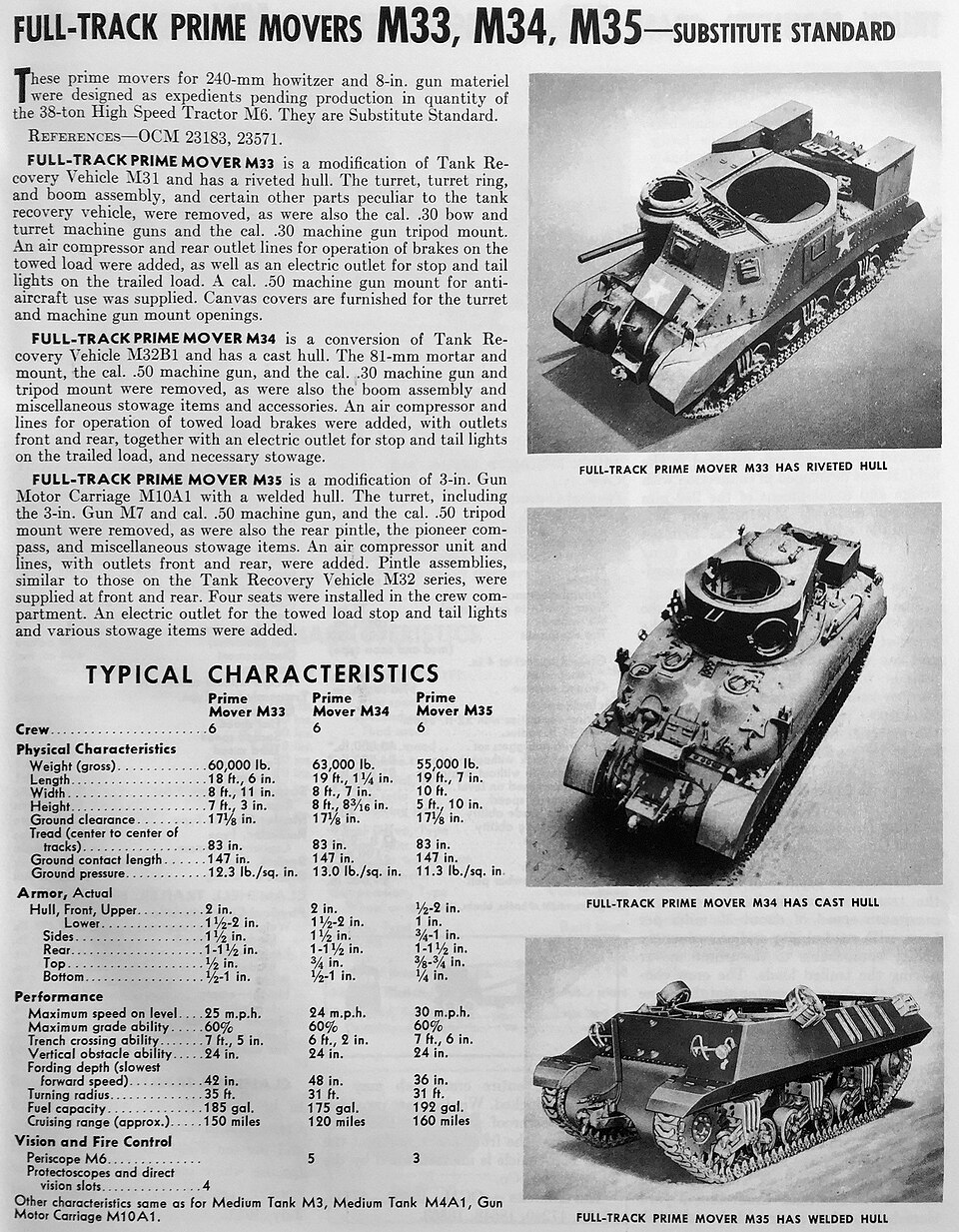
This M33 PNV was lighter than the original M3 thanks to the absence of turret and armament, at 27.2 tonnes. It kept the original ground clearance of 44 cm. The M33 was powered by the Continental R975 C1 radial engine rated for 400 hp at 2,400 rpm connected to a transmission Syncromesh 5 fwd. speeds and one reverse. It had VVSS suspensions (Vertical Volute Springs) like the M3 and following M4 Sherman (early type). Operational range, based on a total fuel capacity of 700 liters gasoline was 240 Km. To speed was 40 km/h on road, below 30 kph on all terrains and even less when towing a heavy gun. Some sources even states 25 Km/h off-road. It could gap a trench 2,3 m wide, climb a max grade between 60% and 31°, a max vertical obstacle of 61 cm and could ford 110 cm water without preparation.Protection
It was the same as the original M3, made like of Rolled homogenous steel armour, riveted, with a front protection ranging from 51 (2 inches) to 38 mm (1.5 inches) on the front, nose, sides and rear had 38 mm as well (1.5 inches) and the front floor was 25 mm thick (1 inch). The rooftop and engine deck were the least protected at 13 mm (0.5 inches). As fire protection there was a fireproof bulkhead between the engine and fighting compartment forward. No smole projectors, but manual standard fire extinguishers like the D37127 Portable 4lb. CO 2 model.Armament
The vehicle still sported a main gun but it was a bogus pipe, fake barrel to deter potential observers. It's main armament was a do-it-all standard Browning M2 Heavy Machine Gun on a pintle with some elevation to deal with approaching planes. It was located on top of the bogus gun barbette,with the MH gunner now standing where the former casemate was located. The HMG moved on a rollerbear ring. The power of these heavy rounds was sufficient to shred any softskin vehicles and light armoured cars. Next was the standard equipment of these rear echelons gun crews, Browning service pistols an eventually two more more Grease Guns (M3 submachine guns). Like the M31 and M32 they had also access in limited quatities to mines (to secure the approaches of the gunnery field) and grenades for close encounters.specifications | |
| Dimensions (L-w-H) | 5,64 x 2,72 x 2,2 m, ground clearance 44 cm |
| Total weight | 27.200 Kg |
| Crew | 6: Driver, 5 Operators inc. MG gunner. |
| Propulsion | Continental R975 C1 radial 400 hp @2,400 rpm |
| Top speed | 40 km/h (road) |
| Suspensions | VVSS |
| Range | 700 liters gasoline: 240 Km |
| Armament | M2 Browning machine gun with 600 rounds |
| Armor | Rolled homogenous, max 51mm (2 in) |
The M33 PMV in action
The M33 prime mover was became for a time, the go-to heavy field artillery prime mover for such battalions deployed to Italy in the spring of 1944. This included the 575th Heavy Field Artillery Battalion. All were equipped with the 8-inch (203mm) M1 heavy howitzer and 697th and 698th Heavy Field Artillery Battalions with M1 240 mm heavy howitzer "Black Dragon". Both shared the same carriage but clearly the latter was heavier, and the M33 had a bit more trouble towing it, as a hefty piece of kit at 64,700 lb (29,300 kg) in action.The first action seen by the M33 was by December 1943, urgently sent to Italy, with two batteries of M1 240 mm heavy howitzers "Black Dragon", seeing action near Mignano by late January 1944. In April 1945, four 8-inch (203mm) M1 heavy howitzers joined this unit, and the M33s had sometimes a hard time moving the M1 240mm heavy carriages, split into a pair of three-axle (six-wheeled) chassis carrying separately the barrel, carriage, each towed by a M33 tractor.
M33 also towed artillery during the bombardment of the Brest pocket on 24 August 1944 by Battery B, 697th Field Artillery Battalion belonging to the 5th Army. They had been deployed previously in Italy, notably seen in action near Cori by May 1944. In the end, the M33 was a success for what it was. Not very fast, it still had the robustness, reliability and strength its replacements lacked. As a derivative of the Medium M3 the soldiers and ordnance used it to the bone literrally, as these chassis sometimes went back to 1940 and their engine was worn out in 1945 so much the vehicles were just unsuitable for further service.
Despite being a "stopgap" vehicle it proved its use, and in fact saw more action than truly dedicated artllery tractors that often arrived late into the war, as combat in Europe in April-May 1945 all but ceased and the were not required in the Pacific. However, shortages of the M31 for conversion led to convert an additional twenty four M32B1 TRVs as the next M34 prime mover like the M33, except the M34 kept the turrets. It seems it was never deployed into combat. Similar efforts were undertaken with surplus M10 Gun Motor Carriage with 209 converted into the M35 Prime Mover in January-June 1944, turret-less however with a few changes on the hull. They soldiered on in France in 1944 after D-Day, filling heavy field artillery battalions such as the 551st, 7th U.S. Army. They were used notably for the breaktrhough in Alsace.
Once deployed on site by a pair of M33 PMVs, the 240mm Black Dragon required a crane to be lifted into position (M31 TRV). The howitzer carriage was removed from its chassis and lowered to its firing location and the barrel was positioned on its carriage. The US Army 698th Field Artillery Battalion tried to breahc the Gustav line from January, 1945 onwards. By November 1944 however, all 8-inch guns and 240 mm howitzers were withdrawn from Italy, sent to the Western Front in Europe, leaving the assault n the Gustav line far more dificult (it was never taken). The 240 mm howitzer blasted former French and newly made German fortifications in Eastern France and especially along the Siegfried line.
In all, fifteen 240 mm howitzer battalions saw action from France and the low countries up to the middle of Germany, the 265th, 266th, 267th, 269th, 270th, 272nd, 277th, 278th, 538th, 539th, 551st, 552nd, 553rd, 697th, and 698th. After the guns went silent, some were redeployed in the Pacific, adding tio the ones already there, the 543rd, 544th, 545th, 778th, and 779th. It was understood they will be required to breach the defensive lines of Mainland Japan for Operaton Olympic but were also used to break the defenses of the "redoubts" of Okinawa in the hinterland. They were not used at Iwo Jima though, much smaller island that was perfectly within range of the heaven larger naval guns from Battleships (16 inches or 400 mm as standard).
Gallery
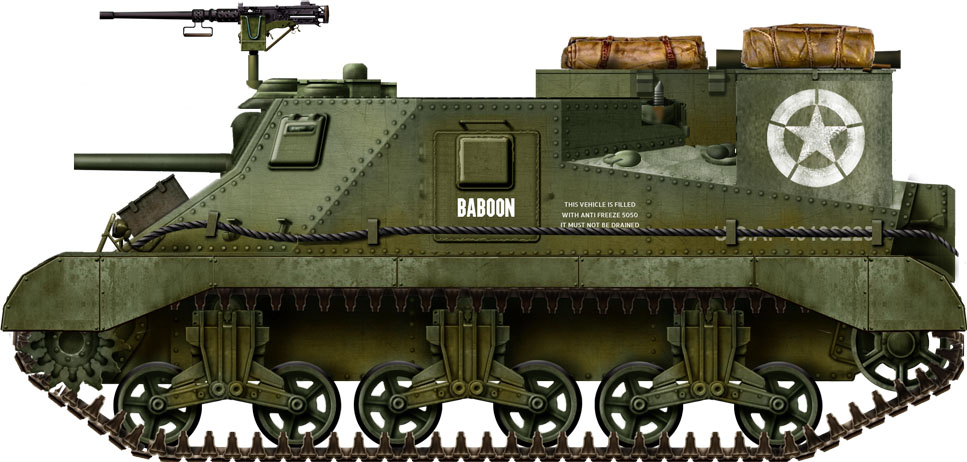
M33 "Baboon" prime mover


Read More/Src
Links
afvdatabase.comworldwarphotos.info
reddit.com
panzerserra.blogspot.com
en.wikipedia.org
rctankwarfare.co.uk
historyofwar.org
mapleleafup.net
wardrawings.be
Videos
Project reconstitutionModel Kits
Chester Tank Depot Conversion. Mirage Hobby No. 720019 1:72missing-lynx.com
WW2 Tanks


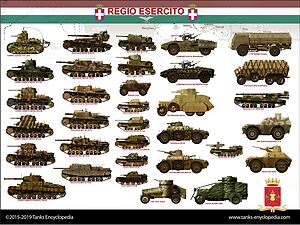
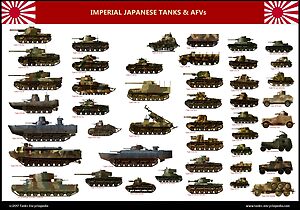
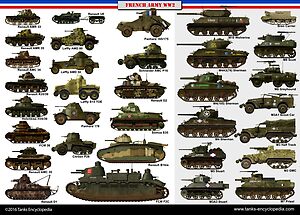
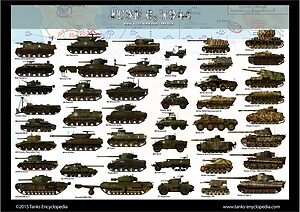
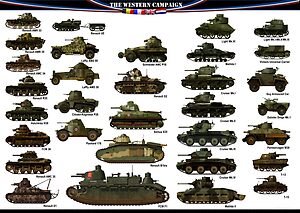
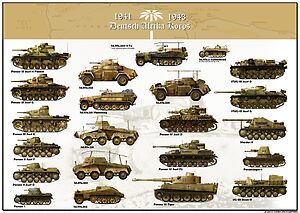
WW2 tanks posters
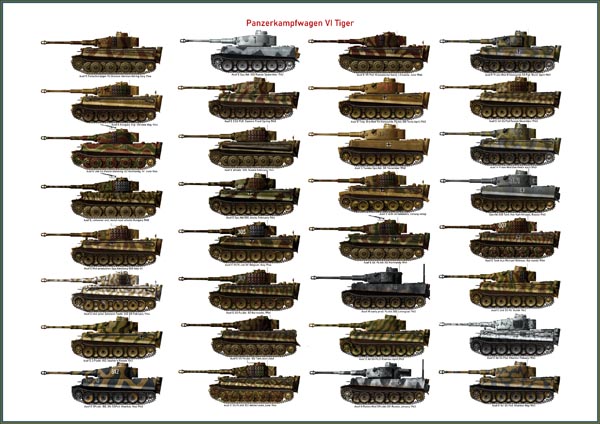
All Tiger tanks liveries.
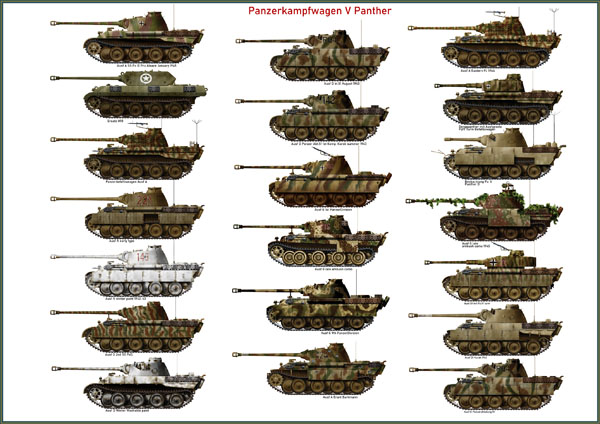
Panther liveries and variants
WW2 Armour - All tanks

Tanks aces and single tanks series
Find more there
Museums, Movies, Books & Games
The Tanks and Armor in pop culture
Tanks and armored vehicles in general are only really grasped when seen first person: The mass, the scale, it's all there. Explore also the way tanks were covered in the movie industry, in books and in video games.Movies:
Best tanks movie on warhistoryonline.com
On imdb.com
On bestsimilar.com/
miltours.com
liveabout.com/
watchmojo.com
Video Games:
pcgamesn.com
historyhit.com
levvvel.com
vg247.com/best-tank-games
mmobomb.com/
alienwarearena.com