OTO Melara Palmaria (1981)
 Italian Self Propelled Howitzer: c230 Manufactured until 1986. In service.
The Italian Cold War Self Propelled Howitzer
Italy, like other Nations embarked on a program to acquire a self propelled howitzer for off-road artillery support, repalcing older US artillery systems like the unprotected M107 SPG and alongside the M110A2 howitzer. Later Italy would also acquire the 221 M109A2, but in between, there was an international program for a new NATO self propelled tracked howitzer and OTO Melara, which just produced the OF-40, lated used as base for the Ariete main battle tank. This program was not a top-down NATO standad project but rather a joint program between the United Kingdom and West Germany in the late 1960s, abandoned due to technical issues and industrial disputes.In 1977, OTO Melara allocated funds for an independent design of a self-propelled howitzer, recycling the R&D gained in the former program, for a vehcle that would be marketed exclusively on foreign customers. From the outset, it was conceived as an evolution of the SP70, this aborted joint self-propelled howitzer but the first prototype was based on the chassis of the Italian OF-40 main battle tank. It was equipped with a larger turret to house the standard 155mm/41 Howitzer and made ready in 1981, at least for the first working prototype tested in 1981. The OF-40 was developed from the defunct Leone project with Germany and shares many components. It was named after the Ligurian Sea island. OTO Melara was so confident in its market potential it set up an assembly line, secured a contract with Libya from the outset, and started production in 1982 for a major order for 210 units that compensated for all the R&D. Nigeria also in 1982 expressed interest and requested twenty-five units. Last custimer was Argentina in 1986, which purchased twenty-five (Or twenty) turrets to be adapted on its national chassis, the TAM (Tanke Argentino Mediano) developed from the German Marder. In total, production totalled 235 units.
Design of the Palmaria
General Layout
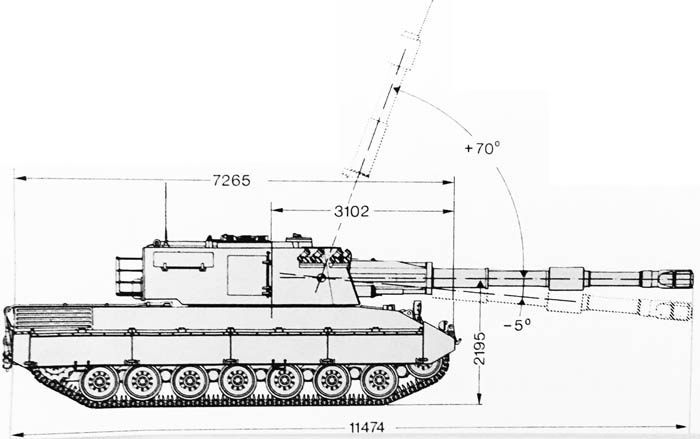
The Palmaria self-propelled artillery gun uses the OF-40 hull as a mobile platform but with many modifications of powerplant, turret, even the hull. The vehicle keeps part of the OF-40 hull layout, albeit the hull is taller and fuller, and the driver is located to the front left, with a sliding hatch for access and three periscopes, including a swappable central IR for night driving. He has transmission on his right, engine compartment at the back with side and top louvres. The upper flanks of the hull are flat. The remainder of the crew is located in the turret, with the commander's hatch on the left (only roof access) dotted with eight peripheric vision blocks to cover all angles, and rear-folding hatch. He has also a pintle mount in front (see later).
The gunner is located to his right, with his main sight ona rotating base, and Infrared option and two range magnifications that the Commander lacks. There are emitter and receiver radio sets at the rear of the turret with whip antennae. There is an additional standard access for the crew via side doors, a classic configuration sported first by the M109. The spent cartridges are ejected via a port in the back plate, right behind the breech with automatic ejection into a turret basket that could be used in transit to store personal items. Tools are strapped onto the front turret sides, shovel, axe, crook bar and pickaxe. A steel cable is stored around the engine louvres on the rear deck.
Powerplant and Performances
In place of the original 10-cylinder, 830 hp engine of the OF-40, OTO Melara installed a slightly smaller and lighter MTU MB 837 Ka-500 V8 turbocharged diesel rated for 750 hp, fed by a 800-litre fuel tank. This German-derived engine made under licence had a torque converter. The gearbox transmission is a Renk planetary type with four speeds and one reverse. It is connected by a shaft to rear drive sprockects. An auxiliary electric motor is likely installed to move the turret independently from the main engine with manual backup. The running gear is derived froml the OF-40 and comprises seven rubber-treaded track wheels with a torsion bar and hydraulic shock absorber each, while the single pin track is supported bt five return rollers. There are idlers at the front, used to regulates tension of the 584 mm-wide tracks. The tracks coukld receive an optional padding and all the double roawheels have a rubber band.This V8 diesel engine gives the vehicle a power-to-weight ratio of 16 hp/t for a top speed of 60 km/h and a range of 500 on asphalt roads, down to 350-400 off-road. The Palmaria was tested capable of negociating a 30% gradient, ford 1 meter of water unprepared, four meters after preparation, gap a trench of three meters, and climb a vertical obstacle of 1.15 m. Tactical mobility is reduced to the largest airlifters.
Protection
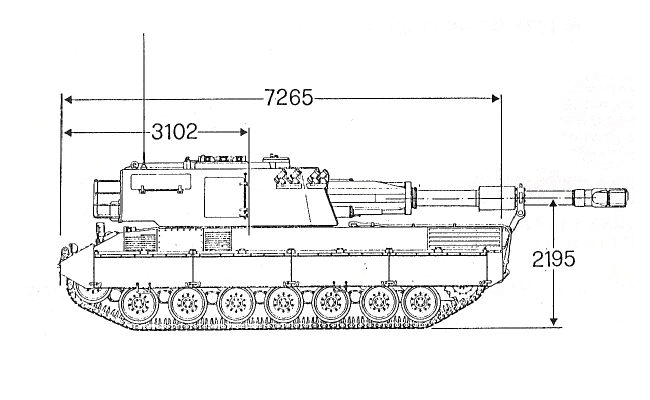
Regarding passive protection, the hull was given a thinner steel armor commared to the OF-40 (hence the smaller engine) while the turret itself, weighing 12.5 tons in combat order is made in aluminum alloy plating welded into a box with three faceted front, lightly sloped to resist 12.7 mm AP rounds, almost vertical sides and vertical back, decreased in thickness to resist NATO standard STANAG kevels of small arms and shrapnel. The roof has the same protection as the back and sides. The SPH has a standard autimatic fire extinguisher system in the engine, transmission, driver compartment and turret. It seems NBC protection is onl optional and was never ordered. For active protection, the vehicle is given four pairs of electrically operated smoke dischargers located on the front tirret faces.
Armament
The primary armament consists of a 155/41 howitzer, derived from the FH-70 howitzer. This howitzer to tame down recoil is given a dedicated two-port muzzle brake and a large fume ejector further down the barrel. The depression goes to -4° and elevation +70° thanks to an hydraulic system, with manual backup. The traverse of 360° is electric, normally engine powered but with a manual backup as well (and possible APU). The ammunition supply is 30 rounds, 23 ready, stored in racks in the turret and the remainder 7 in the hull. These are all 155 mm NATO ammunition ranging illuminating shots to HE and fragmentation. Loading is optionally semi-automatic with manual backup. When a shot is fired, the barrel returns to a pre-set elevation of +2°, the breech opens to accept another round and ropelling charged by hand. Then it closes for another firing.Nominal is 24,700 m, optionally 30,000 m with rocket-assisted shells with 45.5 kg HE charge by Simmel. Simmel has produced a complete range of ammunition for the Palmaria, consisting of four different types of shell, each weighing 45.5 kg. The high-explosive, fog-generating, and illuminating rounds have a range of 24,000 m, and the semi-autonomous high-explosive round has a range of 30,000 m. The Palmaria can fire three shots in 30 seconds or one every 15 seconds. The preferred rate is one per minute. For self defence, the vehicle had a 7.62 mm or 12.7 mm machine gun (Browning M2) installed on the pintle mount in front of the commander's hatch. There is no flexible mount allowing to turn the maching gin around to face backwards, the pintle is fixed forward, but enable traverse left, right and up to 80%. In addition the smoke projectors could be loaded with anti-personal grenades.
Palmaria specifications | |
| Dimensions | 11.474 x 2.35 x 2.874 m (37 ft 8 in x 7 ft 8 in x 9 ft 5 in) |
| Weight | 46,632 kg (102,590 lb) |
| Crew | 5: Driver, Commander, Gunner, Loader, Handler |
| Propulsion | MTU MB 837 8-cyl. diesel 750 PS (740 hp, 552 kW), 16.1ps/t |
| Suspension | Torsion bars |
| Speed (road) | 60 km/h (37 mph) |
| Range | 400 km (250 miles) |
| Armament | 155 mm L/41 howitzer (30 rds), 7.62/12.7 mm MG pintle mount |
| Armor | See notes |
| Total production | 235 1977-1986 |
Users and Combat
Users
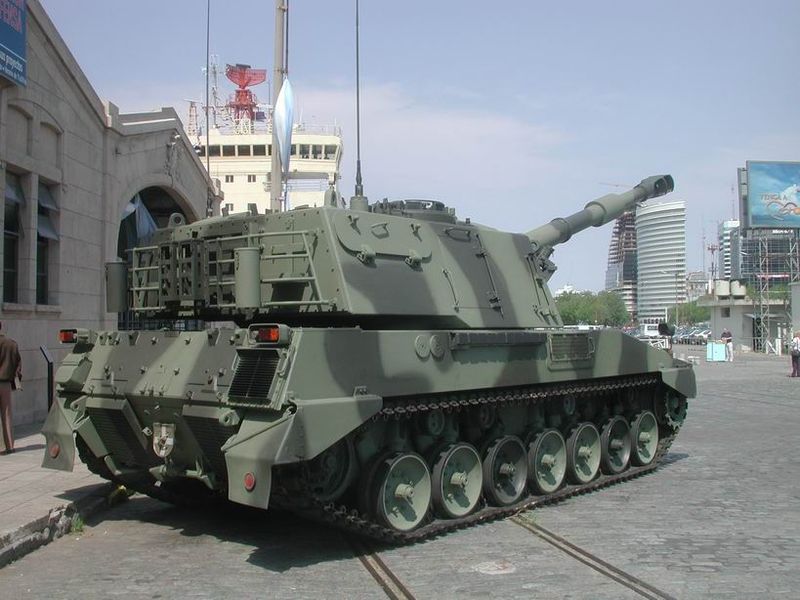
VCA 155mm Palmaria
 libya: Original customer, in 1982 purchased 210 supplied until 1986 (200 in anotehr source). In 2007, 160 reported. None left as of 2026 (destroyed in 2011 air attacks and and the civil war).
 Nigeria: Odered 25 in 1982, by 2007 27 vehicles were observed, so extra ones were delivered unofficially.
 Argentinian TAM CVA 155: The Vehículo de Combate de Artillería de 155 mm has an elongated version of the TAM chassis and the Italian Oto Melara’s Palmaria turret and a main 155 mm (6.1 in) gun-howitzer. The original Palmaria was developed on the basis of the OF-40, a locally built Italian Leopard. Both models shared a lot of common parts. 28 rounds are stored, including 23 in the turret bustle. The maximum range is about 45 to 50 km with additional round booster. In addition, there is a roof-mounted FN MAG GMPG machine-gun. The VCA is the heaviest of all TAM variants, weighing 40 tons, and the slowest (55 km/h).
In Action
The only combat action of the vehicle was the Libyan vehicle, and several were destroyed during the First Libyan civil war as a result of multinational military intervention.It was started once in 2022 that Italy was about to refurbish ten extra vehicles made by Leonardo to supply for Ukraine, at least evaluated, but its dubious. Only stated in 2022 by https://www.difesaonline.it (article retired) 1.
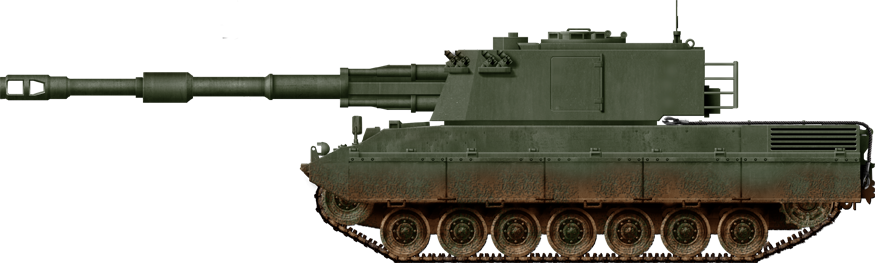
Initial Vehicle tested in Italy, 1977.
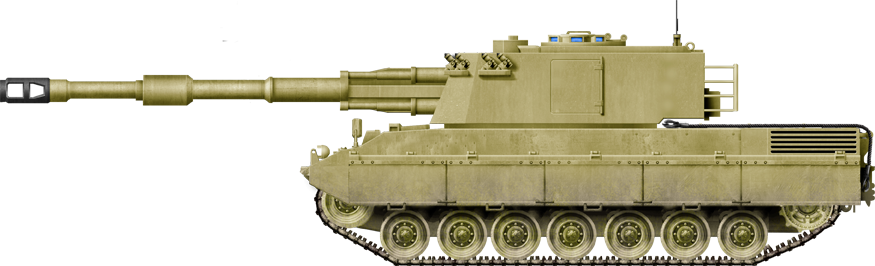
Libyan Palmaria, 1980s. The Nigerian one was in plain light brown livery.
Argentinian TAM-Palmaria as of today. 20 turrets were purchased and integrated in 1987 on the TAM VEC chassis (to come).
Gallery
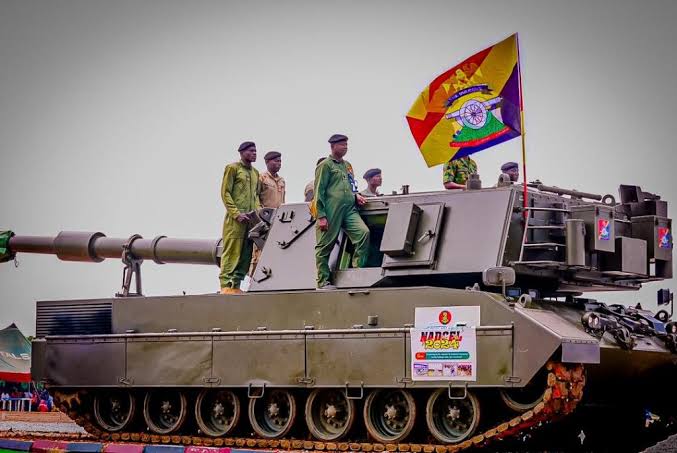
Nigerian Palmaria (X/Twitter)
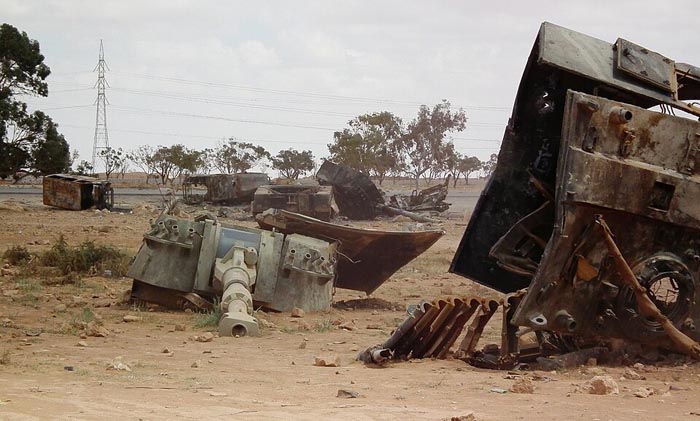
Libyan Palmarias destroyed in Benghazi, 2011
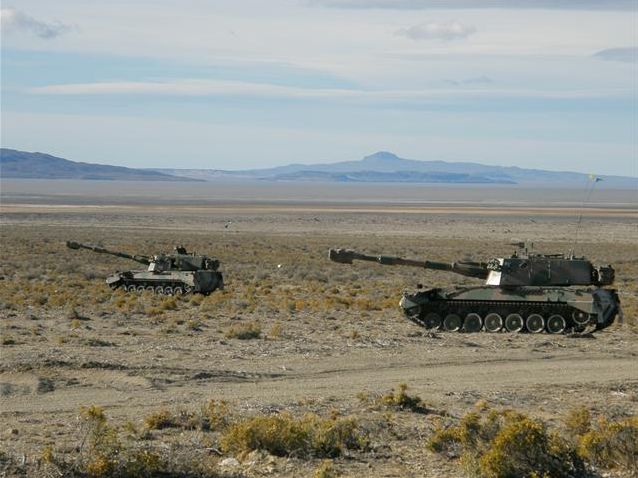
TAM VCA 155
Links
Christopher Langton, The Military Balance 2007, The International Institute for Strategic Studies, 2007.@Mansourtalk (6 May 2019). "#LNA armored vehicles Southern #Tripoli: Palmaria 155 mm Self-Propelled Howitzer
Trewhitt, Philip (1999). Armoured Fighting Vehicles. Dempsey-Parr.
Gourley, Scott (April 1990). "Fire for effect: western developments in self-propelled artillery". Armada International.
Margiotta, Franklin D. (ed) (1996). Encyclopedia of Land Forces and Warfare. Potomac Books. p. 135.
Cordesman, Anthony (2004). The Military Balance in the Middle East. Praeger/Greenwood.
"Battle Of Libya" Al Jazeera video report 22 March 2011
military-today.com/artillery/palmaria.htm
armyrecognition.com
defensenigeria.com
modernweapon.ru
TAM Series of Medium Tracked Armoured Vehicles
thefreelibrary.com
spaziojml.it
en.wikipedia.org
ettaglio_approfondimenti.asp

Cold War Tanks


Cold war tanks posters
Cold War Main Battle Tanks
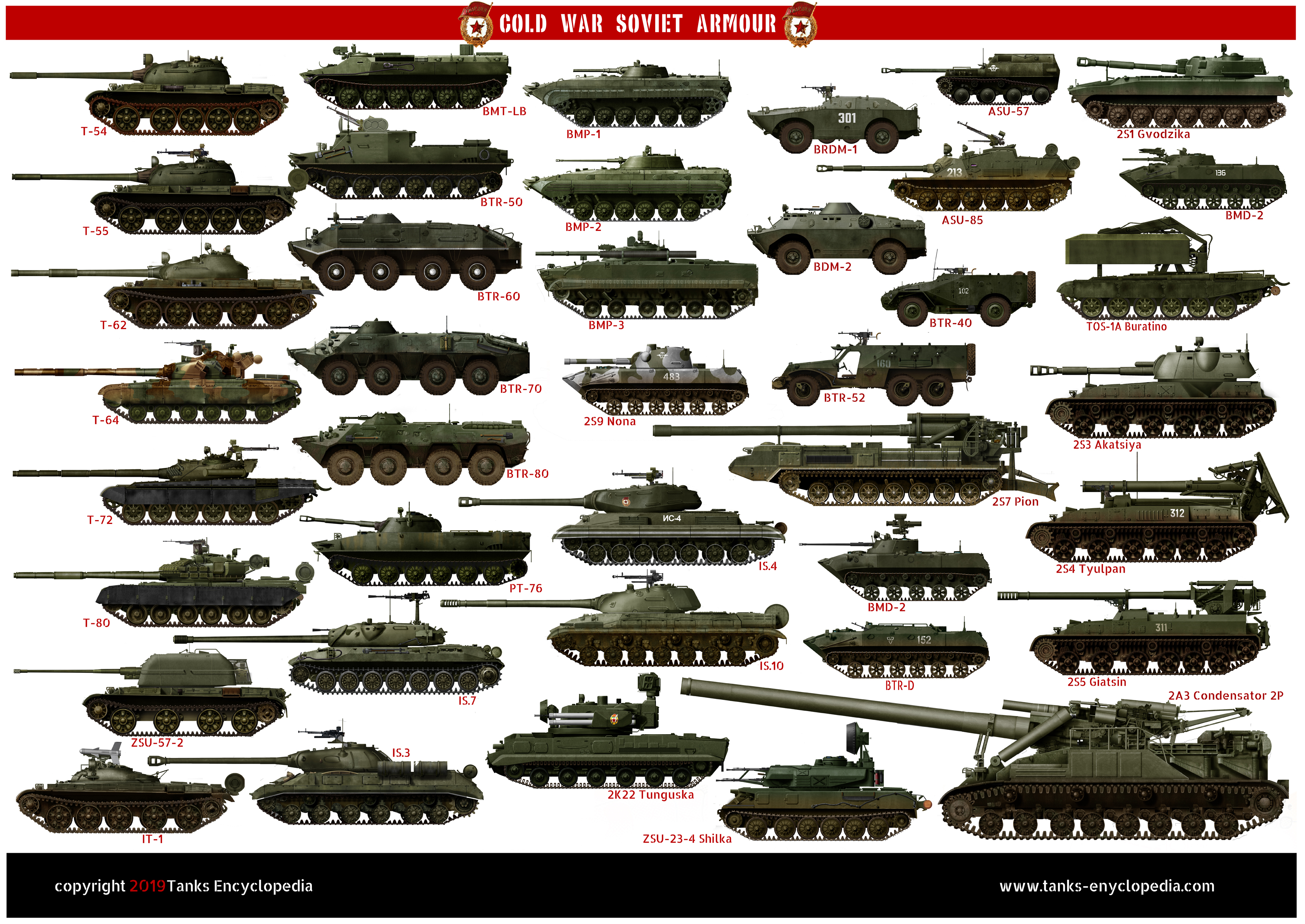
Cold War Soviet Army
Museums, Movies, Books & Games
The Tanks and Armor in pop culture
Tanks and armored vehicles in general are only really grasped when seen first person: The mass, the scale, it's all there. Explore also the way tanks were covered in the movie industry, in books and in video games.Movies:
Best tanks movie on warhistoryonline.com
On imdb.com
On bestsimilar.com/
miltours.com
liveabout.com/
watchmojo.com
Video Games:
pcgamesn.com
historyhit.com
levvvel.com
vg247.com/best-tank-games
mmobomb.com/
alienwarearena.com