Berlier VUDB
 France (1929): 63 built until 1933.
Development
Context
Perhaps less known than other French armoured Cars of the interwar, the Berliet VUDB was the only armoured vehicle built in series by the French truck manufacturer. It's origins are in the Morocco "pacification" as France took the succession of Spain to secure what was then a protectorate. The "rif war" or "Moroccan Campaign" was a serie of insurgencies that went on for twenty-seven years. France needed a rapid infanty transport that could withstand ambushes especially in mountaineous terrain, hence the heavy use of a wide range of armoured cars on this theater. The war started around 1904 and went on until 1934 against the Riffan Tribes and left the French Colonial Army a total of 8,628 dead (inc. 622 officers) et 15,000 wounded plus 12,000 Moroccan goumiers that fought alongside the French Army in a conflict that made an estimated 100,000 dead on the native side. Riffan tribes were decimated.For many top brass like Marshall Lyautey, and future officers both in WWI and WW2 this was almost an obligatory turnaround to acquire ranking and experience. However this was useful also for the French Army to study a war that was almost the complete opposite of the WWI trench warfare. It was fast-paced, covered wide distances, with a frontline that was never determined and French armed columns penetrated deep into Riffan territory and had to face multiple ambushes, ot tried to protect isolated outposts. The Riffans were excellent cavalrymen and used hit and run tactics for which a foot infantry assisted by horse-drown artillery were not suited. This it became a field of experimentation for rapid armoured forays screend and sometimes supported by aviation, with the technologies of the time. A wide array of armoured cars were used in this war, as they appeared the best suited.
Berliet's foray into armoured cars.
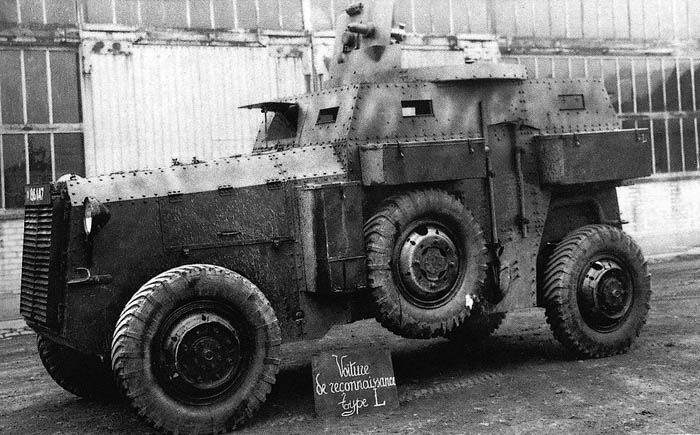
The related VUCL tested at Vincennes
In this context, Berliet, the main medium and heavy truck manufacturer in France (founded 1899) already previded during WWI the bulk of military trucks to the French Army. Postwar years were difficult for the company that saw no more contracts from the army and tried to recycle its teams and assets into personal cars, with mixed successes. Marius Berliet, the founder, still proposed the army new vehicles to renew its park in the 1920s prototypes notably of all-terrain chassis, worked on alternative wood combustion engines from 1923 and in 1926, sent three 6x6 Berliet VPD trucks in a high profile trip from Alger to Gao with 3 tons payload and 22 passengers in the style of Citröen's African cruise. This indeed drew attantion from the Army which needed combat off-road capable vehicle for its new Moroccan mechanized companies.
Berliet indeed also proposed to the army the VPC, in 1927, a 10t, 4,91 m turreted 6x6 with a crew of 5 powered by a 90cv engine and capable of 55 km/h, armed with a 25 mm gun. Berliet also proposed the VPDK, a derivative 6x6 without turret usable as troop transport, and after its VUDB was accepted, the VPDM or "Automitrailleuse 1931", another 6x6 with a larger turret. Closer to the VUDB there was the VPRM (1930), a 4x4 of 1930, a competitor for the Panhard 165 called the VUB in 1931, the VUM in 1930, and a spinoff the VUDB called the VUC also in 1931. The VUDB led to four variants itself.
From the VUR to the VUDB.
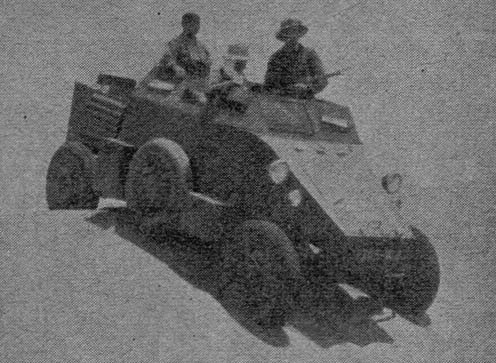
Berliet VUR negociating a sand slope, 1928. Berliet produced many 4x4 and 6x6 vehicles expecting contracts from the Army.
In May 1929, the French army considered the need to modernize its forces engaged in Morocco and emitted specifications for a general purpose armoured car. Berliet proposed a reconnaissance vehicle, derived from its Berliet VUR prototype all-terrain liaison car, capable of carrying troops and intended for operations in southern Morocco. So it was a reconnaissance vehicle designed to support more heavily armed, turreted armored cars notably of the Panhard type or replace truck-mounted infantry that could be exposed in ambushes. However the Berliet VUR ws evaluated by French Army. It was found too weakly powered and unprotected for combat use. The official name was "Voiture de Liaison 1928" but at 2.5t, 4m long, 1.97 wide and powered by a Berliet 40 cv for 70 km/h it was fast but its armour was quite slim at just 3-4mm, offering poor protection against rifle fire. It had however the casemate that would appear later on the VUDB. No further prototype was built, and after the submission of new specifications for a larger, fully protected armoured car, the French army approved in 1929 the plans submitted by Berliet as the VUDB, and placed an order.
The Berliet VUR as a prototype of all-terrain vehicle had a rear engine, a Water-cooled six-cylinder gasoline engine (bore × stroke 65 × 100 mm, displacement 1991 cm³, 11 horsepower, effective maximum power at 1800 rpm unknown). On a chassis weight of 1,7 tons and a wheelbase of 3 m, its general operating permit was issued on December 22, 1928. Only two test vehicles were built, one of which received an armored body in 1929, but soon performances fell. It led to a production version called the VURB2, with a front-mounted engine, a 6-cyl. gasoline engine type MLSB (bore × stroke 70 × 109 mm, displacement 2517 cm³, 12 horsepower, effective maximum output 40 hp at 1500 rpm). It kept the same wheelbase of 3 m, but was 4.18 m long, 1.84 m wide, 2,5 tons unladen. Its General operating permit was obtained on 24 March 1930, and 48 were built 1929–30, or 53 in special versions for the Sahara, one for the Belgian army.
Design of the VUDB
General Layout
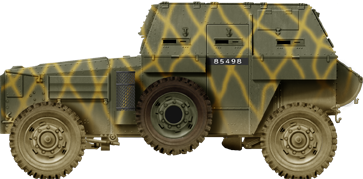
 The "Voiture de Prise de Contact Modèle 1930" was a 4,95t, 4,50 m long, 1,94 m wide, 2,15 m tall, wheelbase was 3.07 m, front track 1.595 m and rear track 1.42 m. This 4x4 vehicle had a crew of just three but an utility cab for more, up to six could be seated. It had no turret and instead nine sight slits and multiple hinged hatches on the upper section of the raised roof to fire either seated or standing. It was powered by a Berliet 42 hp for a top speed of 50 km/h and a nominal armament of two FM Reibel 7,5 mm. The vehicle had storage either side. Protection all around was later raised from 3 to 5 mm (0.2 inches) and the casemate was sloped for its upper part. The radiator was protected, as the long bonnet and casemate. Access was provided via a left side door. Other sources speaks of 7 mm, but it was likely the later serie from 1932-33 and for the front plates only.
There was a spare wheel mid-way of the hull, fixed but rolling on the left side only in order to provide extra mobility when negociating rugged terrain. The final VUDB was 4.04 meters long (13.25 feet) with the same width (6.4 ft) and height (7 feet). As said already the maina advantage was to be able to fire standing in the rear casemate. The front was occupied by the driver and co-driver, the latter normally manning a machine-gun. Two more men and even more could be seated at the rear in troop transport configuration, but as reconnaissance vehicle the normal crew was four. In addition to the three sliding firing ports either side there was a lifting upwards hatch at the rear, and on the roof three two-piece hatches. Storage bins were installed over the casemate's sides, acting as additional mud guards. Personal gear was often strapped above. The vehicle had a towing hook at its low back plate.
To limit production costs, the absence of turret was compensated by many loopholes in its casemate, with movable pintles around the vehicle for two Model 24/29 machine guns, that could be placed at any firing point, and moved into that casemate hull to fire at any angle. Meanwhile more men could fire their rifles through the same openings. The Fusil-mitrailleur modèle 1924/29 made by MAC (Chatellerault) weighted 10 kgs when loaded with its 25 magazine. It was capable of 450 rpm (air cooled), with a muzzle velocity of 830 m/s, max range of 1,000 m and practical range of 600m using the 7,5 × 54 mm 1929C. This model soldiered on until the end of the Indochina War and even were used until the 1970s by the Viet-Minh.
Engine and Performances
The Berliet VUDB prototype (VUDB-1) was initially powered by a 2,517 cc 6-cylinder MLSB engine with an effecxtive power of 42 hp, bore × stroke 70 × 109 mm. It was water cooled and coupled with a four-speed gearbox with reverse and reduction gear. Fuel consumption was 54 liters/100 km, range 350 km. However on trials it soon appeared insufficient for a vehicle that had gained a ton more weight than anticipated after the Army wanted additions. In 1932-1933, all production VUDB (production started in 1929 in small quantities, then larger in 1931) received a 3,308 cc 4-cylinder engine and were sometimes referred to as VUDB 5. Power went from 42 to 43 hp, for a top speed of 53 kph and a range of 350 km.Variants
The VUDB body was reused for two Berliet VPRM prototypes, tested in 1930 but not adopted.VUDB 2
The Berliet VUDB 2 designated a military torpedo-bodied vehicle. 50 VUDB 2s (with the Berliet MLSB 6 cyl. 2 517 cm3) were manufactured in 1929-32 and twenty more VUDB 4s (with the 4 cyl. 308 cm3) were manufactured in 1932-33 and purchased by the French Army as "all-terrain liaison vehicles" (VLTT). Confusingly the 50 first vehicles were 4x4 considered "unarmoured". In the French army, they were designated Berliet AMD (AMD stood for Automitrailleuse de Découverte = motorized machine gun car for reconnaissance).VUDB 4
An armored car directly derived from the VUDB, the VUDB 4, was ordered (four made) in 1931 with a lightweight single LMG turret. Its 4-cylinder engine when tested showed sufficient performances, but further production was cancelled. The four VUDB 4s remained operational, converted into radio vehicles after the turrets were removed. Also called the "Automitrailleuse de Découvert Modèle 1931" this derivative weighted 4.95t for a length of 4.88 m, a width of 1.94 m and height of 2.57 m. Its crew comprised three and up to four men while the same Berliet engine rated for 45 hp was used for a top speed down to 53 km/h due to the extra protection. Armament was lmited to a single 7.5 mm machine gun. Derived from the VUDB, this model was tested in 1932 and performance was generally good, its long range was appreciated, but was rejected as too lightly armed and poorly protected.VUDB 5
A sub-variant proposed with a 55 hp engine, not adopted for production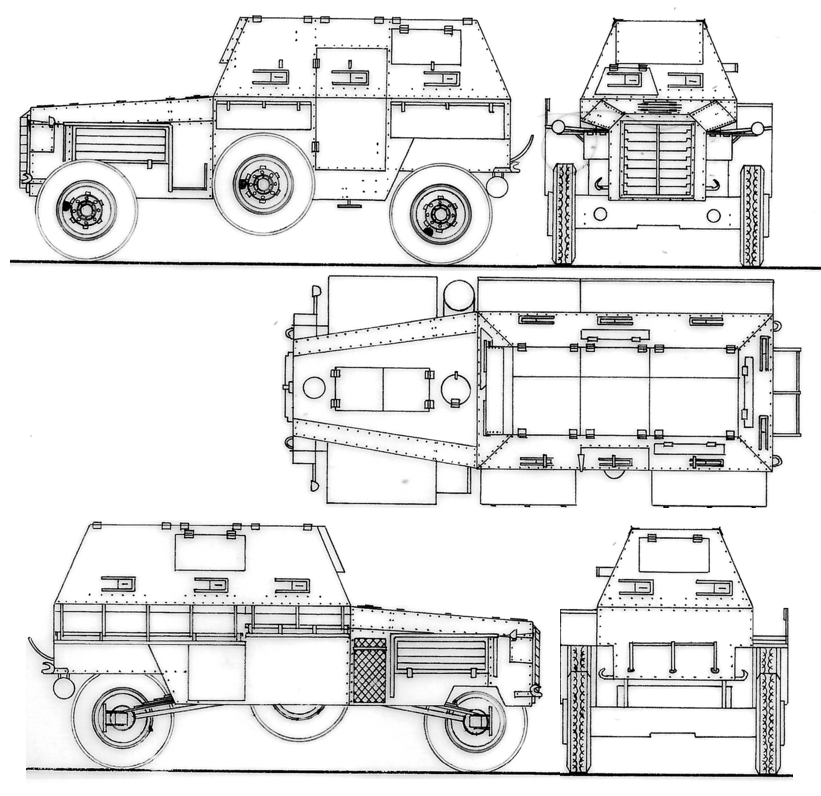
Tech Scheme by Mike Bell, CC
Berliet VUDB 4 (1932) specs. | |
| Dimensions | 4.88 x 1.94 m x 2.57 m |
| Weight | 4.95t |
| Crew | 4 (driver +3). Some sources: 7 crew) |
| Propulsion | 4 cyl. 3L 45 hp |
| Speed | 53 kph |
| Suspensions | Leaf Spring suspension |
| Range/fuel capacity | 200L, 350 km range |
| Armament | 2x Chatellereault M 1924/29 7.5 mm LMG |
| Armor (max) | 7 mm (0.3 inches) |
| Total production | 63 |
The Berliet VUDB in action

Camouflaged Vehicles of the 2nd platoon 3/4th RCA at Goumimine, Summer 1938.
The pre-production vehicle was tested in mainland France but was quickly deployed in Morocco, with the 27th Cavalry Armored Car Squadron (EAMC), and the 1st Foreign Cavalry Regiment (REC), as well as the 2nd Mounted Company of the 2nd Foreign Infantry Regiment (REI), reassigned to the 1st REI on July 1, 1931. Operations started as early as February 1931, but they proved largely unsuccessful. Crews complained about the still thin armor, that could be pierced by the Riffan hardened bullets, and offered no protection at close range. Another major issue was the lack of a reversing gear, prevented any extraction from an ambush situation. Their limited armament was also an issue, as well as their high center of gravity and in general mechanical issues, and they proved underpowered in most situations.
At the end of 1932, Berliet was asked by the Army to modify the existing vehicles and those currently into production, which was done for the last twenty of the 1932-33 production run, often called VUDB 4. By contrast those of the 1st series were called VUDB 2. Some shortcomings were fixed, like adding a few extra plates, albeit stability needed to be preserved. Mostly they were were re-engined with a better 4-cylinder, and with improved crew training and a better-defined operational doctrine, once back in morocco for the final years of the war, they proved much more satisfactory in combat. In Tunisia the regular olive green wa spainted on ocre clear or with ocre stripes on the original green like the photo above.
In March 1933, Berliet platoons of the 1st REI joined the 1st REC and in May, 27th EAMC was disbanded and passed onto the 1st African Light Cavalry Regiment (RCA). The 4th Squadron of the 1st RCA (4/1st RCA) operated Berliets. At the 1st Foreign Cavalry Regiment (1er REC), VUDBs were assigned to the 5th and 6th Squadrons (5th and 6th Battalions, 1st REC), as well as at the regimental training center in Sousse, Tunisia. In September 1934, Berliet trucks of the disbanded 6th Battalion, 1st REC were assigned to the 2nd Squadron, 4th Artillery Regiment in Tunisia. Berliets of the 4th Battalion, 1st RCA were transferred to the 3rd Squadron in 1936. In September 1939, only 32 VUDBs were in service, 12 with the 3rd Bat.
1st RCA in Morocco, others with the 1st REC training center, Sousse, the remainder in the 2nd Battalion, 4th RCA in Tunisia. VUDBs of the 1st RCA from November were replaced by Hotchkiss H35s. Post armistice, the 22 VUDBs remaining were sent to French West Africa, within the 8th Autonomous Group of African Light Cavalry (8th RCA) and a remaining numbers were stored. After Darlan's swap in November 1942 the Army of Africa sided with the allies and some VUDB were used in the Tunisian campaign with French Forces until 1943.
Belgium: The Belgian army ordered twelve vehicles of the 1st serie in 1930 to modernized their armored park, replacing in particular the WWI Minerva armored cars of the 2nd Lancers Regiment dating back from 1914. The Berliets however were found too tall and underpowered by the Belgian crew, and were quickly transferred to the Gendarmerie, assigned to various light regiments across the country. Evidence of their use of in combat is scarce, but they did saw combat in the 18-Day Campaign, until May 17, 1940, and either lost, sabotaged or scrapped. None was used by the Germans afterwards, probably not impressed by the vehicle.
Gallery
Striped camo vehicle of Tunisia, 1939
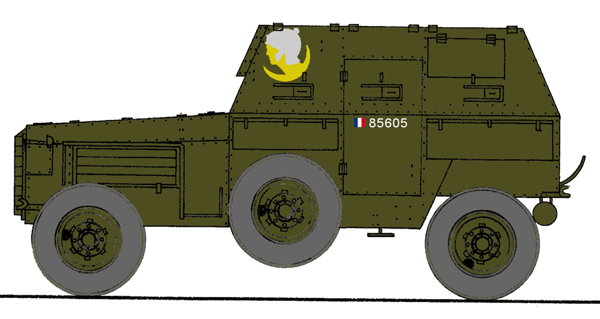
A Berliet VUDB painted olive green, bearing the insignia of the 1st Foreign Cavalry Regiment: a Roman legionary's head.
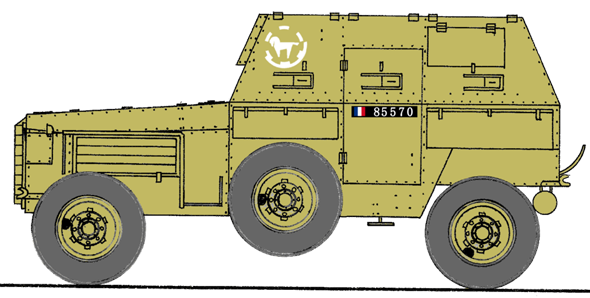
VUDB of the 3rd squadron, 1st Rgt. chasseurs d'Afrique (RCA) in 1937.
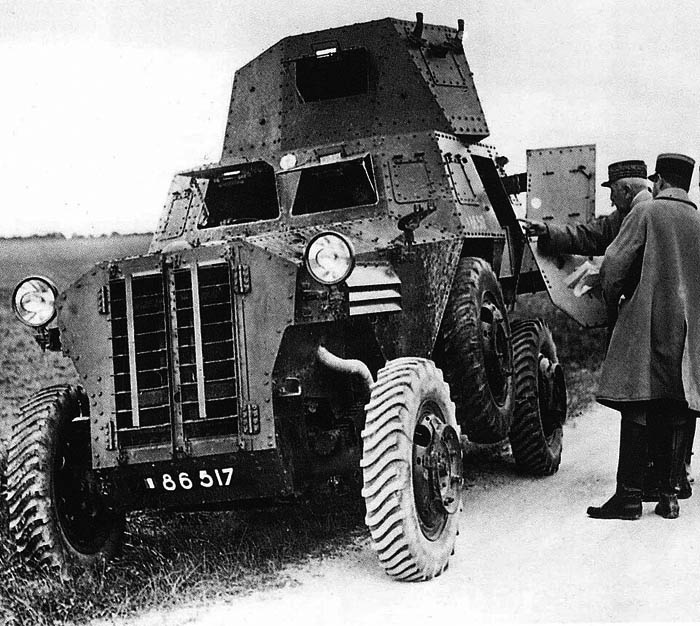
VUDB 4 in manoeuvers, 1932.

In Tunisia, still with the olive green paint (pinterest)

Tested vehicle fresh from the factory with the provisional "46" (pinterest).

A book for more on this vehicle.
Sources
Books
Laurent Tirone, Yannis Kadari, Yann Mahé et Hubert Cance, « Berliet type VUDB », Trucks & Tanks, no Hors série 5. May 2010Jean Tartare et François Vauvillier, «Berliet VUDB», Histoire & Collections 135 jan. 2021
Pierre Touzin, Les véhicules blindés français, 1900-1944, Paris, E.P.A., 1979
, « 1930 - Blindés Berliet [archive] », sur Chars Français (consulté le 11 février 2021). Pierre Touzin, Les engins blindés français, 1920-1945, SERA, 1976 (lire en ligne [archive]), p. 66-67. François Vauvillier, Les automitrailleuses de reconnaissance, t. 1 Histoire & Collections
Saint-Loup, Marius Berliet, l'inflexible, Presses de la Cité, 1962, 336 p.
François Vauvillier et Jean-Michel Touraine, L'automobile sous l'uniforme 1939-40, Massin, 1992
(pl) Tomasz Basarabowicz, « Belgijska broń pancerna w latach 1914–1945 », Militaria XX Wieku, vol. 33
(en) Tomasz Basarabowicz (trad. Grzegorz Grzywocz), « Belgian armored Forces 1914 -1945 » The Armor Journal, no 4 2016
Links
armedconflicts.commarkamorin.com/ berliet-vudb
de.wikipedia.org Berliet VU family
Antoine Misner: chars-francais.net
fr.wikipedia.org Berliet VUDB
Berliet
WW2 Tanks


WW2 tanks posters
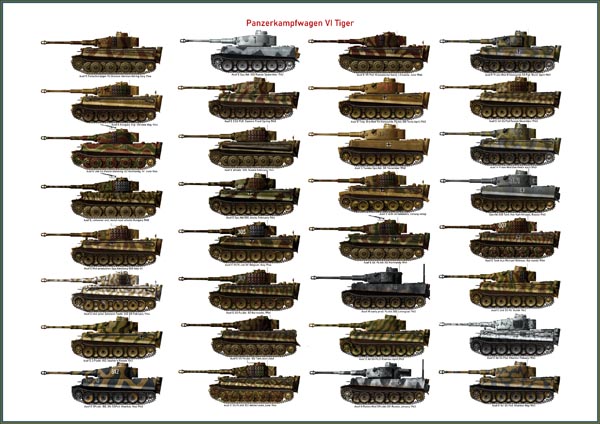
All Tiger tanks liveries.
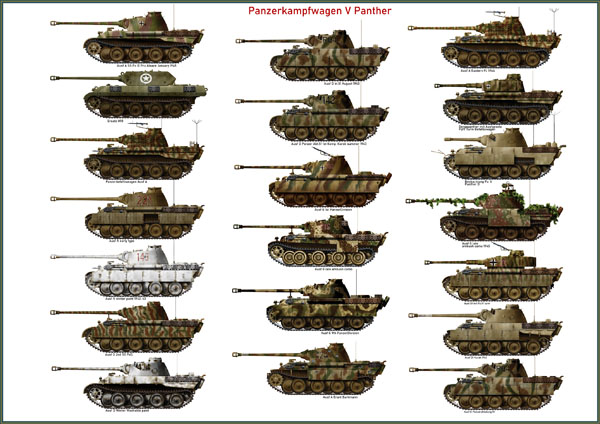
Panther liveries and variants
WW2 Armour - All tanks

Tanks aces and single tanks series
Find more there
Museums, Movies, Books & Games
The Tanks and Armor in pop culture
Tanks and armored vehicles in general are only really grasped when seen first person: The mass, the scale, it's all there. Explore also the way tanks were covered in the movie industry, in books and in video games.Movies:
Best tanks movie on warhistoryonline.com
On imdb.com
On bestsimilar.com/
miltours.com
liveabout.com/
watchmojo.com
Video Games:
pcgamesn.com
historyhit.com
levvvel.com
vg247.com/best-tank-games
mmobomb.com/
alienwarearena.com