M1150 Assault Breacher Vehicle (2008)
 U.S.A. (2008), c187 built
Development
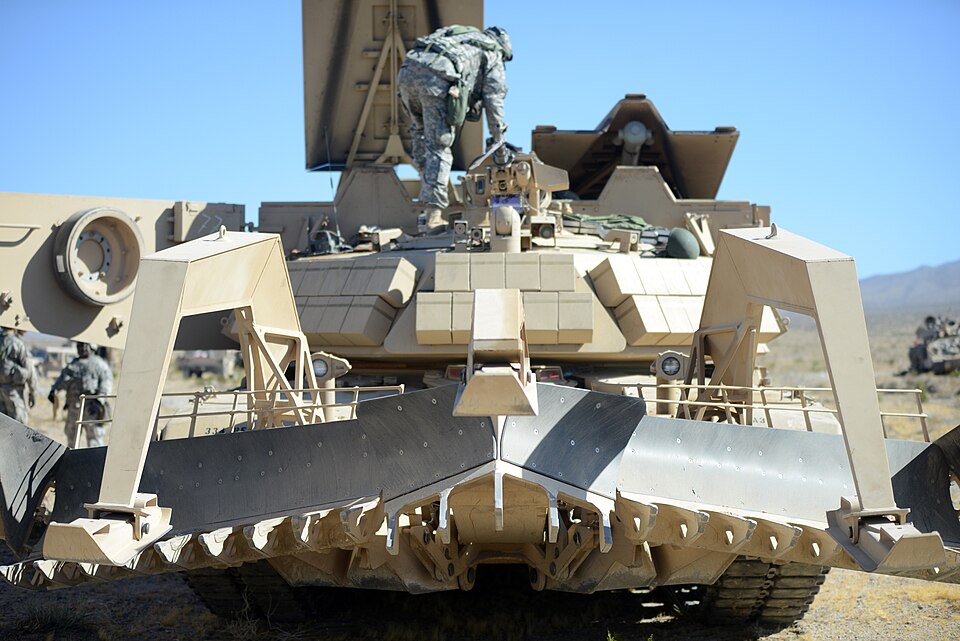
In the 1990s, the U.S. Army decided it could not afford to continue developing complicated, maintenance-heavy vehicles for this purpose. The Grizzly program was cancelled in 2001, and the prototype developed never made it to the production lines. The Marine Corps however persisted and funded its own development and testing. The main body of the final model of the ABV is built on the General Dynamics chassis that is used for the M1A1 Abrams main battle tank. Pearson Engineering of the UK provided the specially designed plow and the other mine-clearing accessories.
In the 1990s, the U.S. Army decided indeed it could not afford the development of dedicated and complex, maintenance-heavy vehicles to deal with mines in the post-cold war war dividends context. The ongoing Grizzly program, also called the ‘Combat Mobility Vehicle’ or ‘CMV’ colloquially dubbed the ‘The Breacher’ was thus cancelled in 2001, after 6 prototype delivered by 1995 and an order for 366 vehicles. The prototypes were mothballed. But not all its development were no lost. Indeed, the Marine Corps persisted in its need for the vehicles, and funded a follow-up development and testing. Meanwhile, the Army decided for cheaper alternatives with the M1 Panther II on an Abrams chassis but the same modifications as the M60A3-based Panther seeing action in the Kosovo War. Only six were delivered.
The USMC in 2003 authorized Anniston Army Depot in Alabama to build three prototypes of the ‘M1 ABV’. The main, final ABV mockup was manufactured by the General Dynamics chassis of the M1A1 Abrams main battle tank. Pearson Engineering (Britain) also provided the specially designed plow and mine-clearing accessories going with the concept. The final result was tested in 2003-2006, until adoption in 2007 with a production standard. It used refurbished 1st gen Abrams hulls, the rest was purpose built such as its new turret to save time and money. In started service in 2008.
Design
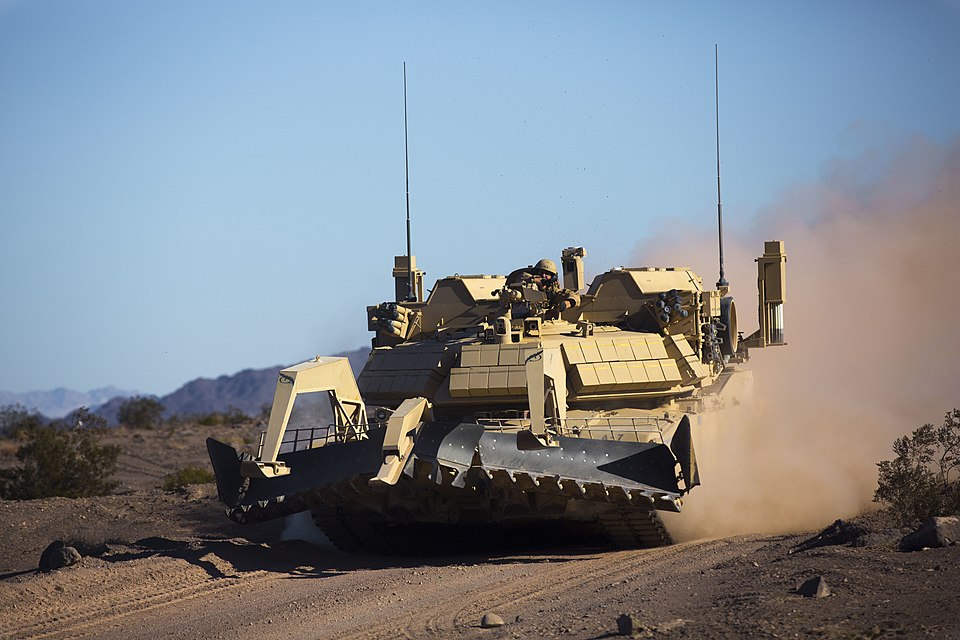
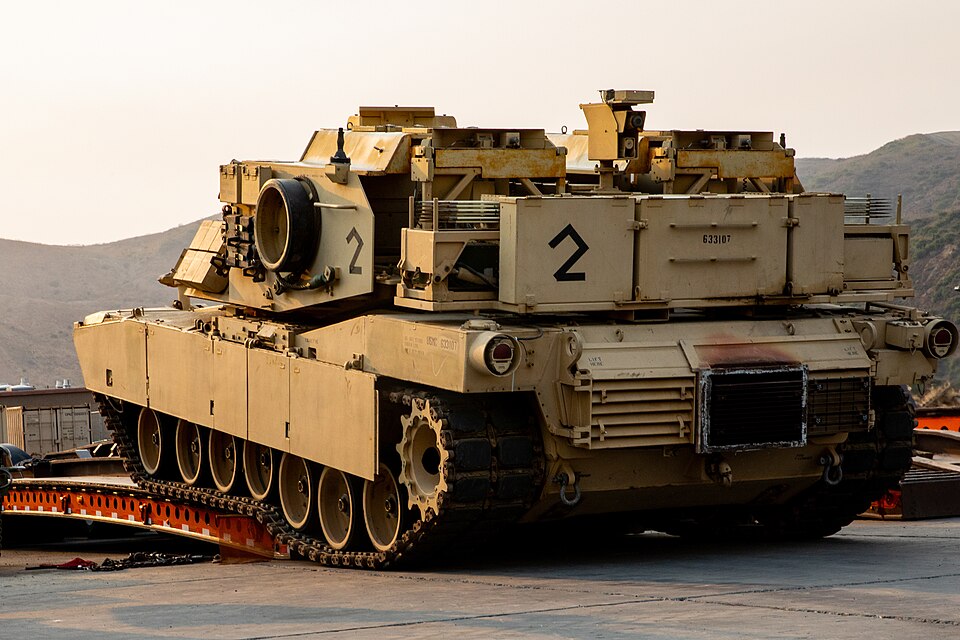
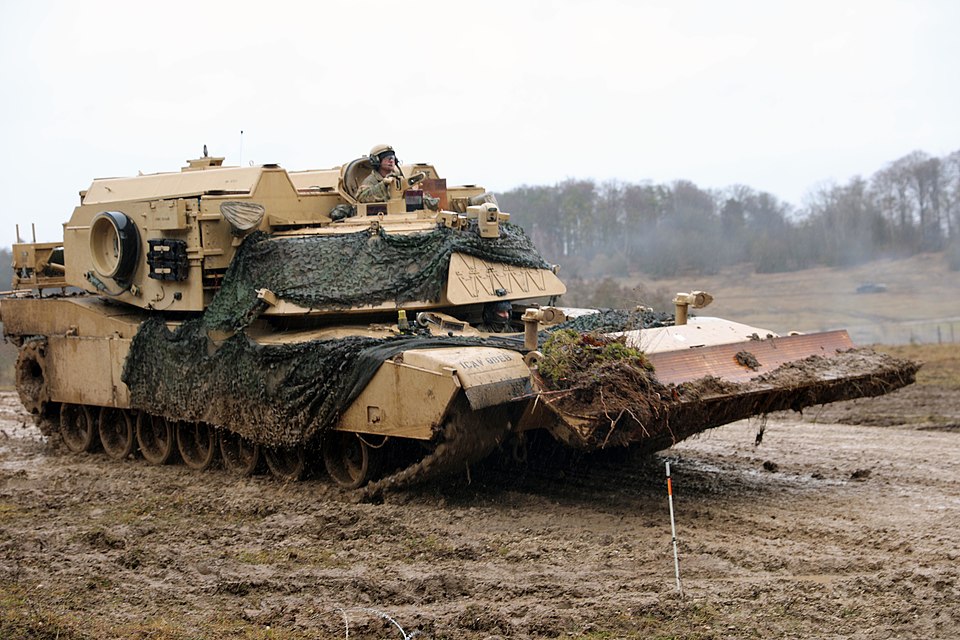
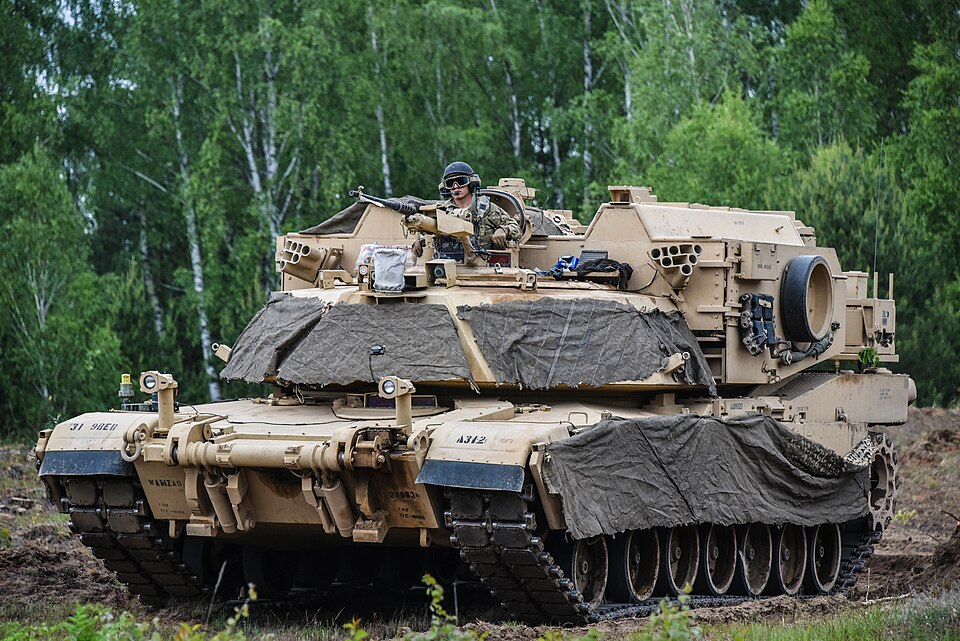
The ABV was developed as a tracked combat vehicle specifically tailored to clear pathways for troops and vehicles through minefields. It was also designed to clear up roadside bombs and improvised explosive devices (IEDs). The bases chosen was the M-1 Abrams for obvious logistical reasons as the robust nature of the 72-ton, 40-foot-long (12 m) base tank to deal with any detonation. That M1 Abrams also brought in its 1,500 horsepower engine and a massive torque for its mine plough. The turret was fixed in place and fitted with only a .50 cal machine gun. Its front-mounted 15-foot-wide (4.6 m) plow is supported by metallic skis gliding alongside. The M1142 when standarded in 2008 is also able to carry and deploy some 7,000 pounds (3,200 kg) of explosives for demolition work thanks to the with linear demolition charge system (LDCS) with rockets carrying C-4 explosives launched from the back of the turret, each with a HE payload projected at a range of 100–150 yards forward, detonating hidden explosives at safe distance. This quick solution enabled troops and vehicles to pass through safely.Equipment
Equipment provided by Pearson Engineering Ltd. comprised the High Lift Adapter (HLA), the Route-Opening/Full Width Mine Plow (ROMP/FWMP), the Combat Dozer Blade (CDB) the Obstacle/Lane Marker System (OMS/LMS) to which the USMC added its M58A3 Mine Clearing Line Charge (MICLIC) rocket system. These were all off-the-shelf and proven systems. See details on the tank encyclopedia article.| Dimensions (L-w-H) | 25 ft 11 in x 11 ft 11 in x 9 ft 5 in (7.91m x 3.65m x 2.88m) |
| Total weight | 65 short tons |
| Crew | 2 (Commander, Driver) |
| Propulsion | Honeywell AGT1500C multi-fuel turbine 1,500 shp (1,120 kW) |
| Transmission | Allison DDA X-1100-3B |
| Maximum speed | 67 km/h (regulated to 65 km/h) |
| Suspensions | High-hardness-steel torsion bars with rotary shock absorbers |
| Range (Fuel) | |
| Armor | 600 mm vs APFSDS, 900 mm vs HEAT + ERA Blocks |
| Armament | Browning M2 .50 Cal (12.7mm) Heavy MG |
| Production | c150 – 240 |
Deployment
Ex-Ukrainian M1150 exposed at Moskow.
On December 3, 2009, the M1150 "breachers" were used in combat for the first time when Marines pushed Nawzad during Operation Cobra's Anger in Helmand province. This was a well known Taliban stronghold, heavily mines and well defended. They also underway dealt with Marjah, 380 miles (610 kilometers) southwest of Kabul. The city was to be assaulted in February 2010. On February 11, 2010, two breachers deployed their rocket line charges outside Sistani, testing Taliban defenses before Operation Moshtarak, closing off the enemy's escape route. On February 13, 2010, breachers of the US Marines, 2nd Combat Engineer Battalion blasted "safety lanes" in the minefields laid by the Taliban, around Marjah. After a report in December 2009, five ABVs were noted active in Afghanistan, with plans of a total of 52 by 2012, 34 already produced and ready to ship in Afghanistan. The U.S. Army reported to have ordered 187 total to cover the USMC needs as well as its own.
By August 2013, six ABVs were sent in South Korea to the 2nd Infantry Division for that capability to make rapid in-stride breaching of mine fields and obstacles on the DMZ. The ABVs was tasked to clear the heavily mined area on the North Korea sector, that experts believed to contain tens of thousands, and up to millions of mines of all sizes and types. MRAPS were also massively deployed. Since these were mine-resistant, this caused North Korea to accuse this deployment as a prelude to a US-led invasion of its territory through the DMZ, preceded by the six ABVs. MRAPs were later withdrawn as the terrain was not wheeled friendly. North Korea however remained silent about the presence of the tracked ABVs.
In 2019, the USMC's "Force Design 2030" program proposed to divest its Armor component, including the ABV. They were thus transferred to the Army. This left the latter as the sole branch of the US Military with that breach capability. The process was completed by 2023 and no ABV remains with the USMC. In April 2021 the US Department of State approved the sale of twenty-nine of these to Australia. The Russo-Ukrainian War saw a proposal in November 2023 to ship ABVs. One was unveiled already in a ceremony to commemorate Ukraine's missile, Artillery and Engineering Troops Day. On February 22, 2024 one M1150 was lost in action in Avdiivka. On 3 March, another was visually confirmed lost near Berdychi, close to Avdiivka. As of January 2026 according to Oryx three had been lost so far. Ex-USMC Breachers were exported to the following countries, albeit this transfer is still Ongoing:
Users
 United States Army, 149 M1150 vehicles.
 Ukraine: xx Vehicles supplied by the United States.
 Australia will obtain 29 M1150 vehicles.
 Poland: 25 M1150 for the 18th Mechanized Division.
 Romania: Four M1150 vehicles.
 Bahrain: Eight M1150 vehicles
Gallery
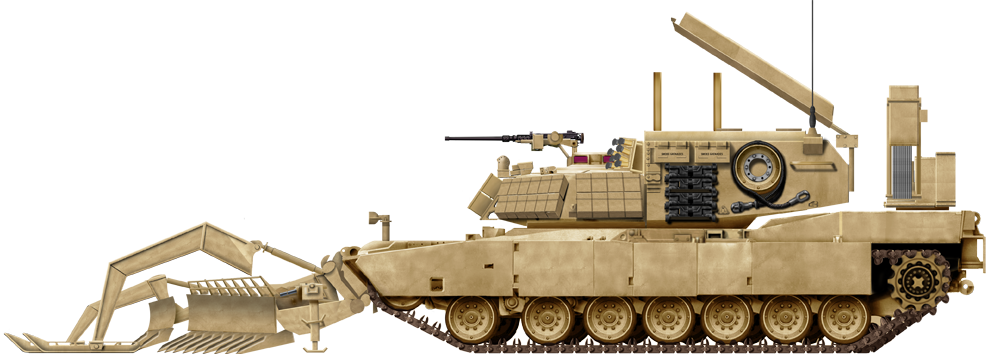
Author's illustration in Afghan Livery
Sources
army-technology.comodin.tradoc.army.mil
armyrecognition.com/
globalsecurity.org
Video
deagel.com
en.wikipedia.org
Oryxspioenkop.com
Modern Tanks
Modern MBTs posters
Denel Bagder (2018)
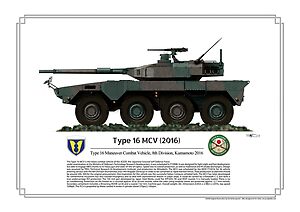
Type 16 MCV (2016)
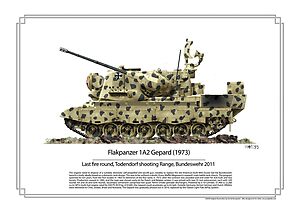
Gepard 1A2 last rounds 2011
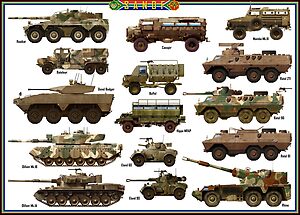
SANDF
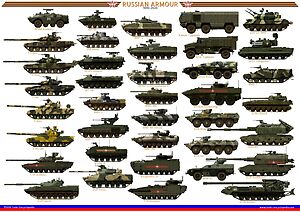
Russian AFVs
Main Battle Tanks