TAM VCA 155
 Argentina (1986) SPH - 18 built
The Argentinian Palmaria
Origin and Development
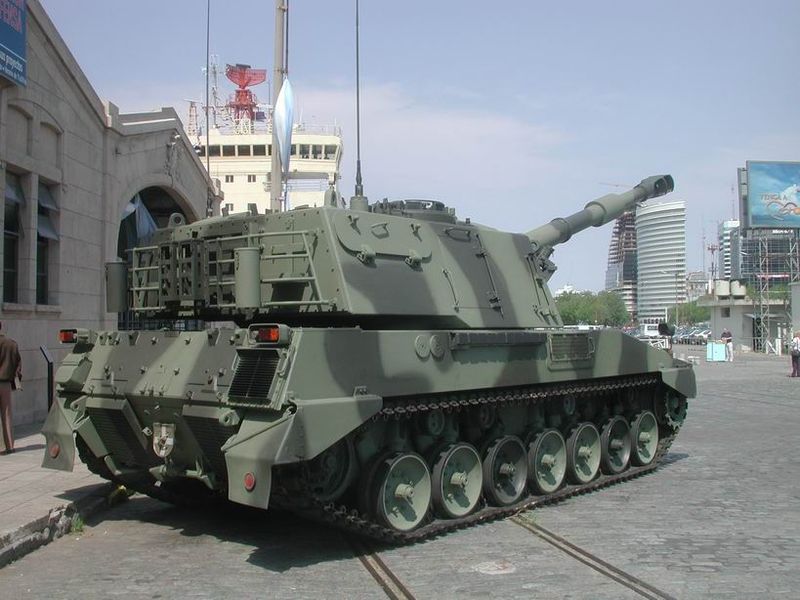
VCA 155 Palmaria howitzer variant
The Argentinians wanted to develop their own modern battle tank back in the 1970s. Their previous choice in the 1960s was to procure through the (“Plan Europa”) AMX-13/105s and the comparable Austrian Kürassier (112 in service). However if well-armed, bith were light tanks, lightly protected, not suitable as combat tanks. They looked at the French AMX-30 and German Leopard for purchase or license production. Then by the early 1970s was launched the TAM (Tanque Argentino Mediano). The commission sent to German was interested by the Leopard MBT, and asked Thyssen-Henschel to design a domestic model for the needs of the Argentinian Army.
They looked at specifications of no more than 30 tonnes, 75 kph, and a 105 mm rifled main gun. Development started in 1974, by early 1977, two prototypes were delivered, ran extensively at TAMSE. Long story short, this gave birth to a successful medium tank with a hull roughly similar to the Marder IFV but with significant differences. It was soon produced to c350 vehicles, including the TAM 2C prototype, and not counting the derivatives the VCTP IFV, the VC supply tank, the VCLC rocket launching tank, the VCA (Ambulance), VCTM (mortar variant) and VCPC (Command Vehicle).
But one variant was the missing link in the Argentinian tree, based on the TAM: The self-propelled gun. This started with the study of contemporary self-propelled artillery systems, and eventually for its size and weight, only the lighter Italian Palmaria gun system proved adapted to the Argentinian needs. Thus, Argentina purchased twenty turrets with all the necessary kits, OTO Melara gun and ammunitions, around 1986, they were delivered until 1988. However the installation proved complex, once the new elongated chassis had been delivered (stretched, with a new axle). It seems the first and only batch was ready by 1992-94. Only seventeen or eighteen were converted. The name VCA stands for "Vehiculo de Combate de Artilleria". At 40-44 tonnes fully assembled it was the largest of the TAM's variants. Initially in some sources, 25 were planned, and it seems budgetary constraints limited the total procurement to 17 or 18 units (19 in others).
Design
Hull & protection
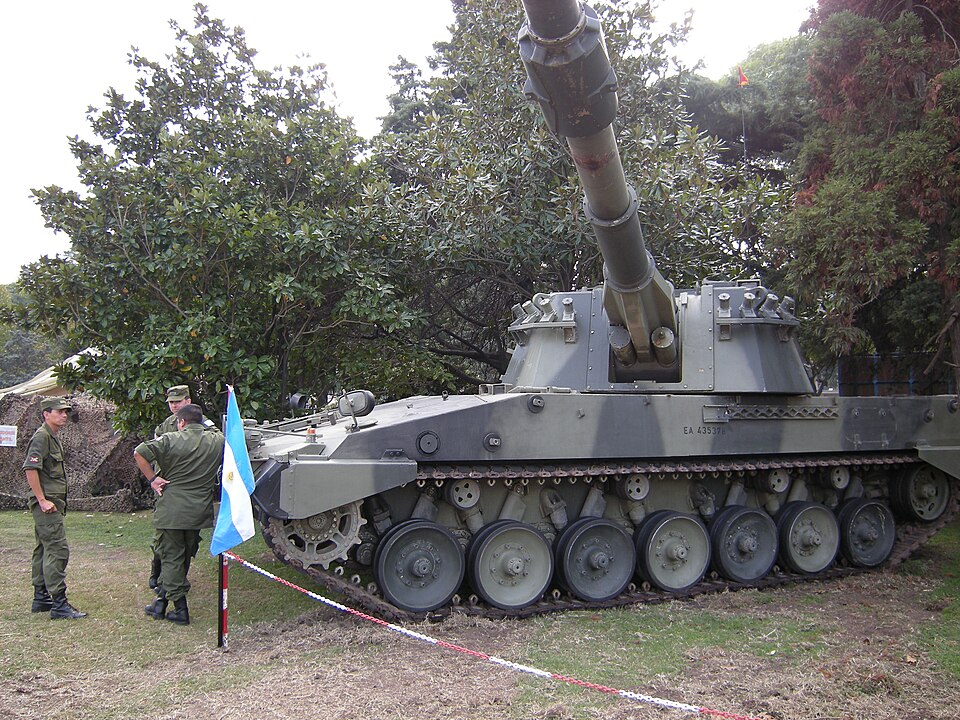
A VCA in exhibit, army day (cc)
The hull is made of welded laminated steel RHA with a raked nose, very long sloped glacis plate 50 mm thick (1.97 inches at 75 degrees) protecting both the powerplant and transmission. This engine was mounted at the front, like the IDF Merkava. It was on the left-hand side and separated from the driver on the right-hand side and fighting compartment at the rear by fireproof bulkheads. The driver had a one-piece hatch, right opening and three periscopes for the frontal arc. The central one could be swapped by an IR vision block for night drive. A single very large hatch opening to the right covered the engine compartment and allowed full access, also enabled full lifting and replacement on the field. The hull was waterproof and NBC protected. Thus, it cross 1.40 m of water or up to 4 meters in depth, after preparation. There was a snorkel installed at the rear over engine louvres. Thus in this layout, the main fighting compartment was at the rear.
The sides were not flat but sloped at 32 degrees, and they protected the vehicle against AP shells, from guns up to 35 mm (1.38 inch) caliber guns. This choice increased mobility over protection, but the low profile of the tank was counterbalanced by the massive turret that was installed. That turret carried two sets of four smoke grenades, and later flares. Fixations and straps along the hull were present, but the wheeltrain was not covered by flexible skirts. Front and rear mudguards only had side extensions. The main difference with the standard TAM was its elongated chassis, also made by General San Martín. The hull was all steel, but the OTO Melara turret is made of aluminium.
Mobility
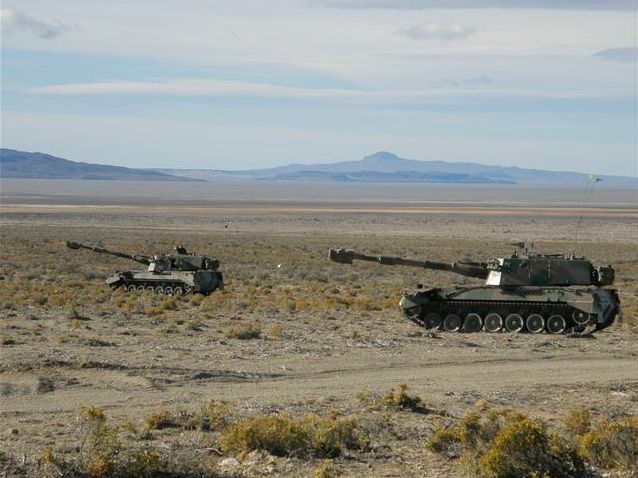
VCA training in the Pampa (cc)
The TAM's best card was its speed. Power was provided the MTU MB-833 Ka 500 diesel, for an output of 540 kW (720 hp), at 2,400 rpm, for a power to weight ratio of 18 hp/t. Same as in the regular TAM tank. It was connected to a Renk HSWL-204 automatic transmission, coupled with a hydrodynamic torque converter. Fuel capacity is 680-liter (180-US-gallon – 150-imperial-gallon) in internal tanks for 500 km (310 mi) for the baseline model. 900 kilometers (560 mi) was possible with rear-mounted drum-type 200-liter (53 US gal – 44 imp gal) external fuel tanks, albeit it seems the Palmaria variants never sported them. There is a double brake system with hydraulic disk brakes on all road wheels. Suspensions were the same torsion bar system as roughly those of the Leopard and Marder, providing excellent mobility. For field performances: Top speed 55 kph, Ground clearance 0.45 m, clmbing a wall 1 m, gap a trench of 2.5 m, climb gradient at 60 % and a slope at 30 %, and fording 1.4 m.
Turret & Armament
Another view with its unusual green camo, also in exhibit (pp).
The Italian turret is a slab-sided structure with a sloped forward side and sides, flat back. The Oto Melara-designed 155 mm barrel is 41 calibres long, is fitted with a fume extractor and a muzzle brake and is loaded semi-automatically. Its semi-automatic loading system is rated for 15 rounds per seconds, one per minute for one hour, or one every 3 minutes, continuously. The semi-automatic loader is at the turret rear, loaded via an hatch, in the turret side. The ammunition loading is automated, at an angle of +2°, but the propellant charge is manually loaded. The housed 23 ready rounds. Seven are ready in the hull. The one ready in the turret are stowed in tubes rows in the rear bustle. The firing percussion mechanism uses an electrohydraulic valve, with firing by push-button and an initial burst rate of three rounds for 20 seconds. The barrel had an a balancing mechanism with an hydraulically actuated cylinder, linked to the cradle, pivoting on the turret structure with elevation limits -4 to +70°.
The two modes of operation are fully wheel-handed or powered, via hydraulics, allowing the gunlayer to directly lay the gun with a control handle. After firing, the barrel is returned to +2° automatically. The traverse of hydraulically operated from a gearbox for a full 360°. The recoil system comprised two buffers, one recuperator. The gun cradle had an elevation of +70° with a force of 45 tonnes. Ammunitions are compatible with NATO standards such as the FH-70 and FH-77B, and US 155 mm M107, M549A1 and M483A1. In any cases, the turret is also NBC protected, and its maximum range is 24 km with standard ammunition, 30km with base bleed ammunition. In addition the turret had a roof-mounted optional GMPG.
The three sighting systems are a P170 direct firing periscope, P186 panoramic sight for indirect sighting, and dial sight. The P170 is usable for observation and sighting, with a magnification of ×8. The main sighting system could swap for an IR system on the day periscope, also enabling sighting in bad weather, low visibility. The gunner's P186 panoramic sight for indirect firing has an illuminated reticle also working in low-light level, fixed, pre-aligned with the optical axis. The elevation counts an electronic plane converter, for rapid and accurate aiming. The P186 telescope is on top of a mount, used for laying the gun and for indirect fire control. The sight has a magnification of ×4, 10° FOV (field of view) and weighting 8 kg. There is an intercommunication system, plus an extra external infantry telephone at the back, a rack with radio sets.
Production and Service
Production of was managed Tanque Argentino Mediano Sociedad del Estado (or TAMSE), founded by the government from all chassis collected from General San Martín, in that case the only ones with seven roadwheels instead of six. On this model, about 70% of all parts were manufactured locally, 30% imported from Germany for the hull, and of course the Turret and gun system are Italian. Overall, twenty turrets had been purchased, but only seventeen or eighteen (this is disputed) conversions made, either because one or more turrets were used for static training, or spare parts reserve, or just because of conversions costs. The VCA-155 Palmaria is in service since 1995 likely, and would remain so for another ten years likely, despite an ageing chassis which conception goes back to 1977.Indeed, by 16 September 2024, the Argentine Ministry of Defense announced that 17 TAM VCA-155 were about to undergo restoration and upgrades. With funds required already allocated in the budget. Details are foggy: It is question of improving firepower (perhaps new, modern 4th-gen 155mm ammunition), but also mobility, electronics, by integrating advanced fire control systems as well upgrading communications equipment. It is the only of its kind, alongside the VCTM and M106 Mortar Carrier. The livery should be standard light chocolate brown and olive green wavy camouflage as standard, albeit there is a version with dark green and olive green, likely the prototype. The VCA-155 does not operate alone but with a few VCA ammunition supply carriers, based on the standard 6-wheeled TAM variant.
VCTP specifications | |
| Dimensions | 10.30 m gun fwd/7.69 m x 3.30 x 3.20 m oa |
| Weight | 40 tons |
| Crew | 2+10 (driver, commander, platoon) |
| Propulsion | 720hp MTU MB833, V6 diesel 25,6 hp/t |
| Suspension | 6 torsion bar units |
| Speed | 55 km/h (34 mph) |
| Range | 719 km incl external fuel |
| Armament | 155mm OTO main gun, 1x 7.62mm GMPG |
| Protection | 45 to 75 mm front (1.77 to 2.95 in) |
| Production | 20 in early 1990s |
Gallery
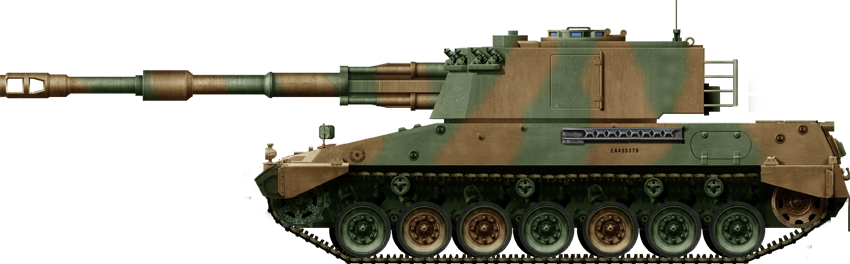
VCA-155 in its standard livery

At max elevation (pinterest)

Gun resting. same.

A platoon in exercises in the pampa. same.

"Chacabuco" gun up. More on pinterest
Links
The VCA on Tank Encyclopediamilitaryfactory.com
bulgarianmilitary.com
army-guide.com
Video
weaponsystems.net
TAM VCA
army-guide.com Palmaria
3D

Cold War Tanks


Cold war tanks posters
Cold War Main Battle Tanks
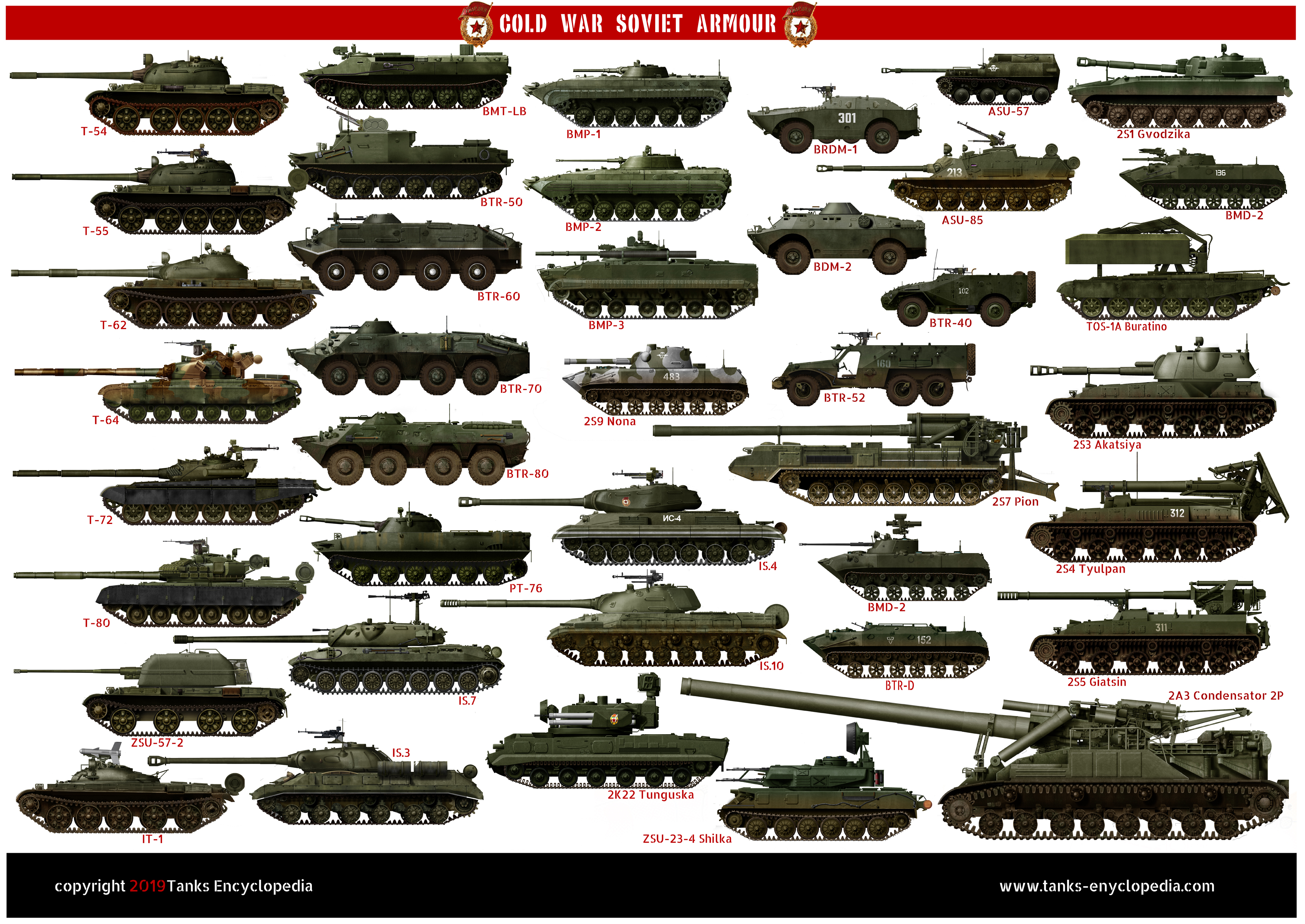
Cold War Soviet Army