PZL-89 (1989)
 Chinese PLA Self propelled Howitzer
Development
Give its early alignment to the Soviet Union's own arsenal from 1949 and its vivtory over Nationalist Chinese, the People's Liberation Army, PLA or PLAGF (Ground Forces) looked at the Soviet 122 mm as its own standard howitzer caliber. With a massive local production of such shells before the Sino-Soviet split of 1961, China did not renounced to the caliber. However the bulk of its 122mm artillery was towed. The time needed to set it up and be underway again was quite long. By the late 1970s, NORINCO started working "improvized" 122 mm self-propelled howitzers (SPH) to meet evoluting Chinese army requirements. Some appeared after the 1979 war with Vietnam, based on experience, like the Type 85. Experience was also gained on the Type 70 (see later). The core requirement was for a range of mobile, light, fast mobile artillery systems for mountainous or difficult terrain. On the upper end, heavier tracked self propelled guns were also looked after.However the lower end was to provide medium to long-range indirect fire support, either to profit motorised infantry or armoured troops. The speed requirement was paramount as these system had to keep pace with them. This led to the best project to be further developed as the Type 89 self-propelled howitzer, later given its military designation PLZ-89. The product of earlier studies, including of the Type 70 (WZ302/Type 54-1/Type 63-1) and Type 85 (YW323) improvized from APC chassis, respectively of the Type 63 and Type 85, lacked the proper suspension systems to deal with the enormous recoil. Plus the weight of the howitzer system, mounting and ammunition slowed them down. Some were used in difficult terrain in 1979 against Vietnam and proved underpowered and unreliable. The then rival, USSR, had produced with the 2S1 Gvozdika in 1975 when it entered service, a relatively compact and fast machine that was seen as a benchmark for the PLA.
Thus, a new, dedicated self-propelled howitzer was developed in the late 1980s wit this model in mind. This Chinese attempt to develop the first pure SPH, from the ground-up rather than an adaptation of another chassis, was an attempt to match the Soviet 2S1 Gvozdika in capabilities, especally looking at speed. Development ended at China North Industries Group Corporation - CNGC, with the help of several institutes, there was a first successful step already, designing a new domestic howitzer: The Type 86 (W-86) 122mm/32 calibre, a Chinese copy of the famous Soviet D-30, but with many local adaptations. Once ordnance was chosen, work went on the mount and its fitting into a rasonably sized turret.
The core design was thus made quickly, with the mating of the turret and mount with a dedicated chassis, derived from the Type 77 APC likely in 1987, tests and improvements in 1988, then final acceptation tests in 1989, a quick development time overall. Indeed, after it was accepted that year, tooling for production started and the first probably arrived in active units of the PLA and PLA Navy Marine Corps in the early to mid-1990s. Overall, "several hundred" were produced, with the most commonly accepted figure of 400 of the artillery systems built and deployed, likely in the southern areas, given their better mobility and small size. It seems however its operational deployment took time and it was only first showcased to the world in 1999 at the Beijing military parade held (50th anniversary of the PRC), ten years after military acceptance. The PZL-89 was seen frequently appearing in PLA exercises since 2000 as well. They are well placed despite their age for a second line reinforcement in Taiwan given the terrain.
Design
Layout and Protection
The PLZ-89 is mounted on a tracked chassis developed from the Type 77 amphibious armoured personnel carrier (APC) as seen above, which allowed to gain considerable time in design. The vehicle houses five crewmembers, all protected by a collective NBC system. There are automatic fire detection and suppression systems as well in the combat and engine compartments. The latter is located forwrd in the nose, with the transmission in front of the drive, which is seated on the right side, with a round, side sliding hatch. He has three persocopes facing forward and at an angle, with the central one removable for an infrared sight for night driving. A commander position is located immediately at its rear, also with his own round hatch, opening rearwards.The PLZ-89 has a combat weight is 20 tonnes (20 long tons; 22 short tons) for an overall length of 11 m (36 ft) overall, gun deployed forward on its travel lock, for a width of 3.4 m (11 ft) and an height of 2 m (6 ft 7 in). The advantage of being based on the Type 77 is its amphibious capability thanks to the built-in buoyancy of the hull. Thus, the Type 89 can swim with the assistance of additional floating devices. There is no trim vane to be erected however, and the overall weight of the vehiclen, much superior to the Type 77, makes it a dangerous proposition.
The fighting compartment and turrets are at the rear, comprising three position, a gun commander located to the right with hois own hatch and MG position for AA defence on the right, a gunner (no hatch) with a fully traversing periscope and IR sight with magnification on the left. At the rear of the turret are located two more hatches for the loaders. Smoke projectors for active concealement are located either side of the forward turret face. The armour protection is light, made of steel RHA estimated between 5 and 13 mm, efficient against small-arms fire and artillery shell splinters. It is greater on the nose, able to resist due to the slope, 12.7 and up to 14 mm AP rounds. The gun crew can also access and exit the vehicle under fire by the two back plate rear hatches, and there is a small ventral hatch for the driver as well if the vehicle is turned over.
Engine and performances
The Type 89 SPH is powered by a 450 hp 12V150L12 diesel engine, roughly similar but improved compared to the one on the Type 77 APC, the 12150L-2 12-cyl. LC diesel 402 hp (300 kW). This compensates for the extra weight and gives it a maximum road speed of 60 kph. Max. road range is 500 km estimated. The drive train comprises the same arrangement as the Type 77, inspirted by the PR-76 with six light alloy pressed wheels, rubber-rimmed, with front drive sprocket and rea idlers. There are no returned rollers, the tracks rests directly on the roadhweels. This is a simple system, but causing more vibrations. The Type 89 had a flotation kit for amphibious warfare as well, notably used by the Chinese PLAN (Navy).Armament
The Type 89 SPH is armed with a 122 mm/L32 howitzer as main armament. This ordnance is derived from the Type 86 (W-86) 122 mm/32-caliber towed howitzer, itself a licensed copy of the Soviet D-30 122 mm howitzer of the late 1950s. For this small size, 40 rounds are carried inside the turret. The gun itself has a semi-automatic loader, enabling a maximum rate of fire of 6–8 rounds per min. Fire accuracy counts of a Chinese domestic digital fire-control system (computerised) and the a electro-optical sight for day/night operations on the left above the gunner's position as seen above. This caliber makes it compatible with a wide array of Chinese and Russian 122 mm ammunition. Best range is 18 km (11 mi) with standard HE projectiles, but 21 km (13 mi) with extended-range projectiles, full bore, hollow base (ERFB-HB). The secondary armament comprises an optionally roof-mounted QJC-88 12.7 mm heavy AA machine gun. The two sets of 4-barrel could also deliver anti-personal grenades in addition to smoke.Service

First revealed in 1999, the PLZ-89 nevertheless was already deployed in active units since 1993-95. They are present in artillery regiments comprising each one howitzer battalion organic to an armoured division or brigade. Each battalion has 18 of these, making three artillery companies of six each. A Marine brigade is also equipped with a Type 89, with a single company in the PLAN Marines armoured regiment. The latter are distinguished by their "Marine" camouflage, still in wavy patterns, but replacing the sand by clear blue and dark green by dark blue, plus olive green. Photos are rare of these Marines versions (see photo above, reddit). Note that a variant mounted on a 6X6 wheeled chassis with reduced combat weight was also developed.
PZL-89 specs. | |
| Dimensions | 11 x 3.4 x 2m (36 x 11 x 6 ft 7 in) |
| Weight | 20 t (20 long tons; 22 short tons) |
| Crew | 5: Driver, Cdr, Gunner, 2 Loaders |
| Propulsion | 12V150L12 liquid-cooled diesel 450 hp (340 kW) |
| Suspension | Torsion bars suspensions |
| Speed (road) | 60 km/h (37 mph) |
| Range | 500 km (310 mi) |
| Armament | 122 mm (4.8 in), 12.7 mm AA |
| Armor | 13-20mm est. |
| Total production | c400 estimated |
Variants & Operators
PLZ-89: Baseline military version: 500 PLZ-89 PLAGF.SH-3: Export variant (improved chassis, engine, transmission: 6 for the Rwandan Defence Force
Gallery
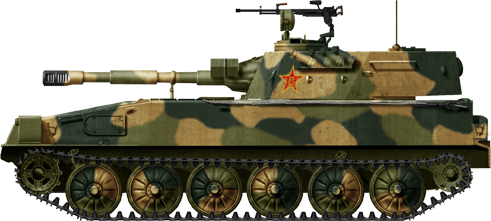
Basic Type 89 with its 1990s wavy camouflage.
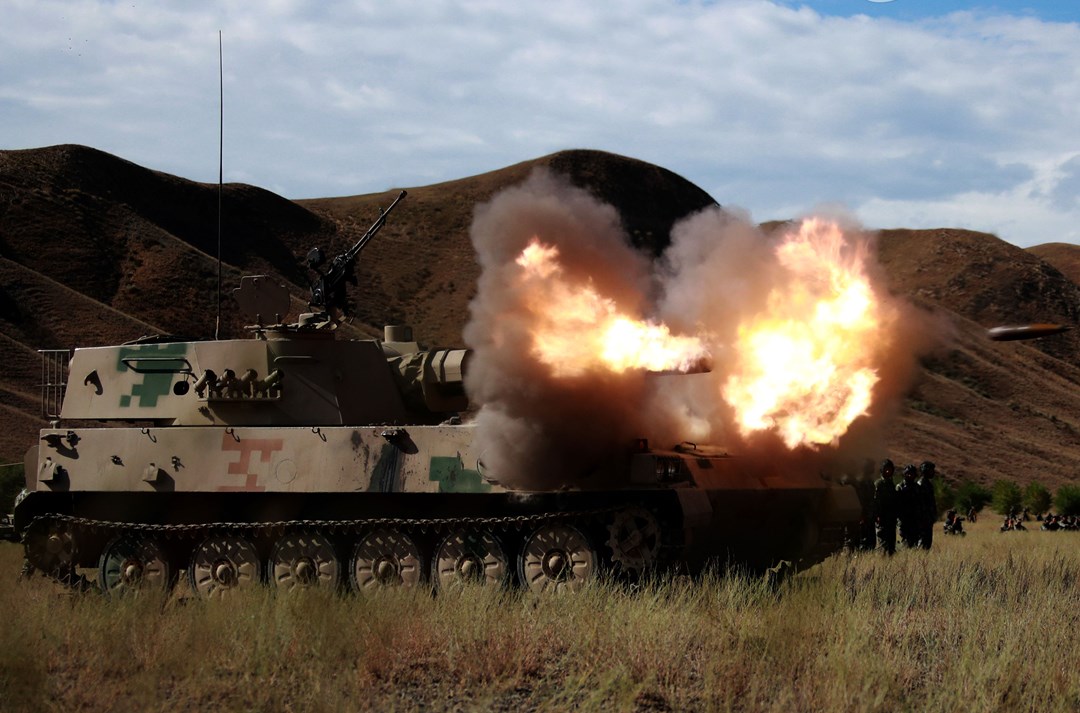
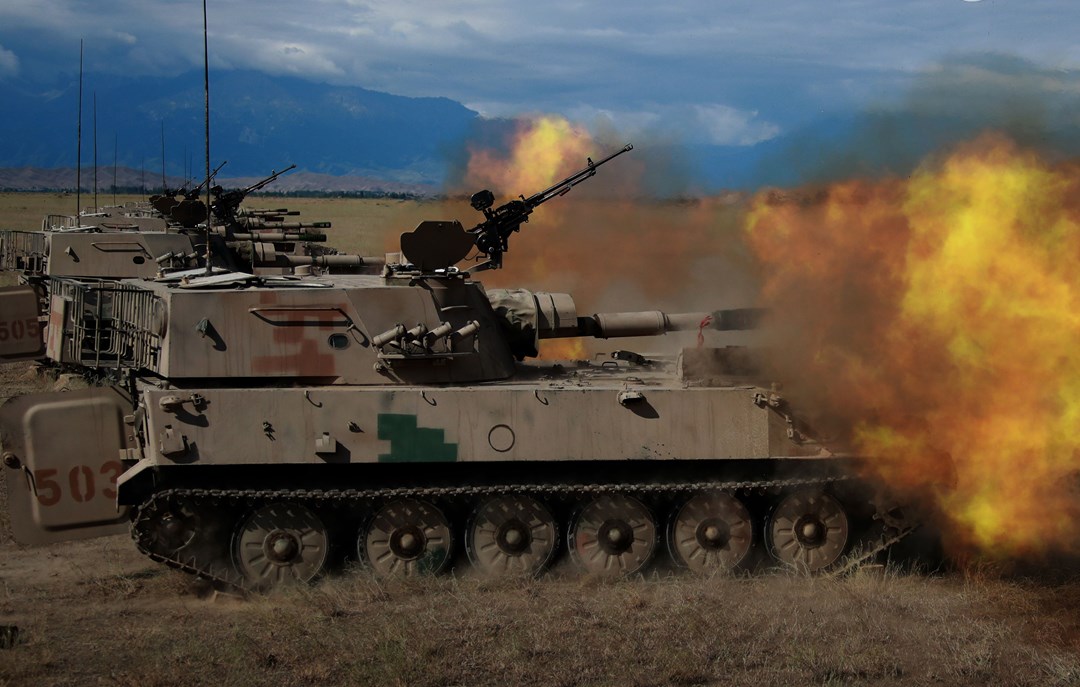
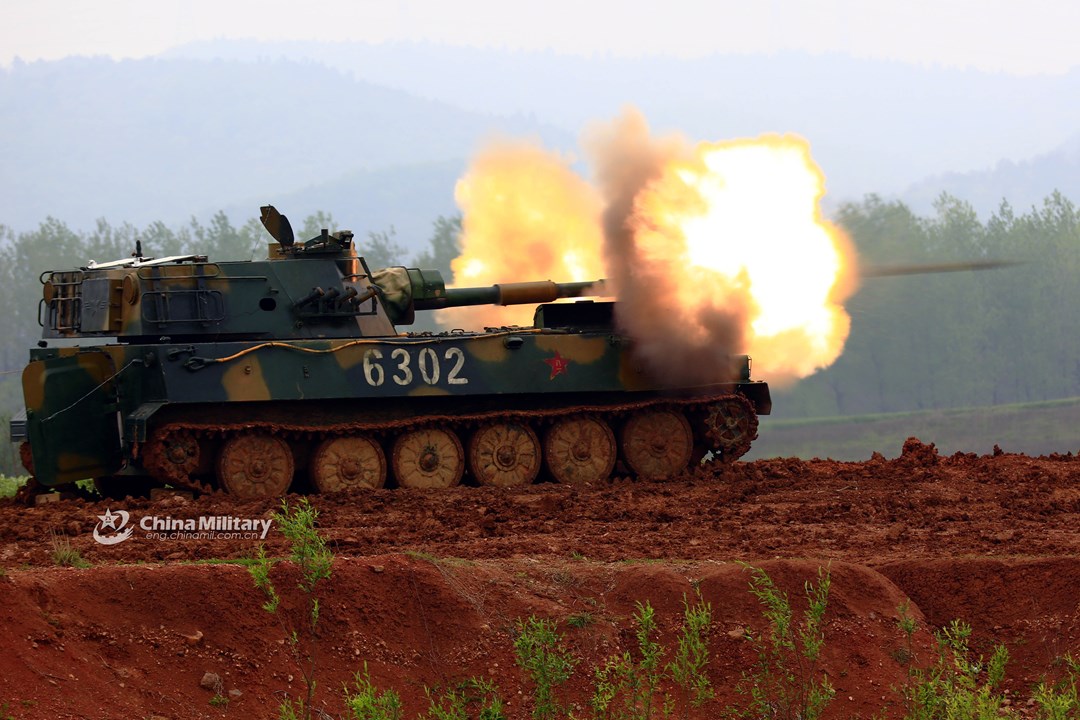


Chinese Naval Infantry PLZ-89 Self Propelled Hotwizer's On The move During Exercises, 2000s.
Links/src
militaryperiscope.com
man.fas.org
weaponsystems.net
militaryfactory.com
armyrecognition.com
deagel.com
army-guide.com
PLZ-89
shephardmedia.com: Rwandan SH-3
defenceweb.co.za
armoredwarfare.com
Video

Cold War Tanks


Cold war tanks posters
Cold War Main Battle Tanks
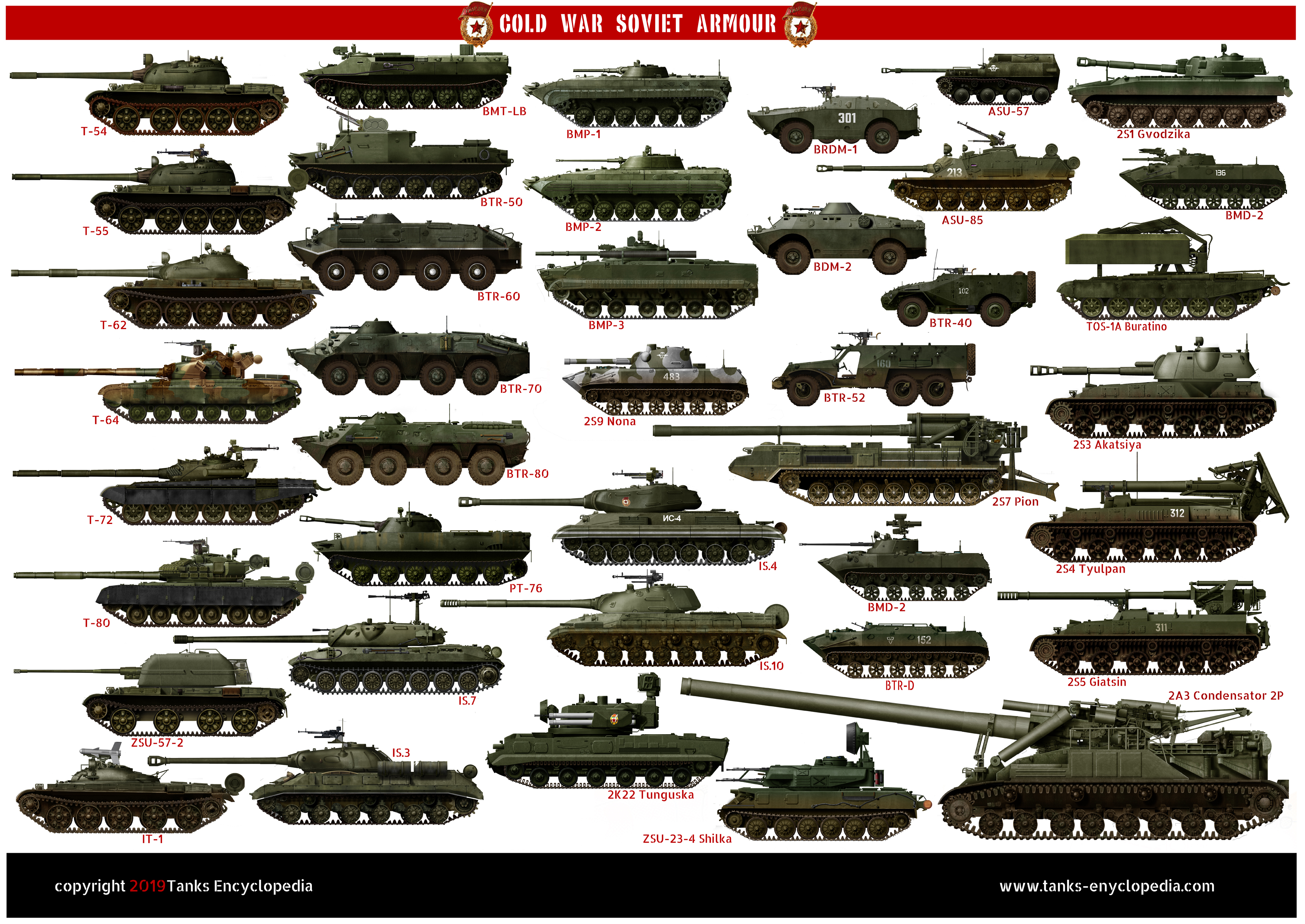
Cold War Soviet Army