JT-34 (1960)
 150 crane tanks
Design
Development
Postwar, Czechoslovakia ws aligned on the defensive network under the Warsaw Pact dominated by Soviet doctrines and hardware. The first Czechlosoval tank of the cold war, was the T-34-85CZ a variant of the T-34-85 made in Czechoslovakia. There was also a T-34/100 proposed modification with as large mantlet mounting a Czech 100mm gun as a tank hunter, never built. Later, the same chassis was reused for three main support vehicles: The MT-34 (1950s) ("mostní tank" or "bridging tank"), a conversion with a PM-34 scissors bridge carried on rollers, on top of a turretless T-34. Next was the VT-34 (VT vyprošťovací tank or "recovery tank") and last but not least, the subject of today, the JT-34, a purpose-built crane vehicle.JT 34 was in fact the first project developed entirely at J. V. Stalin Plant, in Martin, Czechoslovakia. Development started in 1957 based on requirements from the Tank and Automobile Administration under the Ministry of National Defense. In 1958, the fist converted T-34 chassis fitted with a hydraulically operated system was created, then another, modified into a final prototype in 1959 usable for field tests. In 1960, the trials at the factory were complete and it was passed on to the Czech military test and control authorities, for a campaign of trials starting at the start of 1961, until the development was completed.
After the greenlight, the minister approved production of five pre-production JT-34 prototypes in 1962-1963. This phase lasted from 1963 to 1966 and that year, serial production was greenlighted. These JT-34s were manufactured for the need of the Czech Army, albeit they were also exported (several dozen) to India and Morocco, as well seemingly as Iraq.
Main Layout
The vehicle has a crane superstructure installed on the former turret ring, sporting a hydraulically-powered crane arm with a max. capacity of ten tons in field conditions. The vehicle could also double for recovery, removing or and mounting tank turrets, cannons, engines, transmissions and all systems of an armoured vehucle in the field. The vehicle was usable on engineer construction sites and for loading or unloading among others. Its armour grants the use very close, or on the frontline.The crane superstructure is welded from 12 mm armor plates, comprising a cabin for the crane operator which doubled as tank commander, accessing the structure arop the hull via a top hatch, but there are also two side round hatches and two front hatches. Hydraulic control displays are present, as well as radio and observation systems, all usabled withing the structure, below closed hatches. There was a partition to house the large drive unit for the crane, comprising an extra engine running on gas, the air-cooled eight-cylinder TATRA T603C, connected to a gearbox, and driving flexible coupling and an hydraulic pump. Access from the top was allowed by trapezoidal flaps.
The crane itself is raised and lowered by a pair of hydraulic pistons with a boom comprosing a retractable arm and hydraulic cylinder and cable guided rollers and winding drum, powered by the hydromotorem VMP 1600 engine, notably the brake. The steel cable is 20 mm wide, passing through a set of pulleys at the boom's end, and a second pair on which is fitted the hook. The extension arm had a hook for lifting loads up to a 1,25 tons. The crane structure tower rests on the original turret ball track and is powered in traverse by the same VMP 1600, with pinion engaging gear teeth inside the bearing.
Chassis, engine and drivetrain
The chassis is the one of the T-34/85CZ but the system could be adopted to ex Soviet T-34s of an even older model if needed. On the hull sides are fitted straps for additional equipment. Above the engine compartment is the supporting frame strong enough to support and carry a tank engine or fully rigged turret. This chassis is powered by the original IN-2-34 (V-2-34M) diesel with covered lids to access the injection pump, and a travel bracket to secure the boom. The JT-34 has three fuel tanks, one internal of 602 liters and 270 liters in three external tanks. The vehicle has no smoke dischargers, is not protected NBC but could project fuel oil on the hot exhaust to produce covering smoke.The JT-34 is powered by the V-2-34M which develops 500 hp (375 kW) for a top speed on road of 55 km/h, and off-road of 25 km/h. Engine consumption is 160 liters for 100 km on road, but in the field, it is up to 230 liters for the same. Its flat cruising range is 380 km and in the field, down to 270 km. Like the original T-34 it was tested able to climb a grade of 30°, a side slope of 25°, a trench of 2 meters, and a perpendicular wall of 70 cm and cross 1,3 meters of water without preparation. It is not amphibious and requires the same heavy transport airlidt as for a T-55 tank.
The driver and gunner which doubling as assistant crane operator are located in the hull forward. Armament is limited to a defensive DTM 7,62 mm located at the same position as the standard tank. A fireproof bulkhead separated the crew from the engine ar the rear, and the original armpur of the T-34/85 is retained. Regulation plans for this vehicle a two-man crew, so the driver is also supposed to act as gunner or assistant crane operator as well. The DTM machine gun is fed by 910 rounds, but the crew carries also a submachine gun vz.58 with 1200 rounds, a pistol vz.52 with 56 rounds, and a signal pistol with a 1 set of ammunition as well as 10 hand grenades. The commander could also use the type R-113 radio emitter/receiver, and driver and commander communicates internally by a type R-120 interphone.
Specs. JT-34 | |
| Dimensions | 8,9 x 3 m x 3m |
| Weight | 31,500 kg |
| Propulsion | V-2-34M diesel 500 hp (375 kW) |
| Suspension | Torsion bars |
| Speed (road) | 25-55 kph flat |
| Range | 270-380 km flat |
| Armament | DTM 7.62mm LMG, see notes |
| Armor | As T-34. Structure 12mm (0.5 in) |
| Production | 150 |
| Crew | 2-3 |
In action
In terms of production, it went from 1962 to 1966 for a total of 150 vehicles at a unitary cost of 622,000 Crowns. In addition to Czechoslovakia that get about eighty, India acquired the remainder as well as Morocco. Given the date of acquisition, both the latter saw action. The Indian JT-34 likely saw combat in the 1971 war. Organically these vehicles are distributed to upper echelon units tasked of tanks recovery, alongside ARVs. The Moroccan JT-34s saw action in the Western Sahara War against the very mobile Polisario front, and despite their age they likely were used on 7 October 1989, after Moroccan troops in Guelta Zemmour lost more than 18 tanks. The vehicles in service with the Czech Army were likely replaced in turn by the more versatile VT-55A/KS ARV in the 1980s, and the T-72 based VT-72B ARV produced in 1987-1989, before the fall of the USSR and of the Warsaw Pact, then partition between the Czech Republic and Slovakia.Gallery
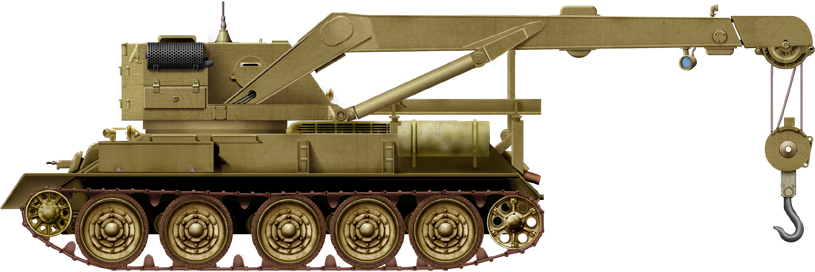
A Morrocan JT-34 in action during Polisario wars.
More photos
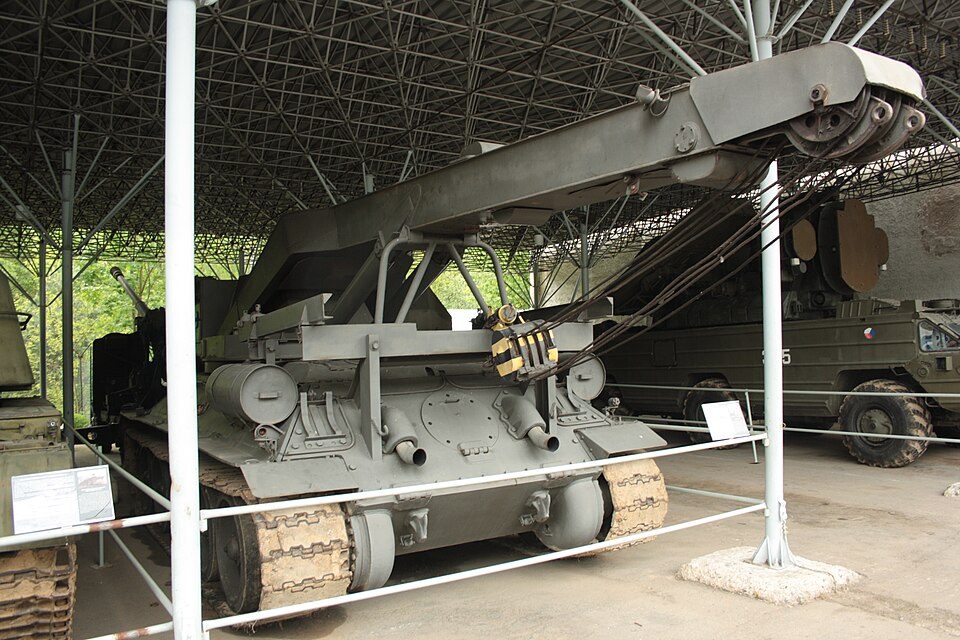
Details, at Lezany Museum
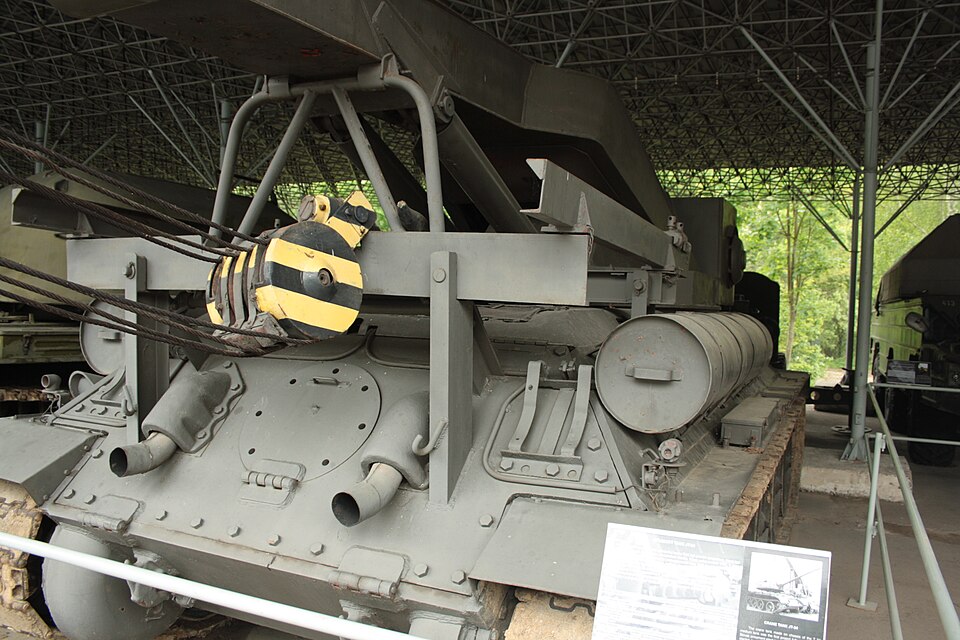
Details, at Lezany Museum
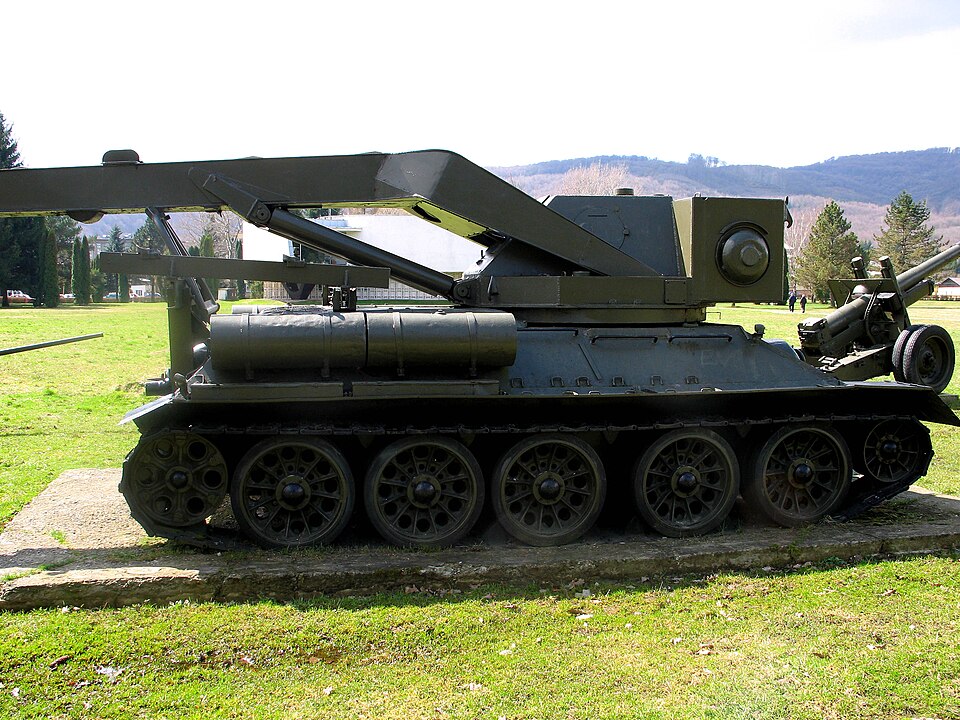
Profile at the Slovakian Technical Museum

The vehicle at Lezany (pinterest)
Sources
JT 34 - the Czechoslovak repair crane tank "Orlik". Polandarmedconflicts.com
valka.cz
conversion kit scalemates
Videos
Cold War Tanks


Cold war tanks posters
Cold War Main Battle Tanks
Cold War Soviet Army
Museums, Movies, Books & Games
The Tanks and Armor in pop culture
Tanks and armored vehicles in general are only really grasped when seen first person: The mass, the scale, it's all there. Explore also the way tanks were covered in the movie industry, in books and in video games.Movies:
Best tanks movie on warhistoryonline.com
On imdb.com
On bestsimilar.com/
miltours.com
liveabout.com/
watchmojo.com
Video Games:
pcgamesn.com
historyhit.com
levvvel.com
vg247.com/best-tank-games
mmobomb.com/
alienwarearena.com