Cadillac Gage Commando Scout (1977)
 Armoured Car 1977-1987: 140 built.
Development of the "Wedge"
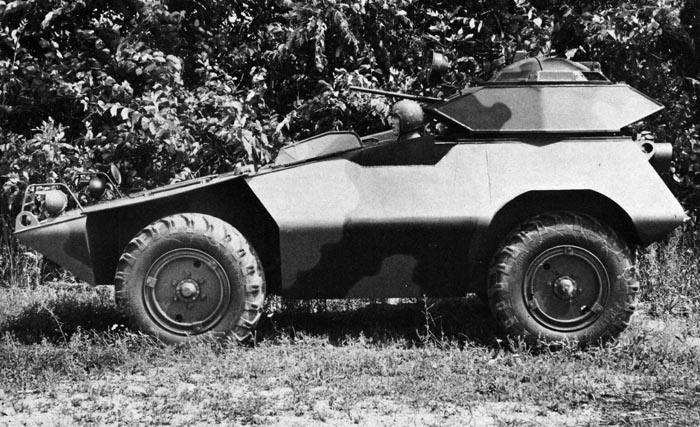
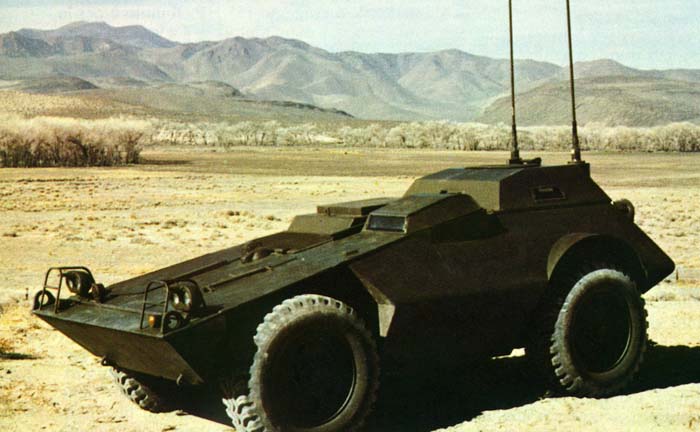
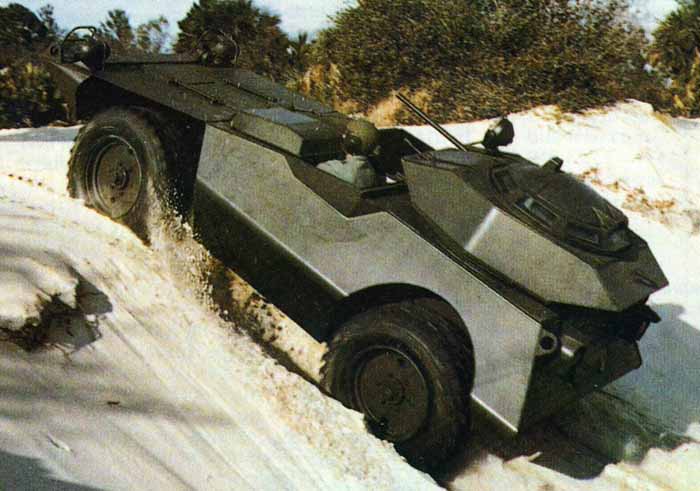
In the 1970s there was a wave of "edgy", very futuristic wegde-like concept cars that tuned heads at each new auto show. Cadillac was of course part of this tendencies. The sculptural Lancia Stratos of 1973 was part of this move, derived on the even more extreme and hugely inflencial Bertone/Gandini's Lancia Bertone Stratos Zero, but so was the Mercedes C111, Ferrari Pininfarina Modulo, Maserati Boomerang (from Giugiaro which also signed the Bizzarini Manta). There was also the Mazda RX500, Alfa Romeo Carabo, Aston Martin Bulldog and Vauxhall SRV in Britain, Alfa Romeo Navajo, Corvette XP-882 in the US, Holden Hurricane in Australia, BMW E25 Turbo in Germany, Autobianchi Runabout, Lotus Esprit M70, Ford Maya, Citroen Karin, Insomnia Dome Zero P2, Lamborghini Athon, all marked their era. So it was not far from Cadillac designers when they envisioned the next military vehicle created as a private venture. This design trend was incorporated into the design, with a wedge-shaped hull, which had practical aspects, like better ballistic resistance on the frontal arc.The vehicle was completely a private venture, targeting export customers, notably those which purchased previously the Cadillac Gage Commando 4x4 armoured car. In the 1960s its success led to numerous copycats, notably the Portuguese Bravia Chaimite. The marketing was that it reused many of the same components, including many of the Cadillac COTS (Civilian stock) making it cheaper, maintenance and logistics around were easier as the training. But this was a completely different vehicle, which was not an APC but a smaller reconnaissance vehicle, a companion to the regular APC taking the lead of a convoy and screening it on a plain terrain (little obstruction). The prototype was built in 1977 and fully tested, leading to a marketing campaign.

The base requirements were for a light vehicle powered by a 155hp V6 Cummins, featuring high sloping angles (even more than the standard CGC) with high hardness steel in order to achieve 7.62 NATO protection at all angles, and more forward. The small rear fighting compartment allowed the presence of a rear hatch for easier access and exit, and was topped by a universal mount, that could be fitted with any turret compatible with the CGC V150 range. This compartment was highly modular, and the brochure showed many iterations of the command post casemate.
There were a "1 meter turret" armed with a 20mm and a 30mm, and "1 meter combination mg turret" armed first with two 7.62mm and then a .50" plus coax. 0.3 (7.62mm) or 40mm grenade launcher. There was 1200 for the 0.8 in and 600 for the .50 cal. or 300 grenades if that was the choice made. There was even a support vehicle armed with a TOW and 106mm RR versions. In the former, two TOWs could be carried inside and 4 more stored externally. However 15 rounds for the 106mm RCR could be carried, coupled with a 100 rds .50" browning used for ranging.
Design
Hull & General Layout
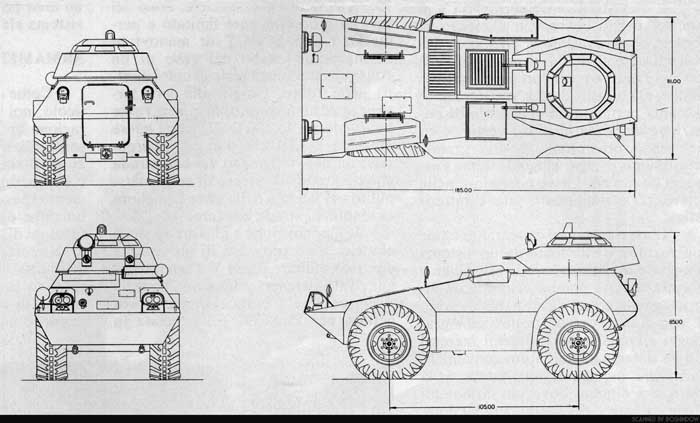
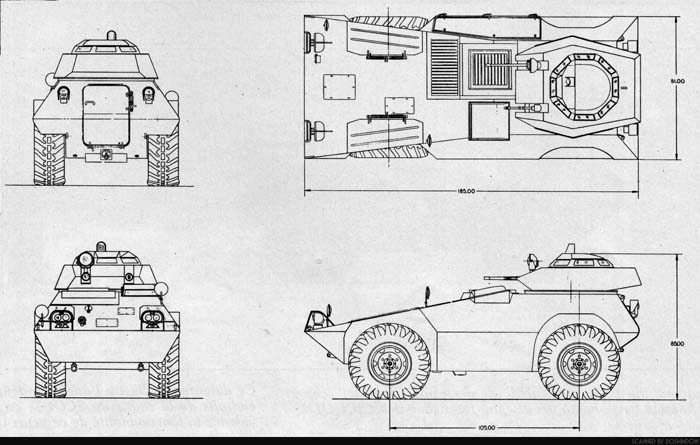
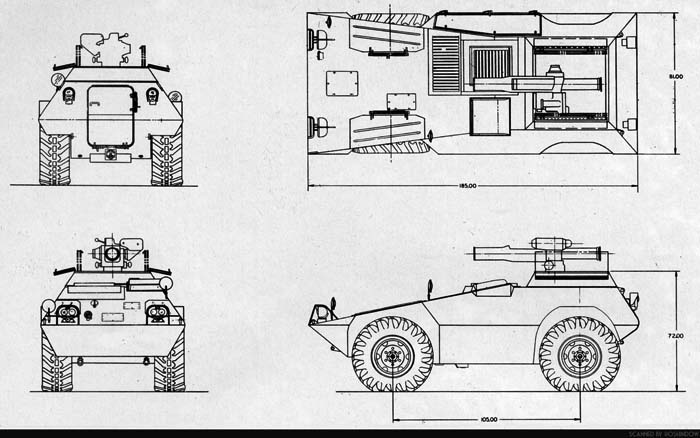
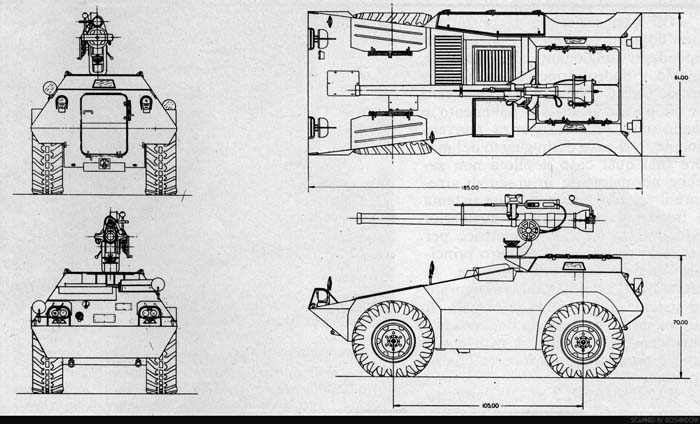
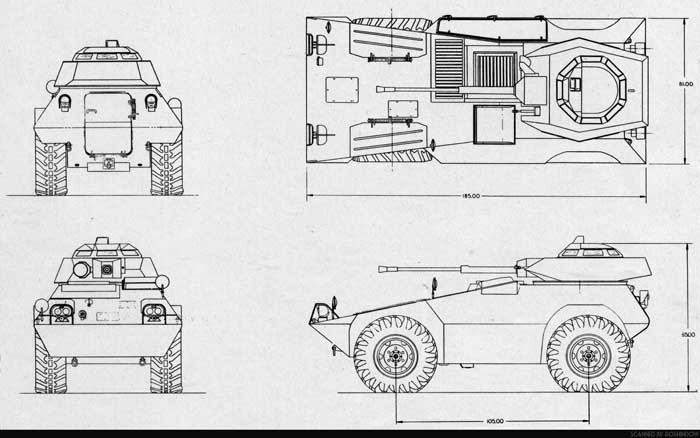
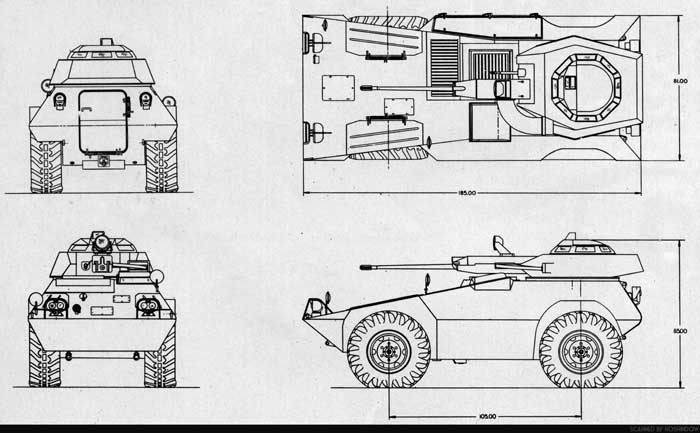
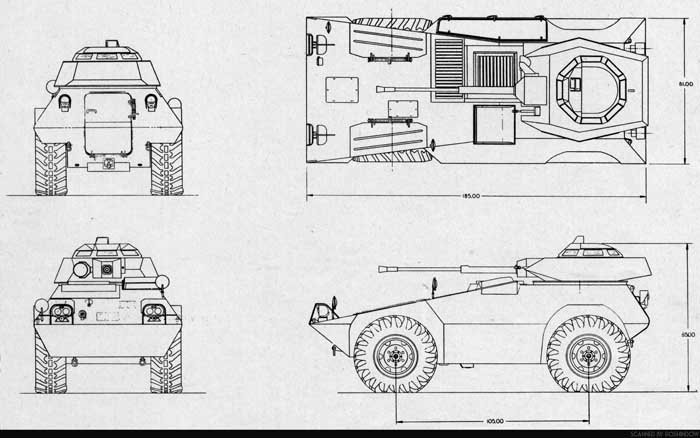
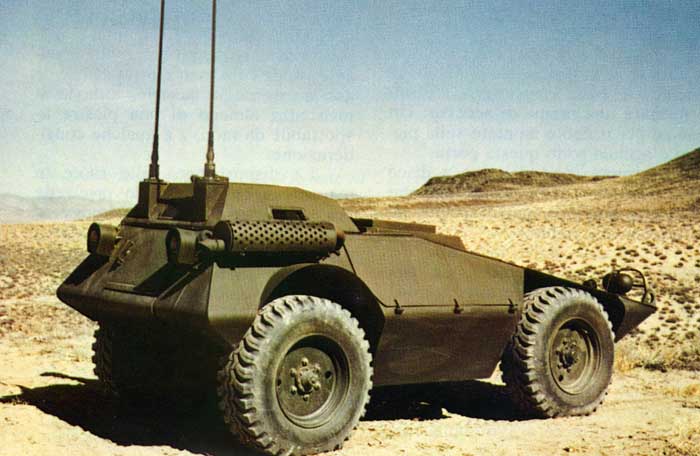
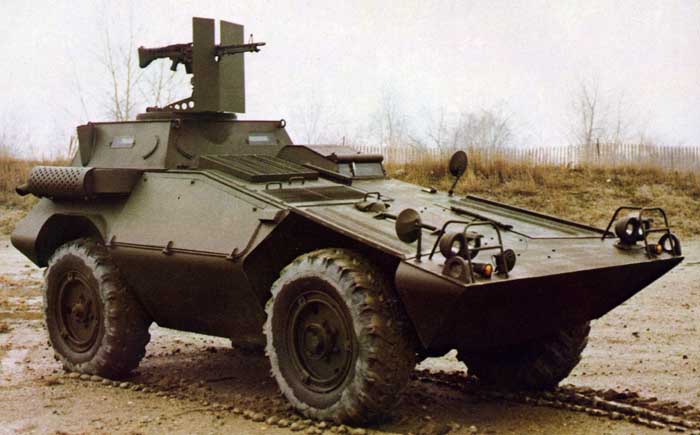
The driver in the Scout is seated on the left, with the engine on his right, with an adjustable seat, single-piece hatch cover forward-sliding when diving with his head out. When buttoned up in attack mode, he could see through three periscopes forward of the hatch covering the frontal arc. However at that time, the max size for a crew was specified not more than 1.85 meters tall, with 1.70m meters tall stated best. The fuel tank is located at the front of the hull, between the wheels, vulnerable, yet protected by the very well sloped nose and behind other items. The turret at the rear for the commander/gunner dependng on the configuration, has a two-part hatch, with the bottom part folding downwards, top opening to the right. The V150 turret procured a full panoramic dome to the commander, ideal for recce and the rear part of the hull, under the rear slope, is reserved for the radio set, with whip antennae.
Mobility

The Cummins 155 hp V6 diesel engine is coupled to an Allison Transmission 4-speed (+1 reverse) automatic transmission, via the patented Cadillac Gage power transfer unit. The complete power pack, inc. the transfer unit and cooling system were marketed to be replaced within two hours in the field. Access was facilitated by a large hatch on the hull's right side. From there, a machanic could also check all fluid levels for the coolant, lubricant, brake fluids notably.
The front suspension features coil springs over a solid axle with trailing arms. The split rear axle is tied to a heavy-duty coil spring suspension. Cone-shaped passages in the rear of the hull allow for high individual vertical roadwheel travel. Both axles are fitted with positive locking differentials which provide improved traction by preventing one wheel spin-out. Tires are 15.5" x 21" tubeless, with Hutchinson run-flat inserts which are good for 50 kilometers once flat. The 14x20 tires used by the V150 can also be used by the Scout (they have the same hub configuration on their wheels), with slighly degraded performance.
The integral hydraulic power steering is powered by a gear-driven pump working directly off the engine. This approach has eliminated the requirement for belt drives which slip or break and steering cylinders that require maintenance. The independent front and rear brake systems function through a split master cylinder and a back-up system supports them in the event of an engine failure. The back-up system consists of an electric motor which supplies pressure to the master cylinder. The tyres are of the run-flat type. Standard equipment includes two hand-held fire extinguishers stowed inside the vehicle, a pioneer toolset, a breaker bar and lug wrench, a first aid kit, a vehicle toolkit, and an air compressor with a 15.24 m hose.
Protection
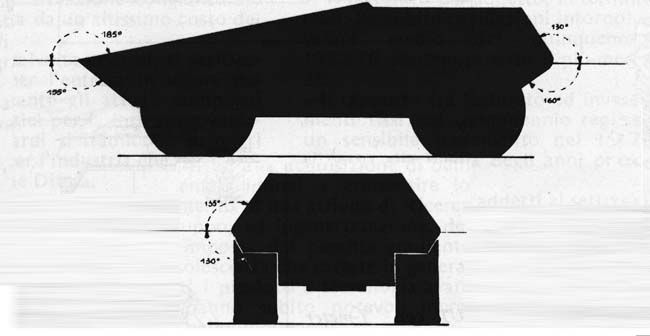
The welded hull used a special hardness "Cadloy" armour plate. It was hardened in a way to defeat at least 7.62 mm (0.25 inches) armour-piercing (AP) rounds. Front, sides and rear were well sloped to maximize protection while keeping the armour weight low, well within the overall weight of the vehicle. The front had an angle of 76° all the way to the end of the driver's hatch to the nose, 2/3 of the overall lenght. In addition of standard ballistic protection it was believed that shape would allow to push through underbrush. The NBC system, night vision equipment are proposed only in option, and it is not amphibious. However other options included a siren/public address system for corw contrl, radio installations for pure recce, extra weapon stowage, water and fuel cans, as well as a slave cable and15.24 m auxiliary cable with winges, as well as camouflage nets and smoke grenades, up to twelve total on the turret. They could also launch fragmentation grenades.
Armament
The following variants were marketed by CG when the Scout was being produced:- Command Pod Scout
- TOW Missile Scout
- 106mm Recoilless Rifle
- Twin 1m Turret
- 20mm Turret
- 40mm and 12.7 Turret
Twin/Combination Machine Gun (1 m) turret
This turret is manually/electrically rotated by a Power Assist Traverse (PAT) system and can be armed with twin 7.62 mm or twin 0.50 calibre machine guns, or a combination of 7.62 mm/0.50 calibre machine guns, which can be elevated from −10 to +55°. Manually traversed rate with PAT is a maximum of 45°/s. The amount of ammunition depends on the armament installed but if twin 7.62 mm calibre weapons are fitted each gun will be provided with 200 rounds of ready use ammunition and 2,200 rounds stowed in the vehicle. If twin 0.50 calibre weapons are fitted, each weapon has 100 rounds of ready use ammunition and 1,000 rounds stowed in the hull. It can also mount a 7.62 mm MG and a 40 mm Mark 19 grenade launcher with 100 ready rounds and 200 rounds stowed in the vehicle. The turret is also provided with eight vision blocks, an M28C sight with a magnification of x1.5 (x5 magnification optional) and a 500,000 candlepower spotlight mounted coaxially with the weapons.40 mm/12.7 mm turret
One-man turret armed as on US Marine Corps AAV7A1 armoured amphibious assault vehicles. This is armed with a 40 mm Mk 19 grenade launcher and a 12.7 mm M2 machine gun with manual traverse and elevation.Twin Machine Gun (1 m) turret
This is armed with twin 7.62 mm machine guns which can be fired singly or together and 400 rounds of ready use ammunition are carried with a further 2,200 rounds stowed in the vehicle. It has manual traverse and elevation and the weapons can be elevated from −10 to +55°. The turret is provided with eight vision blocks, and an M28C sight with a magnification of x1.5 (x5 magnification optional); a 500,000 candlepower spotlight is mounted coaxially with the weapons.Command pod
This model has a crew of three, commander, radio operator and driver and has a pod mounted on top of the hull in each side of which is a firing port and a vision block. A circular hatch cover is provided on which a 7.62 mm machine gun and shield can be mounted. There are 2,200 rounds of 7.62 mm ammunition carried. When fitted with radios the antennas are mounted at the rear of the hull.Anti-tank armed with TOW
This model has a crew of two and is fitted with a Raytheon BGM-71 TOW ATGW launcher which has a traverse of 120° and can be elevated from −10 to +30°. There are two TOW ATGWs carried inside the hull and provision for a further four missiles outside. A standard TOW ground mount is carried inside the vehicle which enables the TOW system to be deployed away from the vehicle. Two positions for mounting one 7.62 mm machine gun are also provided with 2,000 rounds of ammunition being carried for this weapon.106 mm recoilless rifle
This version incorporates a modified pod with top opening doors with armament consisting of a 106 mm M40 recoilless rifle on a 150° rotating swing mount. The weapon backblast cone has been coordinated with the slope angles of the vehicle hull to allow 10° of depression and 10° of elevation of the weapon. The 106 mm M40 recoilless rifle is aimed using a 12.7 mm barrel-mounted spotting rifle for which 100 rounds of ammunition are carried. A total of 15 rounds of 106 mm ammunition are carried for the M40 recoilless rifle.20 mm Cannon (1 m) turret
This one-man turret is armed with an Oerlikon Contraves 20 mm cannon and a 7.62 mm coaxial machine gun. Turret traverse is powered through 360° with manual back-up, while weapon elevation is from −8 to +55°, also powered with manual back-up. The turret is also fitted with an internally controlled hydraulic charger, turret ventilating blower, emergency firing triggers and a rate controller for the 20 mm weapon which allows firing of 1, 2, 4 rds/s or full automatic mode.For night surveillance a 500,000 candlepower searchlight is coaxially mounted to the 20 mm cannon. Sighting equipment consists of a x8 monocular sight and unity periscope with projected graticule, eight direct view vision blocks and an external anti-aircraft sight. The turret is designed to carry 200 rounds of ready use 20 mm ammunition and 220 rounds of ready use 7.62 mm ammunition. Hull stowage is provided for 200 rounds of 20 mm and 2,200 rounds of 7.62 mm ammunition.
CGC Scout specifications | |
| Dimensions | 5 x 2.05 x 2.16 m (16 ft 5 in x 6 ft 9 in x 7 ft 1 in) |
| Total weight, battle ready | 7,24 tons |
| Propulsion | 155 hp V6 diesel engine, Allison gearbox 4+1, pwr 20.58 hp/t |
| Suspension | 4x4 coil springs |
| Speed (road) | 55 mph (88 kph) |
| Range | Unknown, c800 km at cruise speed |
| Armament | See notes: 6 main variants. |
| Armor | c5mm Cadloy SH all round, welded RHA |
| Crew | 2-3, depending on variant |
| Total production | 140 1977-1987 |
Users
 Egypt: 112 scouts purchased after signing an order by August 1986, for US$22.8 million, half delivered in 1986 and the remainder in 1987.
 Indonesia: First customer, purchassed 28 vehicles in 1983.
For both they are still in service today.
Illustrations
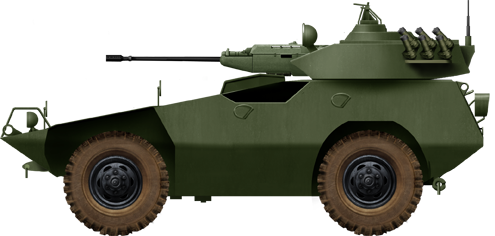
20 mm turret model
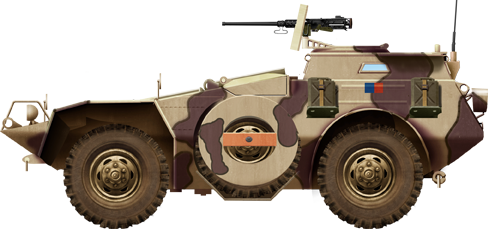
Egyptian casemate Recce version, left side
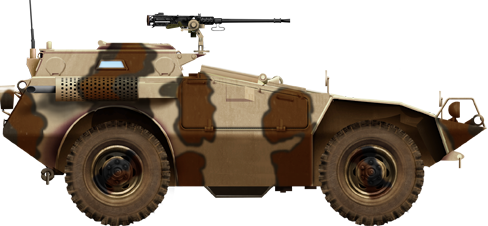
Egyptian casemate Recce version, right side
Photos


More
Books
"Eserciti e Armi" 50, July-September 1978.Foss, Christopher. Jane's Armour and Artillery 1985-1986. Jane's Publishing Co. Ltd., London 1985.
Foss, Christopher. Jane's Armour and Artillery 1994-1995. Jane's Information Group, Coulsdon 1994.
Links
forecastinternational.com/fdi.us.com
warwheels.net brochure
napcointl.com
en.wikipedia.org
Cadillac Gage Commando Scout Overview scribd
armedconflicts.com
beyondthesprues.com
reddit.com
reddit.com
Video
Models
scalemate kits: Armada Hobby 1:72, Red Tank Miniature 1:723D
Cold War Tanks


Cold war tanks posters
Cold War Main Battle Tanks
Cold War Soviet Army
Museums, Movies, Books & Games
The Tanks and Armor in pop culture
Tanks and armored vehicles in general are only really grasped when seen first person: The mass, the scale, it's all there. Explore also the way tanks were covered in the movie industry, in books and in video games.Movies:
Best tanks movie on warhistoryonline.com
On imdb.com
On bestsimilar.com/
miltours.com
liveabout.com/
watchmojo.com
Video Games:
pcgamesn.com
historyhit.com
levvvel.com
vg247.com/best-tank-games
mmobomb.com/
alienwarearena.com