Magirus M-ARW (1929)
 Germany (1926)- 1 prototype built
Introduction
In the mid-twenties, Germany secretly studied new armored vehicles for the future rearmament of the army. Over time, a projects embraced new technologies and oncerned wheeled and tracked vehicles, but especially the former, easier to disguise as police vehicles. For the second, they resumed development in USSR after an agreement between Htler and Stalin from 1933 onwards. The first new armoured cars that could be tested out in the open and even undee the eyese of the allied commission were ready before the end of the decade, the rightly named "roaring twenties". The most successful of these early armored cars was certainly the Magirus M-ARW.This secret program started with a search for optimal solutions and approaches in armoured car design based on WWI experience, and soon a concept was agreed upon of fielding the future army with series of light and medium armored vehicles differing in their appearance, specs, and intended use. Light vehicles were proposed on the cheap, based on existing automobile chassis using off-the-shelff components, with light armoured and limited armament, usable for reconnaissance. Medium armored cars however were to be better protected and armed, and thus needed their own tailored chassis, usable for fire support, and as an interim for tanks.
The MAW program
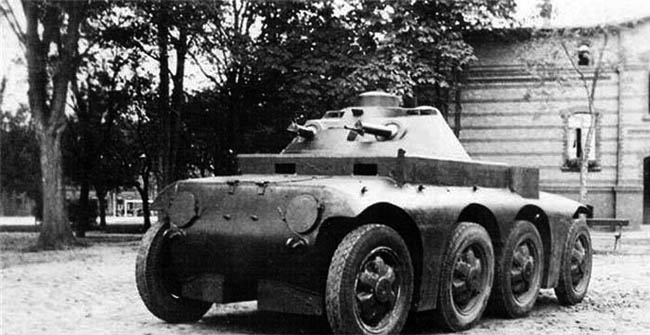
Prototype in 1931-34 at Kazan with its machine guns.
The program behind medium armored vehicles with a powerful armament, was called "Mannschafstransportwagen" appreviated as MTW loosely translated as “Transport Vehicle for Personnel”. In 1927-28, the program reached the stage of technical specifications, that were delivered to contractors judged able to build these, mosy being tractors and truck or bus manufactures. The requirements of the army were favourably received and many manufacturers answered, all leading companies, which develop their own armored car designs for submission to the Reichswehr commission. As a reminder, the whole process was completely clandestined and the specs were never public.
The program attracted three companies with solid experience in the construction of self-propelled vehicles and already combat vehicles back in WWI, Magirus, Büssing-NAG and Daimler-Benz. In 1928, three projects were selected, one by company, based on these technical specifications, gaining their own designations. Magirus project was called M-ARW. for "Magirus-Achtradwagen" or “Eight-wheeled vehicle from Magirus”.
Design of the Magirus 8x8 armoured car
In accordance with requirements, Magirus designed a new armored car from scratch, using a tailor-designed chassis able to have the best maneuverability on rough terrain as well as insulated enough for the vehicle to be fully amphibious and swim rather than just crossing rivers. Buoyancy reserve was part of the package. At the same time, a team work on the protection from small arms fire and shrapnel, another worked on the central fighting compartment and its associated turret, well protected while able to house two standard weapons. Initially there was even a small-caliber cannon and a rifle caliber machine gun. However the requirements soon met limitations in size and weight, and Magirus specialists created the M-ARW with more realistic compromises.The MAW in detail: Layout
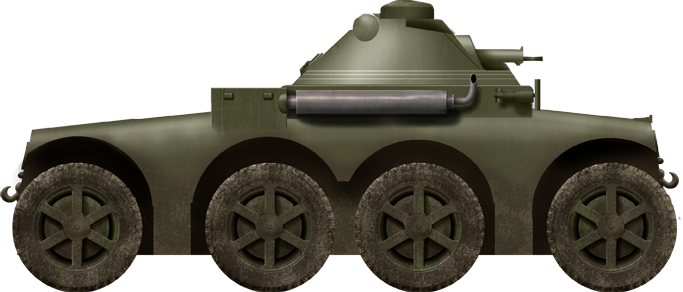
The Magirus armored had a chassis developed from scratch, to be met by a specially designed armored hull above, providing ballistic protection while not weighting too much, playing on sloped shapes and a central casemate, 8,45 meters long with a width of 2,28 m and height of 2,14 m, fully loaded combat weight of 7,8 t. The M-ARW in its final form stuck on a four-axle chassis, able to procure the necessary mobility for that level of protection over all terrains, dividing the ground pressure. There was an unusually shape armored hull not dissimilar to some contemporary Czech designs like the "turtle". The chassis carried the powerplant, axles, and crew and was both bolted and welded to a well sloped armoured upper part. This was in essence a semi-monocoque design, abandoning the classic separate between the chasss frame and hull above, to obtain notably desired characteristics of amphibian capability and protection.The chassis was modular, made of separate parts assembled together, one for each axles, a nose and stern, while the upper hull was made of large sheets in curved shapes aking for a single surface with a minimum of protruding parts. The forward compartment hosted the transmission and driver's cabin, in a central position. Note that there was a single drive forward, not a second one aft as in many armoured cars of the time, for a quick reverse. Unlike police armoured cars designed to deal with urban combat, the Magors MAR-W was designed for operations out on the open, so having plenty of space to manoeuver around. The driver had a gearbox with reverse. The central compartment, under the turret, acted as a fighting compartment, and the aft one housed the main engine and fuel.
The vehicle's hull used prefabricated elements, and was almost modular in nature, in order to facilitate mass-production. The nose had a wedge-shaped profile, with a central bend. The central part adopted curved sides all along. The upper frontal hull showed a significant slope. The central part was curved to blend with the turret. Howeve the chassis was perfectly rectangular for optimization of volumes and ease of production. It was not symmetrical as the back was quite different and the turret was not positioned exactly centrally. The lower hull in development remained unchanged. The only difference in the end of development was its increased length.
Propulsion and performances
The vehicle was powered by a Daimler-Benz M36 petrol engine rated for 100 horsepower in the aft compartment. It was connected to a 5 speeds forward, one reverse gearbox, through a complicated mechanical transmission in order to sent torque on all eight driving wheels and on the stern propeller for amphibious crossings. There were eight large, single single wheels on four axles placed near-heavenly from each other for a lower ground pressure. However the gap between the second and third wheels was reduced and so they shared a common wheel arch. The first and fourth axles were further away and directing the vehicle, unlike the center axles. These were cast aluminum wheels for a lower weight.The flattened nose sported two road light protected by shutters and there were two lifting or pulling hooks on the lower part, as well as on the back plate. The lower end of the hull, a bit boat-like for swimming, also had two rubber mud guards. There was no bumper, but a rear mirror on the right side. The driver sat there, with a small window in the squarish casemate. Two swim, there was a propeller drive aft at the bottom of the lower plate, but no rudder (direction was obtained with the wheels angle) but it had no propeller screw, stored inside and only installed before swimming. Capable of 65 hp on road, probably around 35-40 off-road and a 250 km range estimated, the Magirus M-ARW could negociate a 18° slope, climb a wall 30 cm, overcome trenches 1,15 m wide.
Protection and Armament
The entire chassis and upper curved hull had the same thickness front to back and on the side, of 13,5 mm (0.6 inches), which was way superior to the 5-6 mm found on light armoured cars. In addition the thickness was artifcially increased by the slopes, somehwat upto 20 mm and more, making it able to withstand even lightt artillery hits. It made it possible to protect the crew from rifle fire, light and heavy machine gun fire, shrapnel, and all the way to 20 mm guns on the front nose.Initially, the Magirus M-ARW included a fully protected turret with a hemispherical cap. Forward, it had embrasures for a light gun and a coaxial light machine gun. The project attracted attention from Rheinmetall-Borsig, whose employees developed a new version of the fighting compartment and turret. To increase internal volumes, the dome was reshaped as a truncated cone with a sloping roof and the light gun was abandoned and replaced by a twin LMG mount, also to disguise its military role making it more likely to be accepted for police roles, but with a provision to mount a light gun later. The final turret had a well optimized but more complicated shape, not cast but made of pre-formed sheet metal plates welded together. This turret has a small observation "head turret", and two episcopes facing forward, one for each gunner that could be seated side by side.
As said above, the initial turret was supposed to house a 37-mm gun and a 7,92 mm light MG, with a mount giving an elevation from -10 ° to + 70 °, 66 shells and 3000+ cartridges stored inside. However the second and final version of the turret instead received two ball-mounted Schwarzlose machine guns, water-cooled on independent mounts. This allowed to keep the turret in place while giving them an extra traverse. Ammunition was redfuced to 1050 cartridges for each. They were served by a crew of four or five, with the driver and assistant drivier in the front casemate, both with a rectangular hatch above. There was the commander and gunner side by side in the turret, each with their own MG, and perhaps a radio-Mechanic and reloader sitting lower in the fighting compartment. The Rheinmetall-Borsig turret had a rectangular hatch and extra viewing slots at the rear.
Magirus M-ARW specifications | |
| Dimensions | 8,45 x 2,28 x 2,14 m |
| Weight | 7,8 t fully loaded |
| Crew | 4 or 5 (driver, co-driver, 2 MG gunner, see notes). |
| Propulsion | Daimler-Benz M36 petrol, 100 hp (3 hp/ton) |
| Suspension | Torsion Bars |
| Top speed | 65 kph |
| Range | 250 km |
| Armament | 2x Schwarzlose 8 mm, 1050 rds in 250 rds belts |
| Armor | 13.5 mm (0.7 in) max. |
| Production | 1 prototype (modified) |
Fate of the Prototype
In 1928, the Reichswehr examined the three new paper projects, placing the Magirus M-ARW on its top. It appeared to have higher technical and combat potential, but the military did not embarked on any production yet and instead ordered the construction of older armored vehicles, while confirming the order for a prototype. A year later in 1929, Magirus had its first prototype model for running tests. The eight-wheeled chassis had its powertrain and transmission, but instead of the final armoured hull, had a wooden structure and ballast to reach the same weight as the prospective production vehicle. It was an angular body without turret, but with provisions for one.It passed all tests with flying colors, after which the company on its own decided to create a complete prototype. It received a new casemate, new turret of the initial conical style, assembled by the start of 1930. The vehicle was discretely moved by truck under a tarp and then by night on a train car in direction of the "Kama" military driving school at Kazan, USSR, still in full secrecy. There, the final M-ARW went on its tests on the Soviet territory and notably on the Volga landfills. Most sources points out, ads the original documentation at Magirus, to a single prototype. The initial vehicle simply ha its wooden structure replaced by the final casemate and turret before being sent in USSR.
Extensive tests lasted for several years, until the closure of the Kama school. All its advantages and shortcomings were identified fairly quickly. In between Hitler came to power and it it had promising characteristics and capabilities, this armored car was not adopted by the reischwehr in 1932. One reason was its excessive complexity for mass production, notably its armoured body made of complex curves plates, ill-suited for simplicity, its complex powertrain and eight-wheeled chassis transmission. There were also operational problems and maintenance was noticeably difficult. It was concluded that if the crew was well protected the machine-guns were of limited use for a "medium armoured car" that would be used for frontline reconnaissance combat missions. A light gun would be preferrable but that implied a complete redesign of the already complex turret, extra weight and loss in performances. Even this Schwarzlose arrangement was deemed to bulky and complex and less attractive than a light 7,92-mm machine gun and short barrel 37-mm gun for support as initially intended.
In 1932 already, the German high command decided to not further develop the M-ARW project as well as other Mannschafstransportwagen family vehicles. Tests went on however despite of this, to demonstrate the 8x8 chassis capabilities. It became a running testbed to gather data for duture 6x6 and 8x8 reconnaissance heavy armoured cars. By mid-1933, Hitler decided to close its facilities in the USSR and repatriate its vehicles, equipment and machinery, some ten tanks and one eight-wheeled armored car plus spare parts.
The Magirus M-ARW was the only German armoured car tested in the Soviet Union but did not inspired the Soviets any similar program, as its own BA-3 (1933) for example were instead based on a Ford-Timken 6x6 truck chassis. Back tp Germany the only armored car ever created by Magirus was quietly stored. Records of the vehicle stops there lost, suggesting it could have been cannibalized and scrapped later. Its achievements as part of the Mannschafstransportwagen program was at least to give a lot of data and experience to German engineers regarding design and operation of 8x8 armored vehicles. It contributed to the development of the armored cars Sd.Kfz.231 (6-rad) and Sd.Kfz.231 (8-rad) as well further down the line to the Sd.Kfz.234 in the Second World War.
Gallery
Illustration of the prototype in 1930 by the author
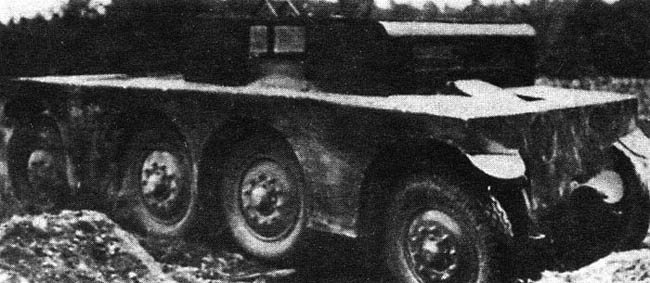
Prototype in 1929 with a wooden casemate and no turret. Note the standard wheels.
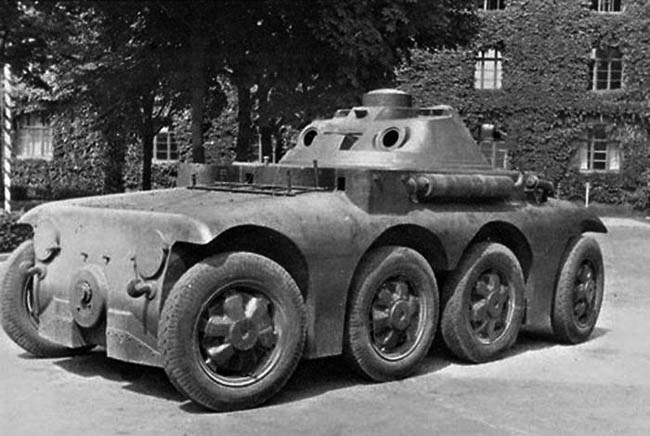
Final prototype in 1930 at Kazan, "Kama" driving School without MGs but final aluminium wheels.
Prototype in 1931-33 at Kazan with its machine guns.
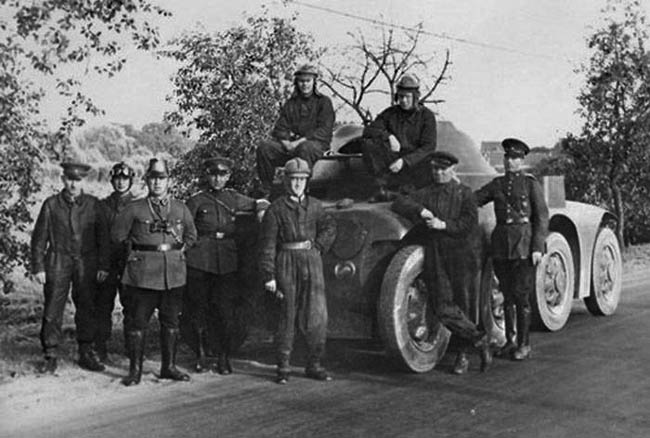
Magirus M-ARW in Kazan with the German crew posing, officers, inc. Soviet officers, date unknown
Src/Links
Chamberlain P., Doyle H. Encyclopedia of German tanks of the Second World War II 1933-1945. AST/Astrel, M .: 2003.W.Oswald "Kfz und Panzer, der Reichswehr, Wehrmacht und Bundeswehr"
aviarmor.net
ost-front.ru
secretprojects.co.uk
kfzderwehrmacht.de ARW
archive.armorama.com
tapatalk.com
kfzderwehrmacht.de (Magirus generic)
militaryimages.net
forums.kitmaker.net
shushpanzer-ru.livejournal.com
en.topwar.ru
WW2 Tanks


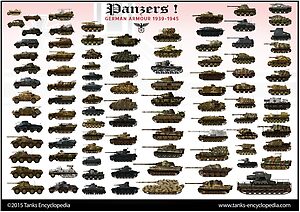
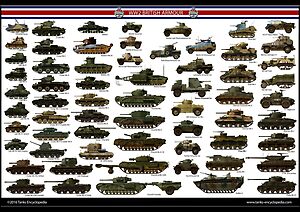
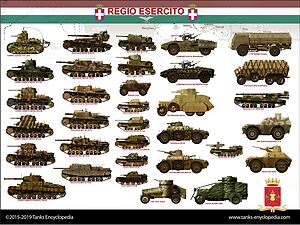
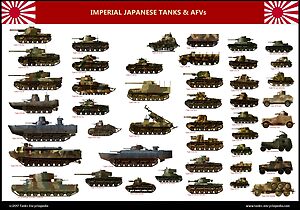
WW2 tanks posters
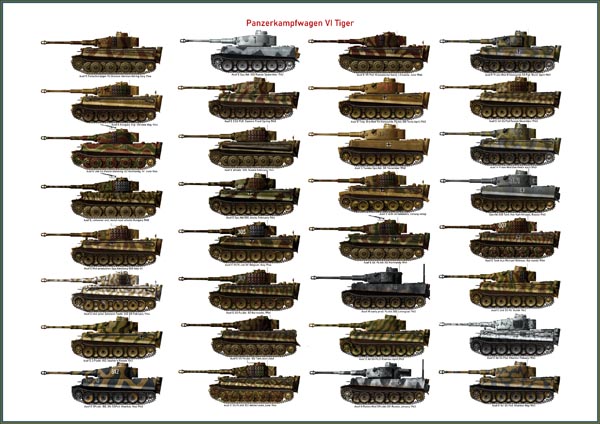
All Tiger tanks liveries.
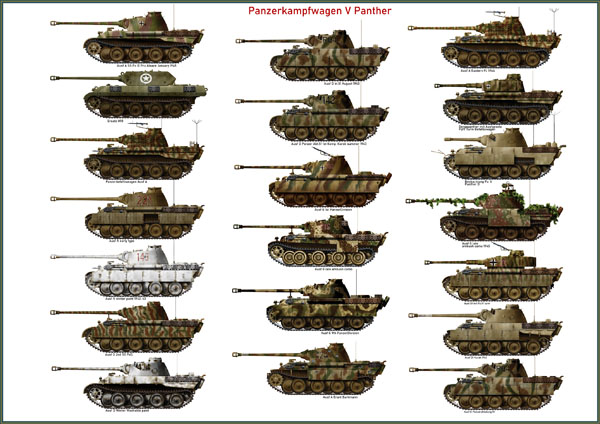
Panther liveries and variants
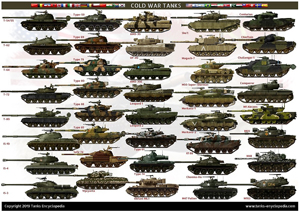
WW2 Armour - All tanks
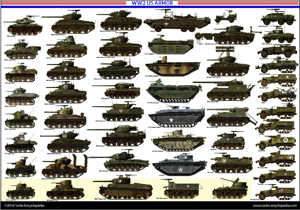
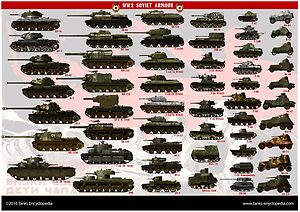

Tanks aces and single tanks series
Find more there
Museums, Movies, Books & Games
The Tanks and Armor in pop culture
Tanks and armored vehicles in general are only really grasped when seen first person: The mass, the scale, it's all there. Explore also the way tanks were covered in the movie industry, in books and in video games.Movies:
Best tanks movie on warhistoryonline.com
On imdb.com
On bestsimilar.com/
miltours.com
liveabout.com/
watchmojo.com
Video Games:
pcgamesn.com
historyhit.com
levvvel.com
vg247.com/best-tank-games
mmobomb.com/
alienwarearena.com