Sig-33 auf jagdpanzer 38(t) (1944)
 Germany (Self Propelled Howitzer)- 1 prototype built 1944 (30 ordered)
Development and Design
The German Army supervised the construction of ligfht tanks in Czechoslovakia prior to the war, and during it, the trusted and sturdy chassis of the Panzer 38(t) was adapted to a number of variants, such as the late was Jagdpanzer 38(t) Hetzer chassis. However it was soon disciovered that more chassis for this vehicle were available than its main 75 mm (2.95 in) gun could be delivered. A bottleneck, which combined with existing stocks of old 15 cm (5.9 in) s.I.G 33/2 heavy field howitzers, had some suggesting to mount them instead and create and impromtu self propelled gun always useful in counter-offensives on the Eastern Front. Infanty kept asking for artillery support.However the prototype chosen for this conversion was not a regular Hetzer chassis but the one from a Bergepanzerwagen 38(t) which seems already better tailored for the job. Soon the waffenamt designated it the 15 cm s.I.G 33/2 (Sf) auf Jagdpanzer 38(t) for "15 cm Schweres Infanteriegeschütz 33/2 Selbstfahrlafette auf Jagdpanzer 38(t)". Some authors postwar also called it the Sturmpanzer (38)t. A "Sturmpanzer" which is not accurate. It was designed indeed to follow the infantry, not precede them, due to the limited protection of the crew. This was especially true in an urban environment, and lob shells to an objectve designated by the vanguard part of the infantry.
Design of the Sig-33 auf jagdpanzer 38(t)
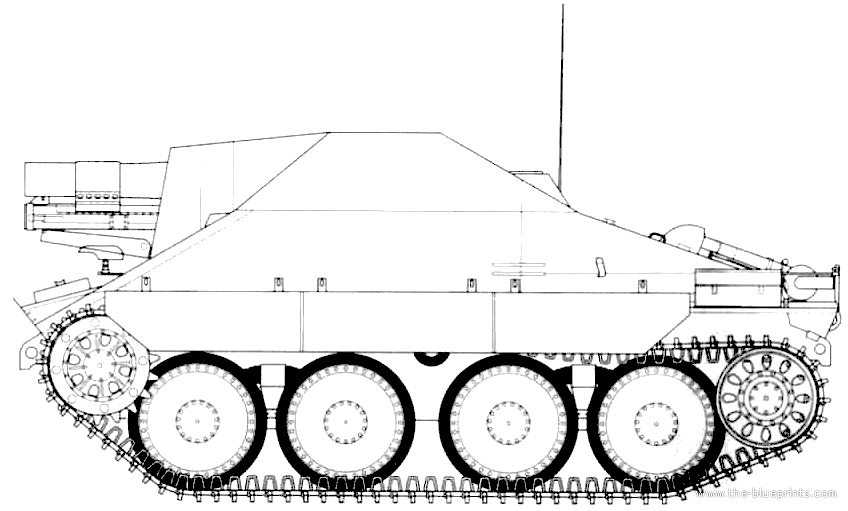
The vehicle bore some resemblances to the hetzer for the ipper armoured hull design, but this was a completely different beast. One one hand, the well sloped upper hull protected the crew well in a fully armored box, enclosed on all sides, armored roof, thick front armour to get close to the objective, typically fortified gun emplacements. For this, the howitzer had an important elevation, going all the way down to 0° ahead, thanks to a downards folding panel. When up, it protected the casemate and gun when elevated enough. The casemate was narrower, and had polygonal sections, opened to the top to enable the ordnance it's max elevation. However this upper casemate was thinly armored, only against rifle fire, unlike the lower hull. These walls prolongated the general shape of the upper hull, albeit much thinner.

There was barely enough room inside for three operators, the gun commander forward, gunner on the left side, loader to the right. Spare shells were installed inside the bucket-like shape of the lower hull, either side, protected by the drivetrain, a row of 11 on the right side. The driver, like other variants, sat on the lower left side corner of the casemate with two windows blocks in bulletproof glass. He could exit the tank ideally from the csameate behind or a trap below him if the vehicle toppled over. At the rear of the casemate were installed extra charge boxes. The rear houise the engine, like for the oriignal vehicle. Its maintenance was facilitated by three side-hinged access hatches. The large exhaust muffler sat transversely further down with a light suppression system. The protection extended to the upper sides of the drivetrain with three standard folding panels and some tooling was present on the mudguard extensions to the rear. Forward was a notek light.
The drivetrain was the same as the original Czech vehicle, a Praga 6-cylinder gasoline engine rated for 160 hp @2,800 rpm (118 kW) for a power to weight ratio in relation to its 15.7 tonnes of 10 hp/t. Suspension comprised Torsion Bars on all four axles, each with a single stamped metal wheel. The drive sprockets were forward, and idlers at the rea, with three return rollers per side and double-pin tracks. Top speed speed was 42 km/h or 26 mph and range 177 km (110 miles).
The vehicle had its howitzer as main armament, but nothing else. It relied on the personal weapons of its crew of 4, and infantry around. The 15cm sIG 33 gun was designed by Rheinmetall in 1927 and formally accepted in 1933. Its ammunition was the 2-part Gr 33 HE shell, with a warhead 8.3 kg (18 lbs) TNT, with smoke box and standard Zdlg.36 exploder system which weighted overall 38 kg (84 lbs). This was tiresome for the loader after a while, so guners and loaders often trained as a pair to rotate. The associated, lighter charge was made of six removable silk bags made of Nitroglyzerin Blättchen Pulver (nitroglycerin flaked powder) or Diglykolnitrat Blättchen Pulver (diglycolnitrate flaked powder). The gun fired this HE shell at only 4.7 km (2.89 miles – 5,140 yd), from a low muzzle velocity of 240 m/s (790 ft/s). It could be depressed to 0° but certainly not usable to fire directly on tanks.

Doyle's book 4 views of the vehicle
Sig-33 auf jagdpanzer 38(t) specs. | |
| Dimensions | 4.83 (hull) x 2.59 x 1.87 m (15’10” x 8’6″ x 6’1″) |
| Weight | 15.75 metric tonnes (34,722 lbs) |
| Crew | 4 (driver, commander, gunner, loader) |
| Propulsion | Praga 6-cyl gas. 160 hp@2,800 rpm (118 kW), 10 hp/t |
| Suspension | Torsion Bars |
| Speed | 42 km/h (26 mph) |
| Range | 177 km (110 miles) |
| Armament | 15cm (5.9 in) schweres Infanterie Geschütz 33 howitzer |
| Armor | 8-60 mm (0.3 – 2.36 in) |
| Total production | 1 (or 30) |
Fate
Between history books, museums and websites all stating thirty of them were produced, it would be easy to assume it's true, however photographs that survived of this vehicle only shows ONE factory prototype. There was indeed an official order for six and a further twenty four on a new chassis signed by December 1944 in the documentation indeed, but nothing prove they had been indeed made and delivered.In any case, they would have been assigned to the schwere infanterie-geschutz (heavy infantry gun) companies of armored infantry regiments, and no regimental records their receiption or deployment anywhere, neither any Soviet photos of captured examples. Same for Allied German military vehicle scrap yards. Spielberger went further and stated an additional 30 built between December 1944 and February 1945, used to support Panzergrenadiers, including six converted from Jagdpanzer 38(t) chassis, 24 newly built. Unless photos or documents are found in the future we can assume only the prototype was made and at some point production relayed or cancelled. Needless to say, none survived.
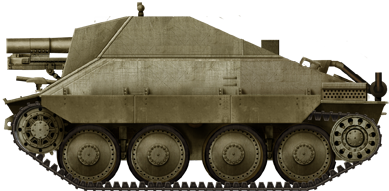
The 1944 Prototype, likely made by Alkett.
Gallery


Over view, factory prototype

Ficctional camouflage

Fictional Livery of operationally deployed on the eastern front.
Links
German Infantry Weapons – US Military Intelligence Service, Special Series No. 14, May 25, 1943.Allied Expeditionary Force German Guns – Brief Notes and Range Tables for Allied Gunners SHAEF/16527/2A/GCT July 1944
Osprey New Vanguard: The Jagdpanzer 38(t) (Doyle/Jentz/Badrocke)
Panzer Tracts 7-3, Panzerjägers (Doyle/Jentz)
Panzer-35t/38t – Spielberger
wehrmacht-history.com
archive.armorama.com
tanks-encyclopedia.com
reddit.com
forum.warthunder.com
WW2 Tanks


WW2 tanks posters
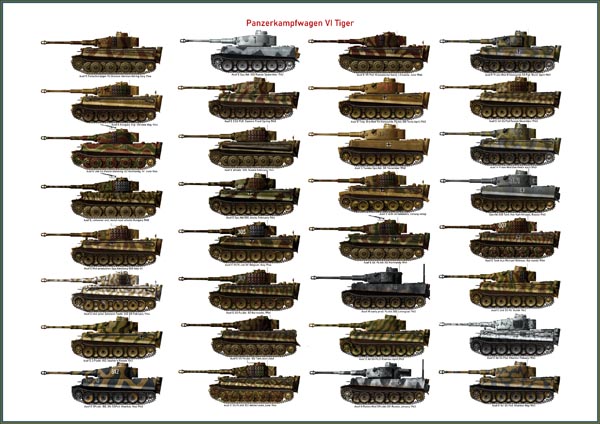
All Tiger tanks liveries.
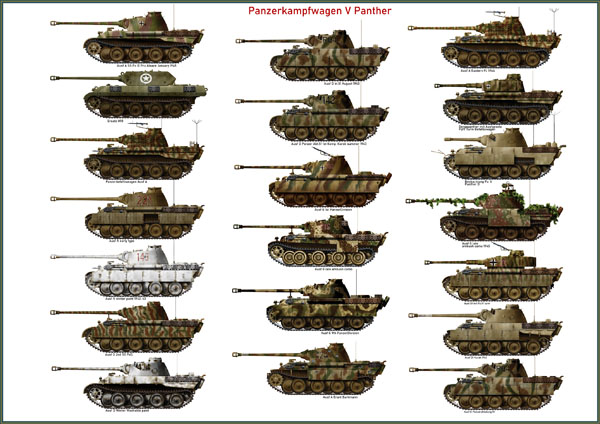
Panther liveries and variants
WW2 Armour - All tanks
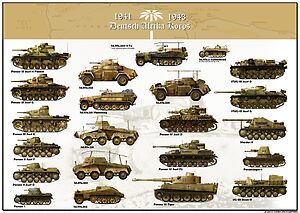

Tanks aces and single tanks series
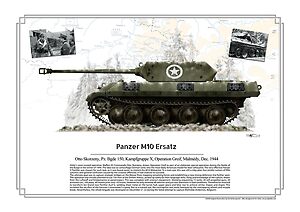
Find more there
Museums, Movies, Books & Games
The Tanks and Armor in pop culture
Tanks and armored vehicles in general are only really grasped when seen first person: The mass, the scale, it's all there. Explore also the way tanks were covered in the movie industry, in books and in video games.Movies:
Best tanks movie on warhistoryonline.com
On imdb.com
On bestsimilar.com/
miltours.com
liveabout.com/
watchmojo.com
Video Games:
pcgamesn.com
historyhit.com
levvvel.com
vg247.com/best-tank-games
mmobomb.com/
alienwarearena.com