SU-1 (1931)
 Soviet Union (1931) - 1 prototype built
Development
The start of the Samohodnaya Ustanovka
SU stands for "Samohodnaya Ustanovka" ot "self-propelled mount". This designated any and all artillery systems on self propelled chassis in USSR. It was applied to many types of vehicles, from trucks to tractors and tanks and all had a gun mounted on a mount never designed for it. It was not necessaary tracked or having a casemate, nor even armoured. English-speaking authors hiwever restrcted thus category to turretless, generally tracked, and either tank destroyers or self propelled artillery. The Russian designation for a turretless tank was "SAU" for Samohodyana Artilleriyskaya Ustanovka (self-propelled artillery mount).What complicated matter is that tanks be either TD (Tank destroyer) or SPG depending on their armament and tactical use. A good exmample would be the SU-152 and all of its successors, capable of either indirect fire with HE or direct fire at short distance on German tanks (and latter postwar NATO) with shaped charge or just HE rounds against other tanks. The latter is interesting as the SU- was followed by the caliber (152 mm) and has nothing to do with an order, which was the case for interwar SPG, such as the SU-1 here. Others were based on the tank of origin (SU-26). Which have us the SU-1 (see below), the AT-1 — "Artillery tank" (for artillery support) with a 76.2 mm PS-3 or L-7 tank gun (2 protos), SU-5-1 with a 76 mm divisional gun M1902/30 in an open-top type hull in 1934, the SU-5-2 which had a 122 mm howitzer M1910/30, same style, with 30 produced in 1936), the SU-5-3 testing the 152.4 mm divisional mortar mod. 1931 (1934), the SU-6 with a 76.2 mm 3K anti-aircraft gun (4 made in 1936) and the SU-T-26 (later SU-76P) with a 37 mm or 76.2mm regimental gun mod. 1927 with 14 made in in 1941.
Genesis of the SU-1
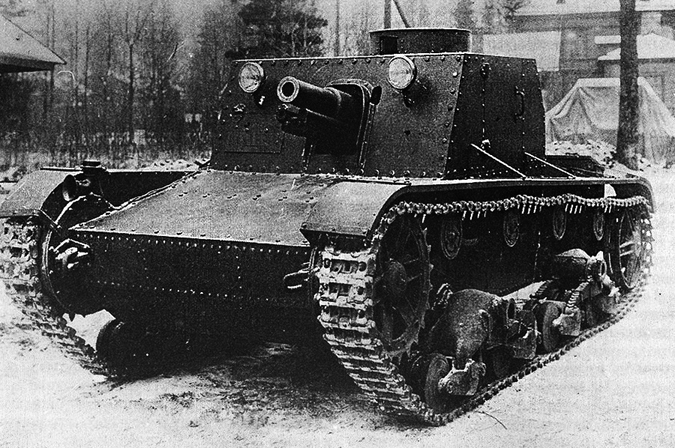
The SU-1 was the granddaddy of the SU-152, and SU/ISU-122. It was developed in 1931 on the T-26 chassis as one of the very first variants on this chassis. A casemate was fitted with a 76.2 mm short barreled model 1927 gun, located in a casemate. Gun depression/elevation was -5/23 degrees for a limited traverse of 5 degrees either way and it had had two DT machine guns for close defence, which had to share space with the main gun in the tiny casemate. It was tested in December 1931, but not ent beyond trials. trials. The drived T-26-4 had a larger casemate but never passed production. But how it started ?
At the end of 1930, in parallel with other adaptation of self propelled guns from the chassis of medium tanks such the T-24 and T-19, the NTK UMM director Lebedev wrote similar requirements for the new chassis in a Soviet-German Technical Commission. From the German side, Daimler-Benz proposed a first design, and from the Soviet side, the project was supervised by the 4th and 2nd specialized section of and look after characteristics sur as a combat weight up to 9 tons (for max a 12 tonnes divisional gun) a crew of 3-4, a 76-mm regimental gun obr.1927, divisional gun obr.1902, 11-20 mm, a speed of 30-35 kph and 180-200 km range.
Preparatory work went on, and soon get it appeared impossibl to resue the chassis of medium tanks as the T-24 production was stopped at KhPZ and the T-19 was considered too complicated to manufacture. In between Soviet authorities tested the British Vickers 6 tonnes infantry tanks (Mark E) and in the states, the Christie M1928. Both were chosen. In 1931, the project evolved in to order to meet whatever chassis would be chosen, with a modular approach. After a seach on existing hardware, the logical conclusion was to take the Vickers tank chassis, just recalassified from an infantry to a light tank, and the base became the B-26 and then T-26, compatible with a 3-inches or 76-mm guns in a self-propelled mode.
The need was great and time was short, so engineers multiplied projects from 1931 to 1934 of self-propelled guns, mostly stayting at experimental levels. The idea was to make the fewest radical changes to the design of the T-26 model 1931 in order to swap to mass production in wartime. The very first of these was logically called SU-1 after a simple order. All work on this prototype was carried out in a very short time. It started by mid-1931 and by October without mockup stage, the final prototype was transferred to the research artillery range, a the Okhta field (Rzhevsky range) to start field trials. This rushed design left a lot to be desire in quality and ergonomic though. At the very first shots, the gun failed, as its cradle was too light to absorbe the recoil of the selected ordnance. After changed in the design and repairing the gun cradle, trials continued (see the fat below).
Design
The SU-1 remained light, albeit comparable to the T26, with a combat mass of 8 tonnes and 50 kgs fully loaded. The hull measured 4,62 meters long for 2,44 meters wide and 2,1 meters hight to the top of the casemate for a ground clearance of 38cm, similar to the original tank, if a bit lower.Hull and general Layout
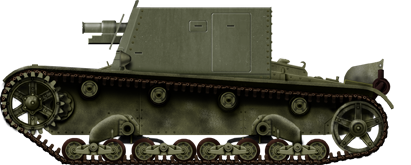
It had a crew of 4, one driver in the same position as the original tank, but seeing now through the frontal shield of the casemate. The latter was the definining feature of the vehicle. It was as large as the hull, leaving space on either side's muguard and walkways, with enough space for lockers and tools. The casemate was short in overall lenght, with a one or two lights, the gun placed in the middle of the front face, a broken back, all riveted, a simple rectangular two-piece hatch for the gunner on the left and a simple cheesebox cupola for the commander. Access was possible also from a hatch on the rear face, also used to reload the gun and evacuate spent cartridges. The cupola could receive a bracket for a LMG.The side and rear armor plates were placed almost vertically, only the front face was sloped to a limited angle angle. Along the sides there were doors for access and exit, and the commander's cupola was fixed, with a round hatch and viewing slots.
Armour protection
The forward casemate face was made of hardened steel at 13 mm in thickness of 0.5 inches, then the lower hull kept the original thickness, made of 10 mm (0.4 inches) all around, upper nose, lower nose, belly plate, back plate, engine deck, drivetrain sides. The hull nose upper plate however was also 13 mm or 0.5 inches thick, highly sloped, making for perhaps 50 mm in equivalent. The Roof was also 10 mm thick.Engine and performances
The chassis was essentially the same as the T-26, "stock", with eight double rubberized support wheels 30 cm in diameter, interlocked in pairs, supperted on axles on four balance trolleys and suspended on leaf, elliptical springs, while the tracks on top were supported by four rubberized rollers with a diameter of 25.4 cm, a guide wheel and crank tensioning system aft and forward drive sprockets with removable toothed rims for adjustment and free the tracks. The latter were 26 cm wide, made of chromium-nickel or manganese steel.The Engine was stock T-26, with a carburetor, 4-cylinder, and a capacity of 90 hp at 2,100 rpm, and tank capacity 192 liters. The transmission was of a mechanical type with main friction and dry friction shaft, a 5-speed gearbox wit its own clutches with belt brakes. The transmission consisted of a single-disk main friction clutch, and cardan shaft. The SU-1 top speed was 30 km/h on flat, 15 km/h on soft abd uneven terrain, and the range was limited to 110 km. When tested it could climb a 32° slope, climb a 0.7 meters step, ford 0.8 meters without preparation or gap a trench 2 meters wide.
Armament
The vehicle was designed to receive a regimental cannon model 1927 (GRAU index 52-P-323) mounted on a cradle borrowed from the WWI Garford armored truck. No good gun cradle was found before the BA-3. This 76.2-mm gun OBR. 1927 in the casemate was limited to a capacity of only 35 shells stacks on the sides of the casemates as there was no space at its back. There was a telescopic sight for the gunner alongide the barrel. The gun was soon upgraded. The barrel recoil length was reduced to 500 mm or 750 mm in other sources, but this did not affect the initial muzzle velocity of 381 m/s. This model 1927 was a short version of the 1913 fueld gun.It was difficult to use it as an anti-tank gun, due to its short barrel and low velocity, but only for fire support with advancing infantry and against fortifications, with an array of high-explosive or fragmentation shots. From 100 meters (328 ft) it could only penetrate 34 mm (1.3 inches), and at 2000 meters (6,560 ft) only 24 mm (0.9 inches). This help creating the tank gun KT-28, created on the same base in 1931 for the TA-1 self propelled gun. Some sources states there were two DT light machine guns, the first coaxial, but it is doubtful how the second could have been mounted. No photos showed them. We can assume the crew of four had their personal service pistols (see below).
SU-1 specs. | |
| Dimensions (L-w-h) | 4,62 x 2,44 x 2,1 meters, Clearance 38 cm |
| Total Mass | 8050 kg |
| Crew | 4: Commander, |
| Propulsion | 4-cyl. 90 hp/2100 rpm |
| Speed | 30 km/h road |
| Range | Tank cap. 192L, 110 km |
| Armament | 76.2-mm gun OBR. 1927, 35 shells |
| Armor | Nose Fwd 13 mm (0.5 in), else 10mm (0.34 in) |
| Total production | 1 Prototype 1931 |
Fate
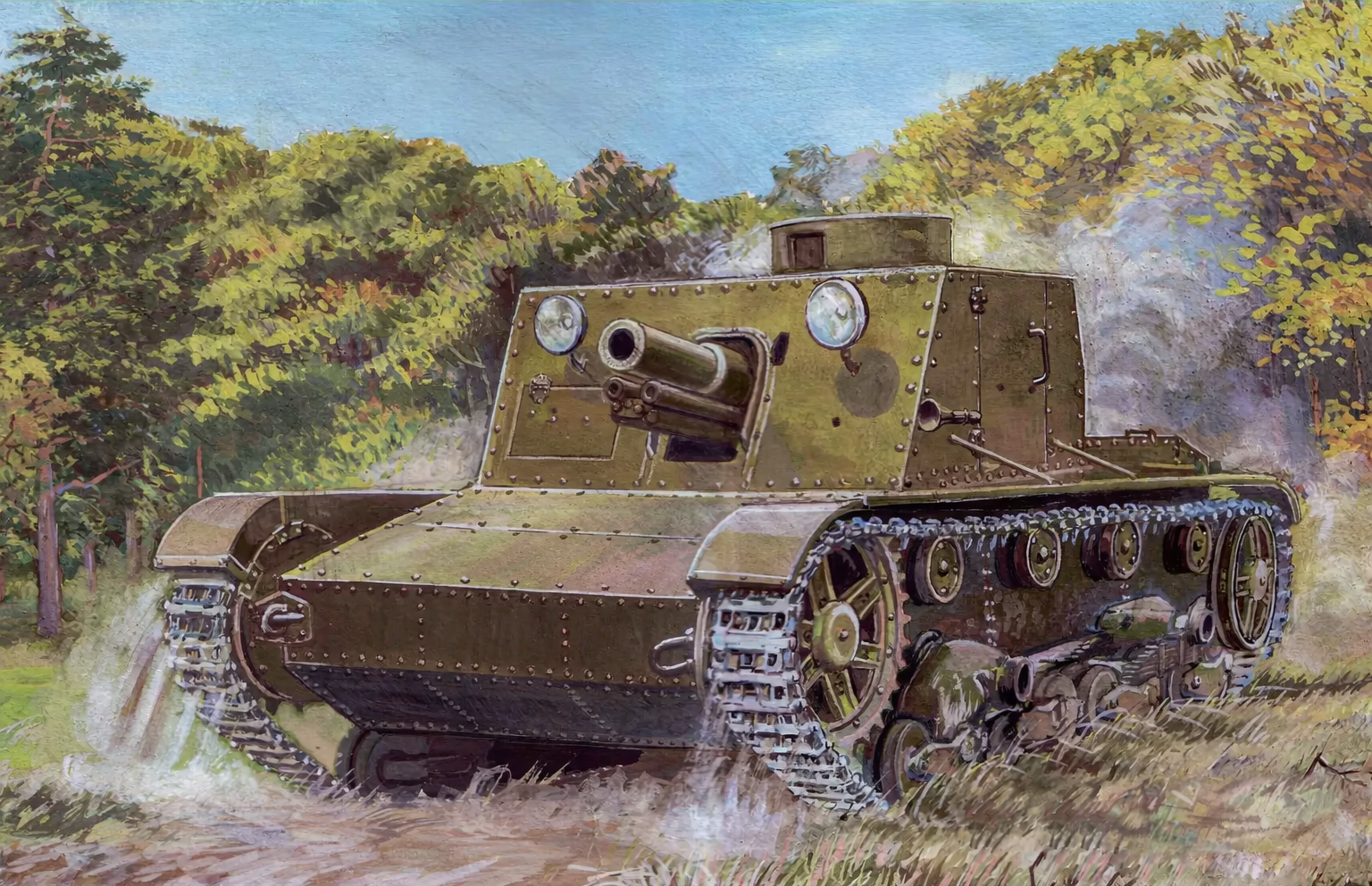
The assembly of the SU-1 casemate and ordance led to a number of design flaws showed by the first tests conducted in the autumn of 1931: The gun failed (with the recoil abnd vibration it was disloged from its cradle mount) right after the first shot. The whole installation had to be repaired and reinforced. Testers also noted many caveats by poor egonomics and space inside the casemates, poor ventilation, and the initial raw steel (non-hardened) used. In addition to the constrained space, installation of the gun was made “by eye” as well as the mount for the coaxial DT machine gun for a 150–200 meters range and spent cartriges flew freely into the fighting compartment. It was decided to removed it to resume tests.
After gunnery trials came field runs. After 30 km, off-road on rough terrain, the SU-1 showed its driving characteristics were identical to the T-26. After the gun was repaired and correctly installed, fire tests resumed, and the SU-1 proceeded to fire 41 shots, more than its internal capacity, alternated from the spot and on the move. Apart from one misfire, there were no complaints. After the mount was completely redesign, accuracy was good, albeit without suspension of the mount and stabilization, fire on the move was a bumpy and inaccurate affair. Further tests were discontinued due to the absence of ammunition for this gun.
Based on the available results in 1932, an improved design of the SU-1 was prepared. However in between the T-26-4 and AT-1 showed both better promised and were preferred. As for the German Daimler-Benz project, it was refused due its considerable delays, tested only from 1933. Its cost and over engineering made its much higher than planned. By 1936, Germany returned to this project and after using the medium tank Pz.Kpfw.III chassis, created the mother of all self propelled guns of WW2 the StuG III. The SU-1 thus was at its origin... The fate of SU-1 after its trials is incertain, as its location. It was probably scrapped and recycled at some point as nothing but rare photos survived, none in creative commons accessible on internet.
Gallery
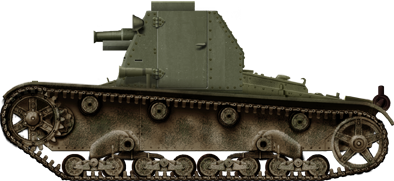
Basic SU-1 as tested in December 1931
Rendition of the AT-1 antitank variant
SU-1 in 1932 src antraspasaulinis.net
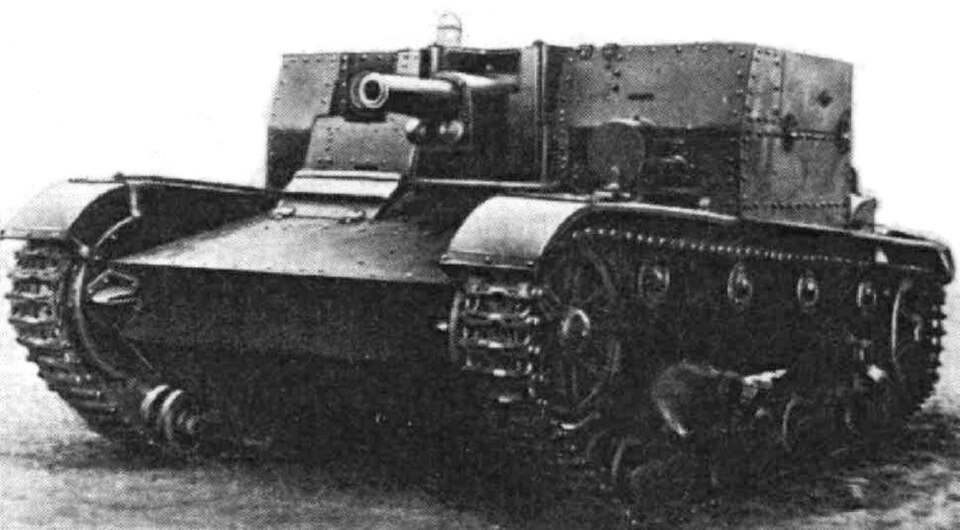
The related AT-1 which was found better
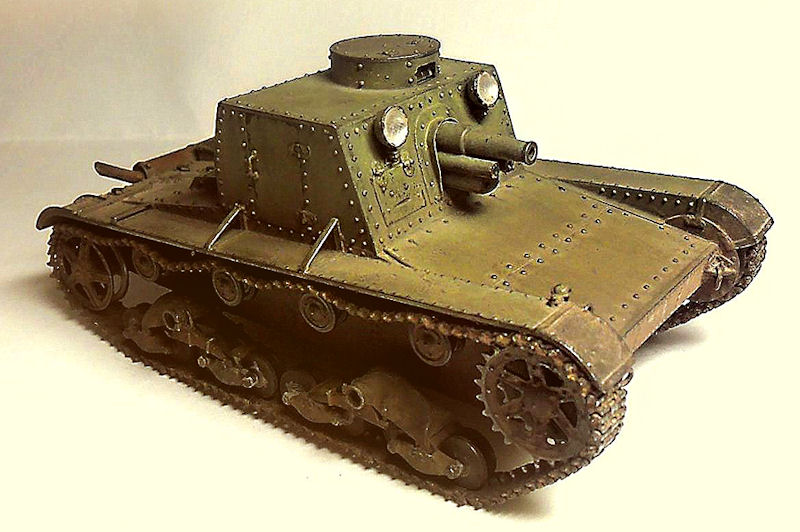
A model of the SU-1
Src read more
alternathistory.ruglobalsecurity.org
ftr-wot.blogspot.com
ebay.co.uk model kit
WW2 Tanks


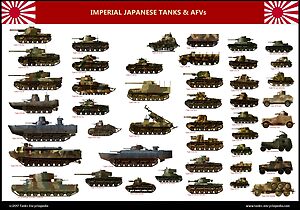
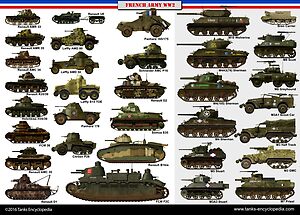
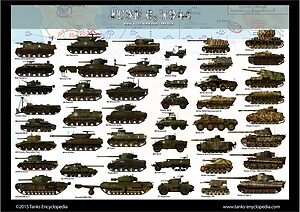
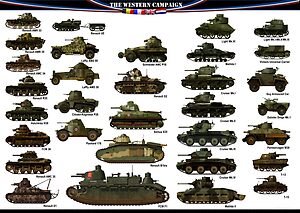
WW2 tanks posters
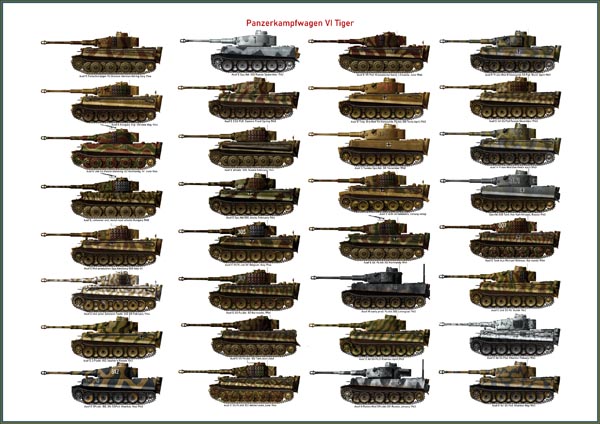
All Tiger tanks liveries.
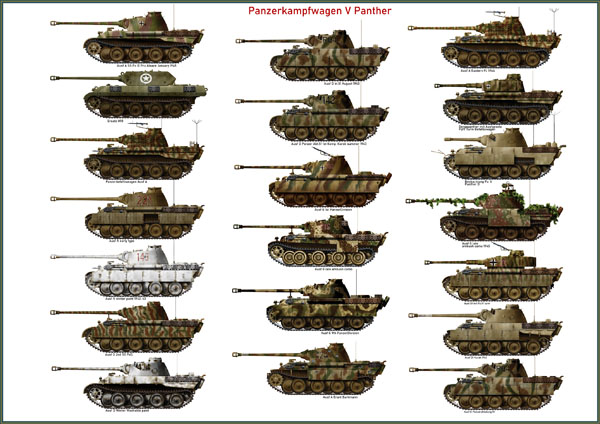
Panther liveries and variants
WW2 Armour - All tanks
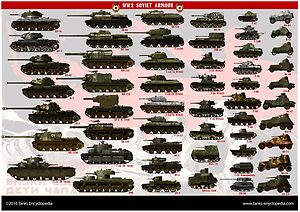
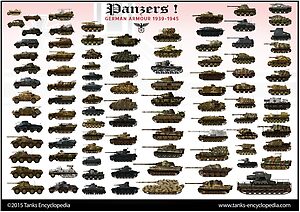
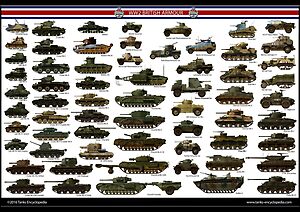
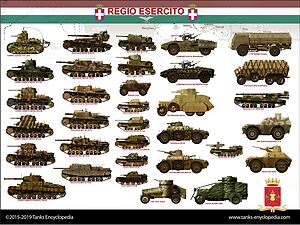
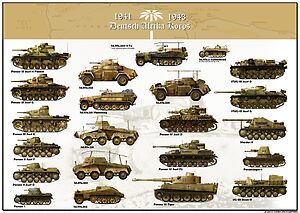

Tanks aces and single tanks series
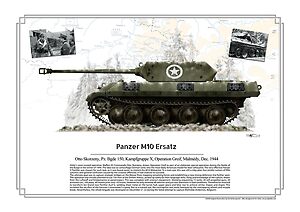
Find more there
Museums, Movies, Books & Games
The Tanks and Armor in pop culture
Tanks and armored vehicles in general are only really grasped when seen first person: The mass, the scale, it's all there. Explore also the way tanks were covered in the movie industry, in books and in video games.Movies:
Best tanks movie on warhistoryonline.com
On imdb.com
On bestsimilar.com/
miltours.com
liveabout.com/
watchmojo.com
Video Games:
pcgamesn.com
historyhit.com
levvvel.com
vg247.com/best-tank-games
mmobomb.com/
alienwarearena.com