MBV D-2 (1933)
 Self-propelled Armoured Car: 31 built.
About the MBV D-2 (short)

A captured Soviet D-2 armored railcar in Wehrmacht service. The photograph was taken on the central sector of the Eastern Front. The vehicle underwent modernization, evidenced by the installation of German-pattern rod and frame antennas.
A total of 31 production-model D-2 armored railcars were manufactured (plus one D3 and one D6) in 1932-39. During the fighting in the summer of 1941, NKVD railway security troops lost seven D-2 units; after repairs, the Germans incorporated them into their own armored trains. The remaining D-2s continued to be used by NKVD units until the end of the war and were decommissioned in the late 1940s.
The Soviet D-2 is a self-propelled, motorized armored railcar used during World War II primarily by NKVD railway protection troops. It featured a built-in internal combustion engine, dual gun turrets with 76.2mm cannons, and heavy machine-gun configurations. Armor Thickness was just bulletproof steel ranging from 10 mm to 16 mm.
The main armament consisted in two old 76.2mm model 1902/30 guns housed in two separate rotating turrets. Secondary Armament consisted in two DT machine guns coaxial left-right in the turrets, plus four Maxim machine guns in ball mounts and a dual-Maxim anti-aircraft mount over the forward turret. As a railcar, it was self-propelled, with a tiny 90 hp internal combustion engine, reaching a maximum speed of up to 75 km/h. Ammunition Capacity was 500 artillery shells and 32,000 machine gun rounds.
Around 30 serial D-2 motorized armored railcars were manufactured ahead of the war in 1941 and entereed service until the winter and early 1942. They were assigned to protect critical rail structures and lines for the NKVD. Losses and Capture: At least 7 were lost during early fighting in 1941. Two more were later captured during the 1942 advance. They were subsequently repaired, refitted, and redeployed by German forces into their own train formations: Two for example were added respectively to Panzerzug 6. All the other eight ended as Panzertreibewagon's N°17-23.
Development of the D2 Railcar

To start with, these vehicles came with many names: In Russia they are still often called today the "Dyrenkov armored railcars" (Dyrenkov MBVs) albeit their official nomenclature was the D-2 model. Albeit they were in service by 1941, development started between 1930 and 1932. This experimental design was also tested by the design bureau led by N. I. Dyrenkov (hence the name) at the Mozherez plant (Moscow Railway Repair Plant), in Moscow. These were classic self-propelled "draisines" combining artillery and machine-gun armament, both quite powerful for their class. Between 1930 and 1934, a total of 33 of these armored railcars were manufactured: 31 units of the D-2 model, along with one each of the slightly different D-3 and D-6 models, nealry all used by the NKVD railways brigades during WW2.
What is called "Motorized armored railcars" appered as a new generation of potentially self-sufficient armored trains. These self-propelled motorized armored railcars could be integrated in existing trains and operate alone, expanding tactical capabilities, by allowing all units of the armored train to maneuver and engage independently. While the development of small armored reconnaissance railcars, more complex motorized armored railcars initially faced difficulties due to their powerplant, between unreliable transmissions and underpowered units, due to the lack of prior experience.
Work started on the first Soviet large armored railcars by N. I. Dyrenkov, an energetic self-taught inventor. In the autumn of 1929, Dyrenkov presented his design for an "armored railway railcar" to the leadership of the Joint State Political Directorate (OGPU). The project was approved, and OGPU mobilized its technical department to manufacture and test a prototype intended for railway security. In January 1930, the first prototype was assembled and tested at the Izhora Plant, based on Dyrenkov’s design.
The 1930 Dyrenkov D-1 Prototype
The hull was constructed from 10–16 mm (0.3 - 0.6 inches) armor plating with four side doors, six observation hatches. Symmetrical, it had an MS-1 tank turret mounted in the center of the hull, with a standard 37mm gun, coaxial DT machine gun, commander's cupola with vision slits. The hull was made of a framing using sloped faces on all sites, secured by using angle-iron brackets. At the center of the frame was a 93-horsepower Hercules YXC autom engine (large numbers were purchased from the USA for trucks at Yaroslavl Plant). It was coupled with a worm-gear transmission designed by Dyrenkov (later designated D-35).This transmission included a reversing grear, for four speeds forward or reverse, a very important feature, like symmetrical armoured cars of the time. The running gear was limited to two railway-style bogies, one driven. The armament added to the turret, one Maxim machine gun at either end of the hull, but also two DT machine guns in the hull sides. The crew comprised 11 men: Commander, driver, gunner, two machine-gun squad leaders, six machine gunners.
Initial trials were good, but revealed issues requiring modifications. However, because Dyrenkov was occupied with designing a medium tank, work on the production D-1 model was delayed. The military took greater interest in the project in between and by January 18, 1930, the Deputy People's Commissar for Military and Naval Affairs sent a letter to OGPU Technical Department to request all the blueprints available at the Directorate of Mechanization and Motorization of the Red Army of the D1 for modifications by other engineers.
The Improved D2 and D3 (1931)
Work on the pre-production Dyrenkov’s prototype resumed in the autumn of 1930. By November the first new vehicle of that study was presented as the D-3 "Genrikh Yagoda". There was also a second prototype armored railcar, called D-2 "Vyacheslav Menzhinsky" studied at the NKPS experimental plant in February 1931. After test runs and issues solving, the D-2 and D-3 were demonstrated to the OGPU command, receving good reviews. In terms of design, D-2 resembled an enlarged D-3. Its hull was also constructed from riveted armor plating ranging from 10 to 16 mm in thickness.A commander's cab featuring an observation turret in the center was given a stroboscopic viewing device on the roof. The hull also had four observation hatches. The D2 was much larger than the D1 or D3, with a wheelbase 900 mm longer and the armament was upgraded to two short-barreled 76mm guns in turrets, four side-mounted Maxim machine guns, three DT machine guns, two coaxial in turrets, one in the commander's cupola. The guns recycle pedestals from the Garford armored car.
Production started (1932)
Representatives from the Red Army and its Directorate of Motorization and Mechanization looked for production and testing as the modernization of Red Army armored trains was also under consideration. The final production model designated D-2 was presented to the People's Commissar of Defense. and at a meeting on December 31, 1931, in a meeting of the Deputy Chairman of the Supreme Council of the Economy it was decided to manufacture no less than sixty D-2s across four factories. All needed to have fifteen completed by March 15. So that they cold equip some twenty Red Army armored railcar battalions.However shortages of alloy agents for the armored steel, as well of electrical equipment, bearings, even oxygen to cut the plates and a general lack of skilled workers, technicians, and engineers made these dates slip. The very first production D-2 had defects and on its trial run on July 17, 1932, suffered a gearbox failure.
Manufacturing
On November 1, 1932, Plant No. 1 of the OGPU Technical Department was transferred to the People's Commissariat for Railways (NKPS) and renamed "Mozherez" (Moscow Railway Repair Plant). Production was reorganized completely, concentrated in a specially organized workshop. However, Mozherez did not deliver a single D-2 before the end of the 1932. The first production model from this plant was handed over by January 1933, while the last and 15th in September.The Kaluga and Kolomna plants, already busy with other orders, did not assemble a single D-2 and eventually were relieved of this order by early 1933. By April D-2 production was taking place only at Mozherez and "Krasny Profintern". At the latter this also dragged on, so that the 15th was delivered by July 1934. Thus, a total of 30 production D-2s were manufactured in Moscow and Bryansk in 1932-1934 before it was decided to concentrate on a new model.
While preparing production, Dyrenkov proposed to the Motorized and Mechanized Forces Directorate a new and updated heavy motorized armored railcar armed with a 107mm gun. But due to heavy workload at his own bureau, already busy with new armored cars, chemical warfare vehicles, tanks, tankettes, all-terrain vehicles, and the new single-turret D-6 railcar (summer 1932), development staggered.
Dyrenkov's D6 (1932)
Construcition of the new D-6 prototype only started by September 1932, and on November 21, it was completed, powered with a 105 hp 'Hercules' engine. Its upper and lower hull sections and turrets were new, now based on turret rings, with new gun mounts, better traversing mechanism. The running gear had manual brakes and the Hercules engine was coupled with a Ya-5 gearbox and D-35 reversing gear. It was cooled by a Kommunar-type radiator have been installed. Mufflers, piping, a temporary fuel tank, temporary controls were fitted for testings and testing started by December 10, 1932. The lack of blueprints delayed completion.By this time, the military dismissed Dyrenkov under an order of November 21, 1932, the D6 was discontinued. All personnel except Dyrenkov were transferred to the Mozherez plant. To accelerate production, the 107mm gun was replaced by two 76mm Model 1902 guns in turrets like for the D-2. These changes were implemented quickly so that th D-6 started official trials early 1933.
Design
The production D-2 resembled an enlarged version of the prototype and they diverged internally by their D-35 gearbox wtih Dyrenkov’s disc clutch allowing for smoother gear shifting and dual control, mechanical and hydraulic. This makes them easier to operate on paper, but in the field, the clutch and control proved unreliable.Protection
Hull and Turrets: The D-2 hull like the one of the D-3 and D-6 was a framework on which were affixed sloped armor plates, ranging from 10 to 16 mm in thickness. The frame used angle sections. Betwee these frames there were four doors, two per side on D-3 and D-2 but just two on D-6. The hull was welded however to reduce its weight, lowering production costs. The central tower was for the commander, radio operator, and driver, made of 6 faces (hexagonal), and seven hatches with vision slits plus a roof hatch. The commander could be buttoned up with his head protruding. The cylindrical gun turrets were identical, faceted, with a lower ring partly buried in the hull. They were constructed from rolled armor plates 8–16 mm thick. The traverse was manual.Armament
D-2s had two 76 mm guns (see below) and at their right was a coaxial, independent ball mount for a DT machine gun, with an horizontal traverse of 30° either side, an elevation of 30° and depression of 20°. The hull was festooned with six Maxim machine guns, four on the sides, two in a twin anti-aircraft mount on one of the turret. Ammunition capacity was 500 shells and 32,000 rounds.Main Armament
76mm Model 1902 guns mounted in fully traversing turrets on standard armored-train pedestal mounts. The turret roofs feature a single overhead hatch within a panoramic cupola designed for the Hertz panoramic sight. The gun has a barrel length of 30 calibers; the muzzle velocity of the 7 kg high-explosive fragmentation shell is 588 m/s. Rate of fire is 10 rounds per minute. Maximum elevation is +30°, and depression is −5°. The gun's elevation mechanism is a manual sector type.Machine Guns
Six 7.62mm machine guns (excluding anti-aircraft guns on the D-2): four Maxim heavy machine guns in ball mounts along the sides of the armored hull (two per side)—with armored cooling jackets—and two DT machine guns, one in each gun turret's ball mount.AA Mount
D-2 anti-aircraft armament: an open-mounted twin machine gun mount (Model 1930) equipped with a ring-type anti-aircraft sight (Model 1929) located on one of the turrets[5]. There is no information regarding such mounts on the D-3 and D-6 models.Powerplant
A 93 hp Hercules YXC automotive engine and a D-35 gearbox are located in the center of the hull frame. Production D-2 models featured a gearbox with a Dyrenkov disc clutch, which ensured smoother gear shifting, as well as a dual control system (mechanical and hydraulic). These innovations made operating the motorized armored railcar easier, though their reliability was low.The running gear consists of two standard railway-car wheelsets, with one pair being driven. The MBV is equipped with a braking system featuring manual, pneumatic, and electric actuation
Variants
D3
By 1940, the single D-3 unit had been fitted with two turrets from T-26 tanks (1933 model), each featuring a 45 mm tank gun and a coaxial DT machine gun, along with four side-mounted Maxim machine guns.D6
The D-6 carried two 76 mm Model 1902 guns in turrets similar to those of the production D-2, plus four side-mounted Maxim machine guns.[4]Other Equipments
Communication and Observation Systems Production MBVs feature fire-control stations and an internal telephone system. Unlike the prototype D-2, production D-2s—as well as the D-3 and D-6 models—are equipped with a radio set (the 5-AK on the D-2) featuring a loop antenna mounted on the roof of the superstructure[6].Combat Use
Following factory trials and the rectification of defects, the D-3 motorized armored railcars and the second D-2 prototype were assigned to the armored division of the OGPU Central Transport Courses, which were located near the Belorussky Railway Station in Moscow at the time. On August 22, 1931, at the request of the military, Shustinsky—commander of the armored division of the OGPU Transport Department—sent a report to the UMM RKKA (Directorate of Motorization and Mechanization of the Workers' and Peasants' Red Army) regarding the results of the study and testing of experimental heavy armored railcars designed by Dyrenkov. These tests were conducted during the crew training period from July 25 to August 14, 1931:"I. Test Runs:In early 1933, Dyrenkov’s motorized armored railcars were transferred to the OGPU/NKVD, organized into "motorized armored railcar company" armored trains; with each train comprising three railcars and an armored steam locomotive. Trials revealed that the production-model D-2s handled railway curves poorly and were difficult to maintain (for instance, the turrets and upper hull section had to be removed for major overhauls of the transmission and engine); furthermore, their transmissions were unreliable and required frequent adjustment. The NKVD armored trains bore the numerical designations of the NKVD regiments responsible for guarding railway infrastructure to which they were attached.
1. The D-3 covered 1,464 km under its own power, with an average speed of 50 km/h and a top speed of 70 km/h.
2. The D-2 motorized armored railcar covered 3,247 km under its own power; of this distance, 1,128 km were covered while coupled to an armored train, and 106 km while hauling two loaded two-axle flatcars (during which wheel slippage occurred). There were no instances of engine failure or general malfunction of the railcar. The average speed of the motorized armored railcar was 45–50 km/h.
II. Firing tests.
Thirty-nine rounds were fired from each gun; no damage to the systems occurred. In conclusion, it is necessary to note the exceptional stability of the D-2 motorized armored railcar during firing—unlike the armored platforms of armored trains, where the oscillation of the entire platform averages up to 15 seconds, resulting in massive shell dispersion during rapid fire.
III. Armament of the D-2 and D-3 motorized armored railcars:
1. On the D-2, the placement of the Maxim machine guns near the driver is poor. Otherwise, all firing points are positioned effectively.
2. The armament—76mm short-barreled anti-assault guns (Model 1913)—is weak. 3. The placement of the machine gun mounts on the D-3 is poor, given that two Maxim machine guns are installed along the side, and only DT machine guns are mounted on the sides; these have limited elevation angles because the drive wheel covers obstruct movement, while the Maxim machine gun mounts have a limited horizontal field of fire due to interference from the buffers.
General observations.
1. The D-2 and D-3 armored railcars were delivered in an incomplete state:
a. Complete lack of fire control systems;
b. Absence of stowage for spare parts and ammunition;
c. Commander's cupolas partially missing vision ports/glass...
Conclusions and observations:
Regarding the design of the D-2 and D-3 armored hull: vehicle dimensions, structural strength, and a low profile relative to the rails provide exceptional stability when firing the cannons; they also feature high tractive power, respectable speed, and a heavy armament loadout. Based on the above, the following positive aspects can be noted: the D-2 and D-3 possess high mobility, significant operational range, powerful artillery and machine-gun firepower, and minimal "dead zones" (near zero). When compared to armored railcars and armored draisines of all existing types, the D-2 has no equal.
Alongside these positive aspects, there are a number of design shortcomings, specifically:
1. The need to improve the cooling system of the D-2 and D-3, which is highly unreliable.
2. The need to improve gear shifting and, if possible, simplify the vehicle's controls (currently, the control levers are awkwardly scattered).
3. The need to adjust the air brake valves.
4. On the D-3, lower the wheel covers to increase the firing angles of the four machine guns.
5. The need to improve the commander's cupola (stroboscopic turret); equip it with fire control systems, an intercom, and a radio station. 6. Equip the armored railcar with appropriate... ...ventilation. 7. Install appropriate racks for shells, ammunition, and spare parts/tools.
Regarding armament: For the D-2 armored railcar: replace the Model 1913 anti-assault guns with the more advanced Model 1903/30 or Model 1915 versions.
For the D-3 armored railcar: Redistribute the Maxim machine-gun mounts so they cover all directions rather than just the frontal arc, and relocate one to each side. The standard armament for the D-3 armored railcar should be considered one 37mm gun, four Maxim machine guns, and one to three DT machine guns. The armored railcars underwent testing in an unfinished state and lacks supporting documentation so their full combat capabilities were not completely determined. The most suitable replacement for the these flawed armored railcars are the D-2 "Menzhinsky" armored railcar.
Winter war, Finnish Front: Three NKVD motorized armored railcar company armored trains saw action on the Karelian Isthmus during the Soviet-Finnish War of 1939–1940. Each company consisted of three motorized armored railcars and an armored steam locomotive, totaling 6 guns, 12 Maxim machine guns, 6 DT machine guns, and 3 twin anti-aircraft machine-gun mounts, with a combined personnel strength of 216.
A motorized armored railcar company from the 51st Regiment of NKVD Railway Protection Troops was based at Rautu Station; it operated two motorized armored railcars in support of the 7th and 8th Armies. Motorized armored railcars from the 4th Brigade of NKVD Troops for the Protection of Especially Important Facilities also guarded supply lines, patrolling the railways and protecting them against potential Finnish saboteurs.
Operation Barbarossa: By June 1941, the NKVD divisions for the protection of railway facilities (OZhDS) included approximately 12 armored train units—specifically, companies of motorized armored railcars (MBV). According to the table of organization, these were supposed to comprise a total of 36 MBVs; this likely explains why some authors state that the NKVD possessed 36 motorized armored railcars prior to the Great Patriotic War, even though only 33 were actually transferred to the agency.
In the pre-war years, several NKVD divisions for the protection of railway facilities were formed to guard railways in border regions. Typically, each division consisted of three or four regiments, with each regiment including either a standard armored train or an armored train unit composed of a company of motorized armored railcars. The armored train's designation corresponded to that of the regiment.
They were deployed in the following areas:
- 2nd NKVD OZhDS Division: Karelia and Estonia
- 3rd NKVD OZhDS Division — Belarus
- 4th NKVD OZhDS Division — Kyiv, Chernihiv, Zhytomyr, Vinnytsia, and Odesa
- 5th NKVD OZhDS Division — Eastern Ukraine
- 9th NKVD OZhDS Division — Brest and Vilnius
- 10th NKVD OZhDS Division — Western Ukraine
- 13th NKVD OZhDS Division — Bălți, Bender, and Uman
- 24th NKVD OZhDS Division — Minsk and Smolensk
- 27th NKVD OZhDS Division — Far East
- 28th NKVD OZhDS Division — Far East
- 29th NKVD OZhDS Division — Transbaikal.
On June 26, a company from the 53rd NKVD Regiment—consisting of two motorized armored railcars and previously stationed on the Kalinin Railway—arrived in Polotsk to provide cover for the railway junction. On July 10, one of the motorized armored railcars was cut off by German forces on the Polota–Dretun line. Wehrmacht combat engineers mined and blew up the railway track. After exhausting their ammunition, the crew blew up their motorized armored railcar. Both motorized armored railcars (Nos. 53 and 76) were lost. In addition to the 3rd Division, armored trains from the 9th NKVD Division’s regiments operated along the Brest–Vilnius line. Later, they were joined by motorized armored railcars from the 24th Division on the Minsk–Smolensk axis.
Ten NKVD armored trains saw action in Belarus in June 1941. In southwestern Ukraine, motorized armored railcars and armored trains from the 4th NKVD Division’s regiments operated along the railway lines. Armored trains from Colonel Mogilyantsev’s 10th Division patrolled the railways near Lviv. In eastern Ukraine, motorized armored railcar companies from the 5th NKVD Division operated along the railway lines. As the enemy approached Kolomyia, Senior Lieutenant Turganov, commander of NKVD motorized armored railcar No. 77, received orders to blow up the bridge over the Bystrytsia River.

After rolling a wagon loaded with aerial bombs onto the bridge, the crew opened artillery fire on it; the resulting explosion destroyed the bridge. The actions of the armored train enabled units of the 12th Army’s 13th Rifle Corps to avoid encirclement. However, in early July 1941, heavy fighting broke out east of Ternopil—which had already been captured by the Germans—involving the MBV-77 armored train. German aircraft bombed the railway bridge over the Zbruch River, cutting off the retreat route for trains near Husiatyn as well as for the armored trains. German tanks crossed to the left bank of the Zbruch and reached the railway line, sparking an artillery duel between them and the armored trains. The MBV-77 fought while encircled for two days; due to damage to the railway track, it could only maneuver along a 150-meter stretch. After exhausting its ammunition, the crew blew up the locomotive and armored cars.
The last major combat engagement for the MBV D-2 at the front likely took place in late November 1941. At that time, as German forces broke through to the Moscow Canal, the Yakhroma–Dmitrov railway section was being defended by the 1st Shock Army. The 73rd Independent Armored Train of the NKVD troops served as a key source of firepower in the area, patrolling along the canal and defending the bridges. The bridges had been mined and prepared for demolition. However, on the night of November 28, German forces captured the canal bridge at Yakhroma, disarmed the explosives, and crossed to the eastern bank. That same night, Armored Train No. 73 was stationed at Verbilki, a short distance from the canal and Dmitrov.
Lieutenant General Kuznetsov, commander of the 1st Shock Army, ordered the train to move immediately to intercept and halt the German tanks that had broken across the canal. The 73rd sped toward the canal bridge. An armored locomotive sat in the middle of the train, flanked by armored platforms—each with a control platform at its front and rear. The armored train surged forward to meet the Nazi tanks. Four 76mm guns mounted on the two armored platforms opened fire; three tanks burst into flames instantly. The German column’s advance slowed. To widen the field of fire, Captain Malyshev decided to detach a self-propelled armored platform from the train; it broke away and moved toward the bridge.
Lieutenant Zhukov’s self-propelled platform fought valiantly, knocking out several tanks and destroying a tankette. Under the platform's machine-gun fire, enemy infantry scrambled from their vehicles to the ground, and many soldiers lost their lives. Enemy return fire intensified. A shell struck the armored cabin, tearing the door off its hinges and sending it crashing inward. Bardakov, the platform’s driver, lost consciousness. The first gun was put out of action and the second jammed, yet the machine-gun crews led by Sergeants Pavlovsky and Kalashnikov kept firing at the infantry, pinning them down. Ammunition was running low. Lieutenant Zhukov decided to withdraw the platform from the engagement. Day was turning to evening, but the battle raged on. Both units—the 73rd and the armored car—were targets for the enemy. In this battle, the Nazis lost 12 tanks, 24 vehicles, and at least 700 soldiers and officers.
During the first year of the war, more than 10 MBV armored railcars were lost. Seven of these were repaired and modernized by the Germans in 1944 (receiving new diesel engines and radios, as well as modified turrets). After 1942, the remaining MBV units were primarily used for railway security. For instance, the MBV unit of the 67th Regiment (29th NKVD Railway Security Division)—comprising three non-standard armored railcars (the second prototype D-2, the D-3, and the D-6)—guarded tunnels on the Circum-Baikal Railway near Slyudyanka station throughout the war.
Other units were deployed in the Far East and Transbaikal regions: the MBV unit of the 68th Regiment (29th NKVD Railway Security Division) near Olovyannaya station (southwest of Chita); the training MBV unit of the 69th Regiment near Ukurey station (east of Chita); the MBV unit of the 70th Regiment near Kuybyshevka station (northeast of Blagoveshchensk); the MBV unit of the 71st Regiment (27th NKVD Railway Security Division) near Vyazemskaya station (south of Khabarovsk); and the MBV unit of the 72nd Regiment (27th NKVD Railway Security Division) near Voroshilov station (now Ussuriysk in Primorsky Krai). The remaining D-2, D-3, and D-6 units—along with the D-2 prototype—remained in service with NKVD units until the end of the Great Patriotic War and were decommissioned in the late 1940s.
Conclusion
Motorized armored railcars (MBVs) surpassed armored trains in terms of their lower silhouette and maneuverability—factors that often determined a vehicle's survival in combat. An MBV carried armament equivalent to that of one or two armored train cars. While offering high firepower density and maneuverability, the MBV was incapable of effectively engaging tanks, artillery, or aircraft; it was suited only for combating enemy infantry and firing points, and for protecting railway infrastructure.
Although its design addressed the threat of air attack—to which railway rolling stock is particularly vulnerable due to its fixed path—the rifle-caliber anti-aircraft machine guns provided inadequate protection. High speed allowed for active maneuvering. Another advantage was the absence of smoke, which often betrayed the position of steam-powered armored trains. While armored rail-motorcars (draisines) shared these traits, the MBV surpassed them in firepower.
However, the MBV featured relatively weak armor, protecting it only against bullets and shell fragments. Given its substantial size, this posed a potential vulnerability. Yet, at the time of the MBV's design and construction, its 16mm armor (set at a slight angle) was comparable to the average armor thickness of tanks (for instance, the T-26 models produced before 1933 and the BT-5 had a primary armor thickness of 13mm). The MBV's transmission suffered from poor reliability and could not withstand prolonged operation; consequently, MBV companies were assigned an armored or standard steam locomotive, leading to their designation as "MBV-company armored trains".
Gallery
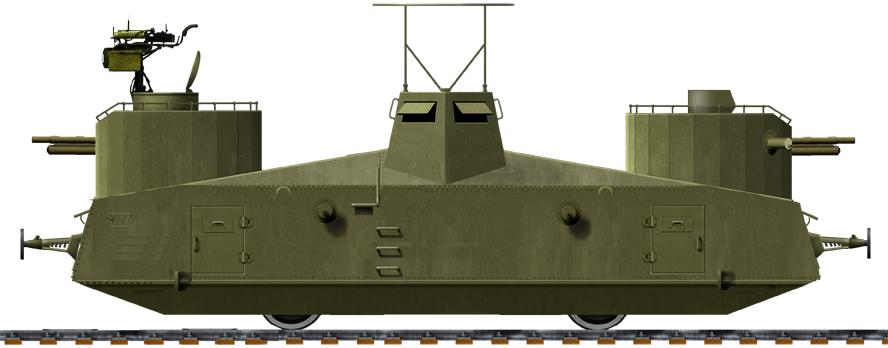
Author's rendition of a standard wartime D2 Railcar used by the NKVD. More to come.


Sources
Baryatinsky M. Super-tank on Rails. — Moscow: Modelist-Konstruktor, 1998Drogovoz I. Fortresses on Wheels: A History of Armored Trains. — Minsk: Harvest, 2002.
Efimyev A. V., Manzhosov A. N., Sidorov P. F. Armored Trains in the Great Patriotic War of 1941–1945. Moscow: Transport, 1992
Kolomiyets M. Domestic Armored Draisines and Motorized Armored Railcars. Moscow: Strategiya KM, 2005.
Kolomiyets M. Armored Trains of the Great Patriotic War: "Land Battleships" of the Red Army. Moscow: Yauza, 2010.
reddit.com
warhistoryonline.com
nevsedoma.com.ua
waralbum.ru
reddit.com
wio.ru
ru.wikipedia.org
francis-maks.livejournal.com
vk.ru
ru.ruwiki.ru/wiki
alternathistory.ru
ru.wikipedia.org
starcom68.livejournal.com
starcom68.livejournal.com
vk.ru
- Baldwin Railroad battery 1861
- No 6 Garrison Arm. Train 1894
- Ladysmith Train 1899
- Crewe Works 1915 coastal train
- French mobile artillery battery (1914)
- Royal Navy armoured Train 1914
- Regia Marina Arm. Trains 1915-18
- Ajmer arm. trains 1916
- Hungarian MAVAG train
- German Panzerzug Ost (1916)
- Bolshevik Armored Tram 1917
- Finnish Arm. Train (1918)
- Zaamurets (Orlík, BP-4, Lenin)
- Khunkhuz
- General Annenkov
- Yenisei
- Amur
- Terek
- Don
- Dywizja Syberyjska trains 1918
- Kozak
- Piłsudczyk
- PP3
- Gromobój
- Pionier
- Śmiały
- Lis-Kula
- Hallerczyk
- Stefan Batory
- Generał Iwaszkiewicz
- Chrobry
- Wilk
- Danuta
- Poznańczyk
- Kaniów
- Zawisza Czarny
- Zagończyk
- Paderewski
- Mściciel
- Reduta Ordona
- Huragan
- Podhalanin
- Bartosz Głowacki
- Pierwszy Marszałek
- Groźny
- Śmierć
- Śmigły
- Stefan Czarniecki
- Generał Sosnkowski
- Putilov armoured trains
- Izhorskiy Armored Train
- Czechoslovak Legion Trains
- Estonian Trains
- Lithuanian Trains
- Zhang Zongchang Train
- Danuta
- Poznańczyk
- Generał Sosnkowski
- Paderewski
- Śmierć
- Pierwszy Marszałek
- Piłsudczyk
- Śmiały
- Groźny
- Bartosz Głowacki
- Smok Kaszubski
- Drezyna R
- Drezyna TK/TKS
- UK dywizjon Trains
- SOK Draisines 1945
- Arm. draisine Crochat
- Austro-Daimler Draisine
- Armoured draisine Tatra T18
- MBV-2 Rail cruiser
- D-2 Draisine (MBV-31)
- D-37 Draisines
- Krasnaja Zvezda (KZ-1)
- D-3 Draisines
- BTD heavy Draisines (5)
- CB-1 Draisines
- DT-45 Draisines
- BD-41 Draisines (12)
- BA-I-Zhd Railcar
- BA-6ZhD Railcar
- BA-20ZhD Railcar
- BA-10Zhd Railcar
- VS-60 Train/Wagon
- BP-35L/H Train
- NKPS-42/Wagon Train (40)
- PL-35 Arty Wagon
- PL-37 Arty Wagon
- PT-35 Arty Wagon
- KV-1 Arty Wagon
- Crimean 76mm univ. Wagon
- "Tank" Wagon
- BP-42 Train/PL-42 Wagon (10)
- BP-43 Train/Wagon (54)
- 7.62mm Maxim SPU-BP Flak wagon (28)
- 37mm PVO-4 FLAK Wagon (120)
- OB-3 Light Wagon
- 27th Div armoured Trains
- 29th Div armoured Trains
- 48th Arm. Div armoured Trains
- "Stalinets" armoured Train
- "Mir Jafar Bagirov" armoured Train
- "Kozma Minin" armoured Train
- "Dzerzhinets" armoured Train
- "Za Rodinu!" armoured Train
- "Kolomensky Rabochy" armoured Train
- Zenitnyy (AA) armoured Trains
- Goering's Asien
- BP42 armoured train (full)
- BP44 armoured train (full)
- Panzerjägerwagen BP44
- BR 52, Steyr Schwerer Schienen Panzer
- Schwerer gustav Train
- P204(f) rail tank
- Schienenkampfwagen SK 1
- Schwerer Spähzug (s.Sp.) Artilleriewagen
- LeichteSchienenkampfwagen 43
- Zeppelin Panzer Draisine
- Panzertriebwagen N17
- Panzertriebwagen N16
- Panzer Draisine Funkwagen
- Panzerdraisine/Pz.III turm
- Panzerdraisine/Pz.IV turm
- Panzer Draisine Le.Sp.
- Panzer Draisine Flakvierling
- S.Panzer Draisine Kugelblitz
- L2670 leichtes panzertriebwagen
- AB Ferroviana
- Littorina OM 36
- LiBli 42
- Type K2 Steam Locomotive No.134
- Type C56 Steam Locomotive No.31
- Type 90 240 mm Railway Cannon (Futtsu Cannon)
- Type 91 Broad-gauge Railroad Tractor (So-Mo)
- Type 94 Armoured Train
- Type 95 Armoured Railroad Car (So-Ki)
- Type 98 Railroad Tractor
- Type 100 Railroad Tractor
- Type 2598 Railroad Car
- Rinji Soko Ressha 1933
- 1940 coastal defence Trains
- Royal Armoured Corps Trains
- Romney, Hythe and Dymchurch Train
- Malaya Arm. train 1942
- 101-104. sz. páncélvonat
- Finnish Winter War Train
- Croatian Armored Train
- Can. Aleutian No.1 Armoured Train
- Slovak resistance armoured train
- Iraqi armoured train (1941)
- Polish 1945-55 trains
- Arm. train La Rafale 1948
- Tren Blindado 1958
- Panser Rel V16 (1955)
- White Train 1957-87
- RT-23 Molodets ballistic wagon
- Trans-Siberian Arm. Train 1970
- North Korean Arm. Train
- Krajina express 1990
- Volga (2022)
- Baikal (2022)
19th Cent. Trains
WW1 Armored Trains
 Poland
Interwar Armored Trains
WW2 Armored Trains
 France
 Austria
 Czechoslovakia
USSR
 Nazi Germany
 Italy
Italy
 IJA
IJA
 UK
UK
 Others
☢ Cold war Armored Trains
References
blog.railwaymuseum.org.ukarmedconflicts.com Russian Trains
warhistoryonline.com
feldgrau.com ww2 german trains
cuttersguide.com
wikipedia.org/wiki/Armoured_trains_of_Poland
derela.pl/drais
derela.pl/tatra.htm