ATF Dingo (1994)
 Germany (1994) 147 Dingo 1 and 1,000+ Dingo 2, ongoing.

Development
IFOR and the 1994 context
Before 1991 and the fall of USSR and reunion of Germany (East and West), the Bundeswehr rarely deployed overseas its army by principle, albeit assets could be sent for disaster relief. In fact there absence of Combat/UN Mandates prevented the Bundeswehr to even take part in UN blue-helmet peacekeeping missions or foreign military interventions until after German reunification and the 1994 Constitutional Court ruling. But its first major military out-of-area deployment occurred during the 1991 Gulf War. Under IFOR, the army was deployed for the firts time in number out of national frontiers: The IFOR (Implementation Force) mission marked a historic turning point for Germany. After signing of the Dayton Peace Accords to end the Bosnian War, the German Bundestag voted decisively on December 6, 1995, to contribute troops to the NATO-led multinational force. Germany deployed approximately 2,700 soldiers as part of the multinational coalition but this remained highly sensitive at the time, so it was restricted to logistics, medical support, engineering, and air reconnaissance. Most German personnel were stationed outside Bosnia itself, operating primarily out of a major logistics base established in Trogir/Split, Croatia.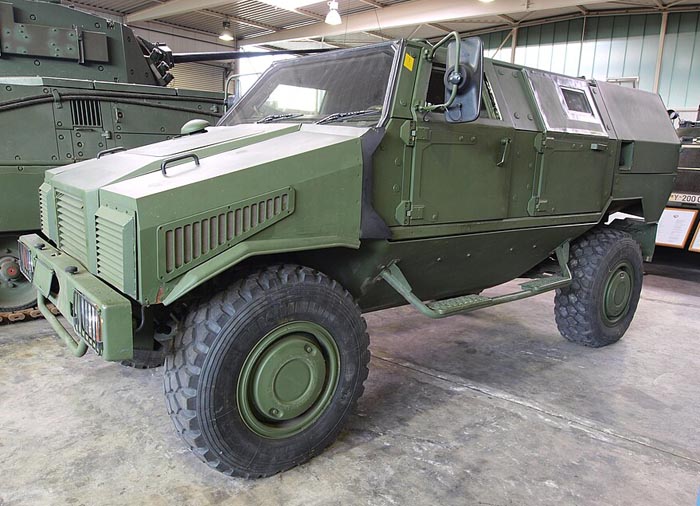
ATF Prototype
With its deployment under IFOR, a need arose for vehicles specifically protected against anti-tank mines. Up-armoring existing platforms such as the 6x6 Fuchs or MAN G1 cross-country truck, of the Mercedes-Benz G-Class "Wolf" fitted wth a modular protection kit (Modulare Schutzausstattung/MSA) became readily available interim solution. But they failed against anti-personnel mines and small-arms fire. The Fuchs was too large to operate in areas with narrow roads or bridges, the "Wolf" still had an inadequate level of protection for patrol duties. So the Bundeswehr’s armaments division ("Armaments Task 41, Ballistic Protection") lanched a procurement program to develop a mine deflector. It drew on the experience of South Africa with V-shaped blast deflectors which started to be available in 1990.
The armaments division of Krauss-Maffei collaborated with Ingenieurbüro Deisenroth to integrat one such V-shaped deflector onto a naked Unimog U 100 L chassis for blast tests. KG II 5 (former Federal Office for Defense Technology and Procurement or "Bundesamt für Wehrtechnik und Beschaffung" also tookpart in the program. The chassis was then transformed into a fully-flegded vehicle called the ATF 1, optimized for off-road travel and compatible with tactical air transport. The design core was a reinforced safety cell providing the crew with protection against mines and armor-piercing rounds from snipers. The vehicle was developed for trials in a few months.
However, evaluations in 1995 revealed shortcomings both in the chassis and running gear. Driving characteristics were also poor. The ATF 1 remained a prototype, no producgtion was made or deployed in Bosnia-Kosovo. The original chassis indeed appeared too short and unstable, leading to the adoption of a longer U 1550 L chassis. The new prototype was named ATF 2. It offered a higher payload and had superior mobility and maneuverability in off-road conditions. Internal factory testing and evaluations followed in technical testing agencies for qualifications. However, the ATF 2 prototype as shown at the military training schools failed against the the more promising GTK Boxer then under development.
1999: The production is voted
However, as Krauss-Maffei Wegmann (KNDS Deutschland from April 2024) looked for a new project after the cancellation of the "Superfuchs" program, following a landmine incident that destroyed a TPz Fuchs in Macedonia, the company answered the call from the State Secretary for Armaments for the procurement of MRAPs. The Armaments Division of the Federal Ministry of Defence also favored the existing ATF 2 over foreign alternatives. So by October 18, 1999, the project was commissioned as an "urgent operational requirement" and budgeted for 42 million DM, approved three days later on October 21, by the Federal Minister of Defence, Rudolf Scharping. The Budget Committee approved this in turn by December 15, 1999 and KMW was awarded the contract on the 16th to provide a first pre-production test batch of 56 ATF "Dingo". The name remained in the tradition of canine beasts for soft-skinned vehicles, this drew inspiration from the free-ranging wild dog of Australia.Deliveries started from August 24, 2000, for the first two and a large portion was sent directly to operational units in Kosovo (KFOR) and Macedonia for field testing in real conditions. This experience led to several modifications:
-The storage box mounting was too fragile and had to be reinforced.
-The suspension was too soft and unable to cope with the Dingo’s increased weight compared to the Unimog
-Other minor adjustments were made to the equipment to improve ease of maintenance and safety.
However reports were globally positive, with high levels of acceptance among troopers. So the Bundeswehr decided in November 2001 to order a second batch of 57 vehicles. A third followed in March 2002 for a total of 147. Production ceased however after DaimlerChrysler removed the U-1550-L chassis from its product range. This forced KMW to develop its own chassis in 2002.
2002: ATF-3 (Dingo 2)
Designated ATF 3 (Dingo 2) a new vehicle was developed by KMW using the Unimog U-5000 chassis as a base, heavily modified, with a higher axle load, enabling a more robust safety cell for extra protection. The two prototypes were delivered for tests to the Federal Office for Defense Technology and Procurement. They were characterized by their longer wheelbase (3,850 mm), and one pre-production vehicle with a short wheelbase (3,250 mm). Between November 2003 and May 2004, the two long-wheelbase pre-production vehicles underwent intensive testing by KMW and the Bundeswehr’s technical testing agencies. Results were positive.The Bundeswehr thus ordered a first batch of 52 long-wheelbase "Patrol and Security Vehicles" (PatSi) under the "GE A1" variant in 2005 for a cost of 36 million euros. By late 2005, KMW received a contract from BWB to supply a Dingo 2 demonstrator for the "Class 3" protection program called GFF (Protected Command and Functional Vehicle). A further 149 under the new GE A2 variant followed with deliveries starting by June 29, 2006, some 12 years after the global program started. 15 fell under the "urgent operational requirements" to de deployed in Afghanistan, under a global cost of 109 million euros. Procurement was accelerated in 2007 with 100 more delivered instead of the 33 originally planned. In 2006, the Bundeswehr imposed a temporary ban after reported brake failure and front axle catching fire due to overheating. KMW and DaimlerChrysler flew mechanics to Kabul for troubleshooting. The final proce of the Dingo 2 was stated as €600,000 and 1 million euros by combing equipment.
In July 2006, a new contract was awarded for 78 Dingo 2 as carrier platforms for the EADS Ground Surveillance Radar (BÜR), to replace the RASIT and ABRA systems. Organically they would be deployed and procure awareness for ground and low-altitude airspace, specifically to detect asymmetric threats like roaming insurgent technicals. By late 2009, two system demonstrators were delivered for validation with a serie scheduled to start by 2012, but pushed down due to budget cuts until 2021 (69 of the Bodengebundenes Aufklärungs- und Raumüberwachungssystem were then ordered).
By June 26, 2008, the German Bundestag approved procurement for 98 Dingo 2, including 50 under the GE A2.3 variant, four repair vehicles ("Battle Damage Repair and Maintenance" or GSI/WtgTrp) variants and forty-four 44 GE C1 variants. On April 6, 2010, BWB ordered extra optional units, handed over to the Bundeswehr around November-December. Back in 2009, the Bundespolizei also ordered two vehicles to be deployed in Kabul by its "Task Force for Protection Duties in Crisis Areas" (ASSIK). 34 more of the GE A2.3 variant fitted with the new FLW 100 and 200 remote weapon stations (RWS) were also ordered in 2009, and 41 GE A2.3 as APCs (MG armed) delivered on March 29, 2010.
By September 2011, in a defense exhibition in London, KMW unveiled a its latest a and heaviest variant, capable of carrying three tonnes for a total of 14.5 tonnes. On June 4, 2012, KMW was awarded another order for 79 Dingo 2 APCs. Thus, the 1000th Dingo was delivered and celebrated as such on June 20, 2013, in a ceremony to Christian Schmidt, MoD State Secretary. KMW extended its catalog to some 16 official variants.
Missions
The primary roles of the ATF Dingo are convoy and patrol operations on reasonably firm terrain, peace support operations, in areas where the threat of landmines exists. As all MRAPs it provided exceptional level of mine protection for its weight class, in relatively compact dimensions also enabling use in densely built-up urban environments. Protecting its crew as top priority also comprises the use of a remotelly operate weapon system. Conversely the Dingo is also well-suited for operations in moderate to difficult terrain unlike the TPz Fuchs, with a higher center of gravity, four wheels, softer suspension system, and also air-transportable via Transall C-160 medium transport (as well as C130 Hercules and larger like the A400M) at the same time as infantry units.
Dingo used for transport on trials (pinterest)
Design
Chassis & Protection
The ATF Dingo 1 features a modular design consisting the chassis, protective cell, storage compartment, engine compartment, and mine deflector. All these are connected solely via the chassis and mounted in a flexible way to diffuse blast force. The Dingo 2 differs by a mine deflector integrated into the protective cell. The Dingo 2 GE A2.3 improved with enhancements to the base armor. The chassis has run-flat tires enabling to run 40 km at max 50 km/h, with a tyre punctured or ripped off. Its low weight relative to its protection rests on angled and deflecting armor elements. Indeed all Surfaces vulnerable to hits like windows are sloped at a 20° angle, making up to 30° resistance at upper angles.The same principle applies to the mine deflector below, and angled armor require much thicker armor plating to resist and deflect a blast. Featuring a V-shaped profile and positioned beneath the protective cell it also consists of several layers of specialized protective materials (MEXAS armor) in order to deflects 50% energy from a potential mine or IED blast, redirecting the force to the sides and ensuring the safety cell survival from below. The engine compartment is located on the chassis forward of the protective cell and still benefits from plating string enough to cope with direct small arms fire (up to 7.62 × 51 mm).
The protective cell on the Dingo I was mounted on the chassis above the mine deflector and constructed from armored steel, with additional internal protective materials. It featured five large bulletproof glass windows for all-around visibility. The crew could indeed ingress or exit the vehicle via side doors. The Dingo 1 was indeed designed to accommodate five fully equipped soldiers. The entire safety cell is protected up to 7.62×51mm NATO, or 4 kilograms (kg) TNT. The interior is engineered to ensure that no components can break loose inside.
The storage compartment aft is mounted on the chassis, behind the safety cell, with its lower half housing the fuel tank, protected against both explosions and gunfire. The upper half remains unarmored but is covered by a tarpaulin over a steel frame. It features a tailgate to facilitate loading. The ATF Dingo, whatever the version is also painted by a coating filtering infrared-filtering elements to make it stealthrier to thermal imaging equipment or heat-seeking projectiles.
The Dingo is 2,55 meters high but on top of roof. It reaches 2,95 leters at the top of weapon station, somthing to consider when clearing tunnels. The Dingo 1 is 5,45 meters whereas the Dingo 2 is 6,08 meters long overall, but both have the same width of 2,39 meters. The protected compartment had a volume thus ranging from 6.5 to 8.2 m³ as there is added lenght in the middle for an extra set of seats. The rear stowage compartment has a volume of 2 m³. The vehicle has a dross weight rating of 12.5 t for the Dingo 2, and a payload of 3 t, but 2.5 tons for the Dingo 1. RThe Dingo 1 was a bit limited indeed as an APC, with only 5 personnel on board, the driver, commander, gunner, and 2 security personnel when the Dingo 2 carries 8 personnel, including the driver, commander, gunner, two security personnel and 3 infantry soldiers. For better protection, none has seats directly resting on the floor, instead they are carried by the flanks and suspended from above as extra protection from a blast.
Powerplant
 The Dingo 1 was powered by a Mercedes-Benz OM 366 LA III/4 rated for 178 kW (240 hp). The Dingo 2 is powered by a Mercedes-Benz OM 924 LA, Euro 3 rated for 160 kW (218 hp) up to the Dingo 2A1 and 163 kW (222 hp) from Dingo 2A2 onwards making for a top speed on road of 100 km/h. The vehicle, whatever the version, has a ground clearance of 480 mm, a fording depth of 1200 mm and could climb a gradient of 60% on trials. The vehicle is air-transportable to some extent as seen above. It is also equipped with a SEM 90 radio set, and features air conditioning (full NBC protection) or CBRN (ABC) protection/ventilation system, as well as auxiliary heating, centralized tire pressure control system to cope with all terrains, rearview camera, activable ABS, activable GPS navigation system, external intercom. In addition to its all-time 4x4 it features a differential lock and tachograph.
Armament
The base armament comprised a MG3 firing the 7.62 × 51 mm NATO standard bullet. The same mount can accomodate either a M48 40×53 mm automatic grenade launcher or the heavy Browning M2 0.50 BMG machine gun, all operable in an open position by a gunner.KMW 1530 RWS
However for extra protection was introduced the KMW 1530 mechanical overhead weapon station. Shared by the Fennek reconnaissance vehicle, this weapon station comes on the baseline is armed with the same MG3 machine gun. It is mounted axially, rear of the armored crew cell. Additional kits could accomodate on the same mount the GMW 40×53 mm automatic grenade launcher or heavy Browning M2 12.7 × 99 mm NATO machine gun.However the latter was discontinued due to its heavy recoil and mount wear. It is only deployed on the FLW 200 system. This weapon station is operated from a seat withing the protected cell. It can be fired either electrically or with a manual backup. The gunner only needs to partially exit the cell to reload or to clear malfunctions. Ammunition is stored in separate compartments within the armored crew cell for better safety. The weapon station has a camera set providing a 360° awareness and is capable of an elevation up to +45°. The sight features a 4x magnification and night-vision under electrical power.
KMW FLW 100 RWS
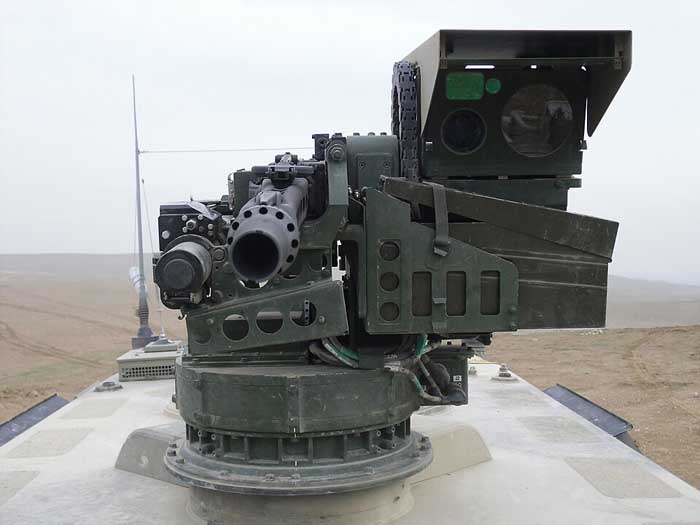
This other option is a lighter weapon station accomodating the MG3 or MG4 on the version 100, when the version 200 could accomodate the same grenade launcher or 12.7 mm BMG. They all shares the same 12-inch display, daylight channel with 10x magnification, night-vision with a thermal imaging system cooled for the FLW 200, not for the FLW 100, gyroscopic stabilization system to remain stable in motion. In addition the camera is AI-assisted to automatically identify targets and adjusting ballistic parameters over 360° and up to +70° elevation. The Dingo 2 under the Geschützte Führungs- und Funktionsfahrzeuge program is intended to be equipped entirely by this more advanced RWS. Delivery of the first 110 FLW 200 was scheduled for early 2011 and has been completed.
GMW
In Afghanistan, the urgent need was placed by August 2010 for additional automatic grenade launchers (GMWs) and their integration kits. The first were installed on KMW 1530 mount as an interim measure on the Dingo 2A2. Given the production 9-month delay, they were sourced from existing Fennek vehicles instead, supplemented with an integration kit.Belgian RWS
The Belgian Dingo 2 is equipped with a domestic FH Hrestal ARROWS-300 weapon station instead. It features weapon stabilization, daylight camera, night-vision, 360° azimuth, elevation -20° to +55° and could be equipped with additional armor.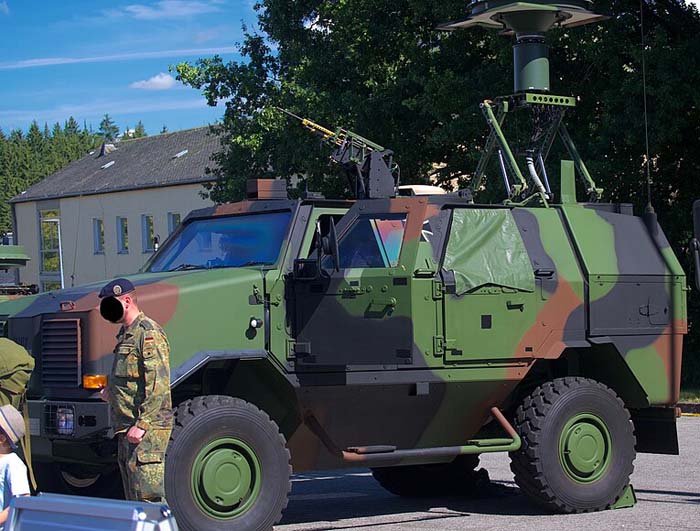
EloKa RWS
ATF Dingo 1/2 specifications | |
| Dimensions | 5,45*/6,08m** x 2,39m x 2,55m (2,95m RWS) |
| Weight | 12.5 t (Dingo 2) |
| Crew* | 5 personnel (driver, commander, gunner, 2 security personnel) |
| Crew** | 8 personnel (driver, commander, gunner, 2 security personnel, 3 infantry soldiers) |
| Propulsion* | Mercedes-Benz OM 366 LA III/4 178 kW (240 hp) |
| Propulsion** | Mercedes-Benz OM 924 LA, Euro 3: 160 kW (218 hp) up to Dingo 2A1 |
| Suspension | Torsion Bars, Hydrosprings |
| Speed (road) | 90 kph road |
| Range | 600 km |
| Armament | MG3, Browning M2, 40×53 mm Grenade Launcher |
| Total production | Total 1,000+ |
Variants

German
Dingo 1: 147.Dingo 2 A1/A2/A2.3: 287 basic APC and GFF 3 class vehicle.
Dingo 2 BÜR (ground surveillance radar): 78 planned, 2 delivered.
Dingo 2 A3 repair vehicle: 25 ordered, 4 delivered
Dingo 2 C1 GSI battle damage repair variant: 48 all deliv. by end 2010
Dingo 2 A3.2 troop transport: 45, all deliv. by end 2010
Dingo 2 A3.2 operational intelligence vehicles, 20 ordered 17.11.2010, assumed delivered.
Dingo 2 A3.3 troop transport: 39 ordered 17.11.2010, assumed delivered.
Dingo 2 A4.1: 50+65 (50 ordered November 2023, 65 ordered December 2024.
Dingo 2 Ambulance: Exported only.
Operators
 Bundeswehr:
-Dingo 1: 147 delivered, Dingo 2 A1/A2/A2.3: 586 + 115 on order, 636 before transfer.
-Germany Federal Police (Dingo 2 Polizei): 2 delivered
 Belgian Land Component: 158 Dingo 2 MPPV Fus (patrol)
Dingo 2 MPPV PC (mobile command post): 52 delivered
Dingo 2 MPPV ambulance: 10 delivered
Dingo 2 APC: 66 delivered. Total Belgium: 286.
 Luxembourg Army: Dingo 2 Protected Reconnaissance Vehicle: 48
 Austrian Armed Forces: Dingo 2 ATF: 60.
Dingo 2 AC NBC reconnaissance: 12, AC ambulance: 3
 Czech Army: Dingo 2 A2: 21 delivered.
 Norwegian Army: Dingo 2 A3: 20, All donated to Ukraine 2024.
 Iraqi Kurdistan: Peshmerga Dingo 1: 20.
 Qatari Army: Dingo 2 A3.3 troop transport: 125
 Serbian Army: Dingo 2 ambulance: 2, donated in 2024
 Ukrainian Ground Forces: 50 Donated in 2022.
Operations

The effectiveness of the Dingo 2 protection was demonstrated on June 3, 2005 close to Kabul. After a Luna UAV mission, the last vehicle in convoy struck an anti-tank mine (6 kgs TNT) blasting under its right front wheel. The Dingo was threw sideways by two meters and ran into a similar size crater, 50cm deep. The wheel, suspension, and unprotected front section were gone, but the safety cell remained intact. Two men sustained minor injuries. A year later on June 27, 2006, a Dingo 1, even less protected, still survived a suicide car-bomb attack near Kunduz. All occupants remained uninjured by the blast, 25 meters away. On March 27, 2008, a Dingo 2 was submitted to an IED blast near Kunduz. Two German soldiers were seriously injured, one slightly injured. The IED charge was estimated 10 kgs TNT and completely flip over the vehicle.
On July 23, 2009, when Operation Adler was launched a Dingo 2 was ambushed and hit by three RPGs. Nobody was harmed. On April 2, 2010, in the "Good Friday battle," a Dingo 2 struck an IED wounding four soldiers but no fatality. The armoured cell held, but the rest of the vehicle was a write-off and needed to be scuttled. In April 2010, the Bundeswehr officially recorded five Dingo 2 as total losses but sitll no fatality. One was a GE A1 variant, three were GE A2 variant and one GE A2.3 variant. By September 2022, its announced that 50 Dingos would be donated to Ukraine. The first 30 arrived in Ukraine in November 2022. Oryx blog by April 2026 started at least 14 had been lost or badly damaged.
Gallery
Illustrations
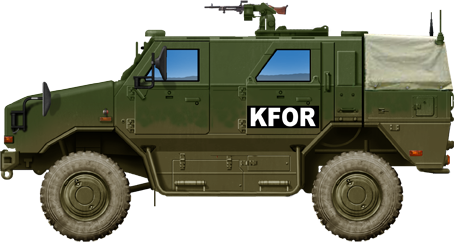
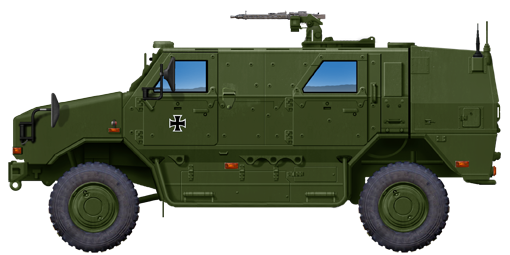
Dingo 1 of the KFOR in Kosovo, 1990s
Early Dingo 2 with the MG3 LMG.
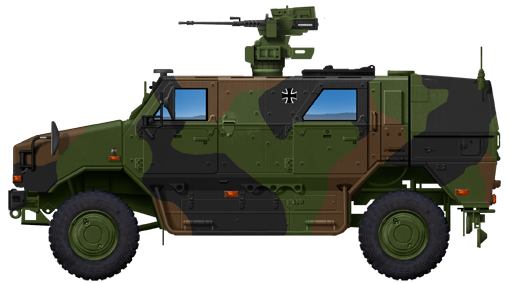
Dingo 2 with 0.5-in cal. RWS
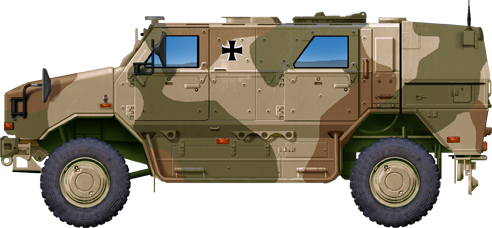
Dingo 2 in Afghanistan, 2010s
Photos
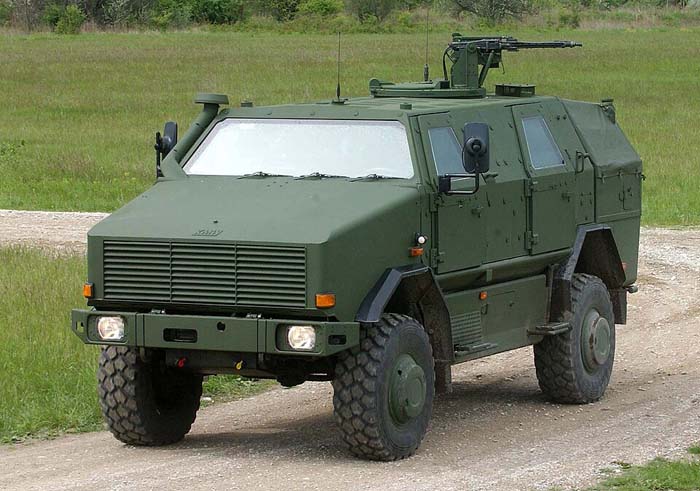
Early Dingo 2 on trials
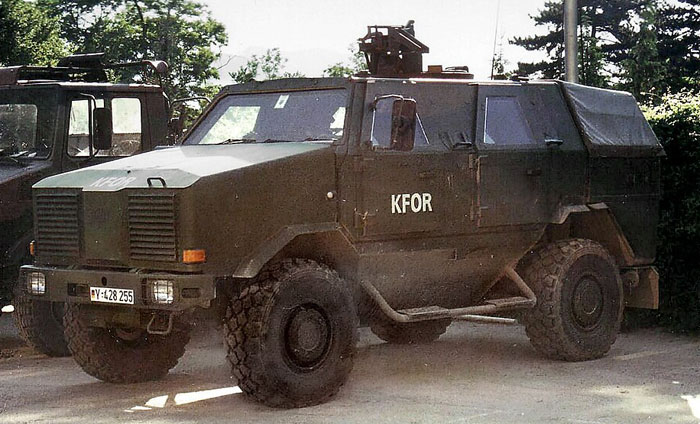
ATF-1 Dingo, KFOR
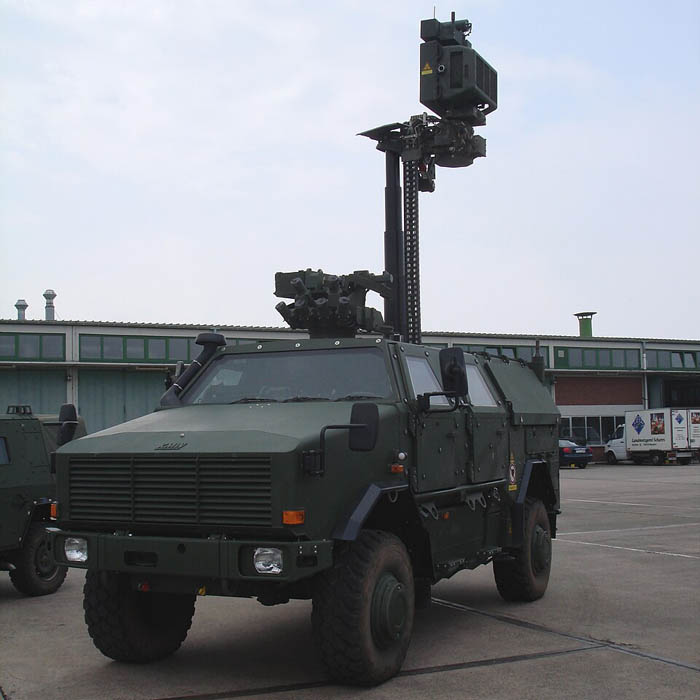
ATF Dingo 2 with ground surveillance radar (BÜR) from EADS.
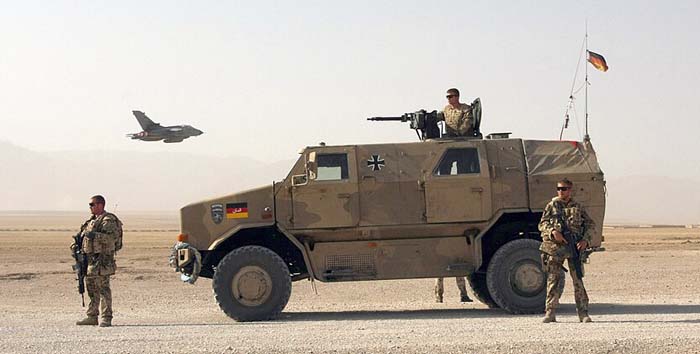
German forces near Camp Marmal during a patrol outside of Mazar-e-Sharif, Afghanistan November 2009. Germany is part of the 48-nation military coalition assisting the government of Afghanistan in the establishment and maintenance of a safe and secure environment, thereby facilitating the nation's reconstruction and stability. (ISAF Public Affairs Photo) Deutsch: Deutsche Einheiten in der Nähe von Camp Marmal während einer Patrouille außerhalb der Stadt Mazar-e-Sharif in Afghanistan November 2009. Deutschland ist ein Teil der 48-Staaten Militärkoalition zur Unterstützung der afghanischen Regierung für die Errichtung und Aufrechterhaltung der Sicherheit im Land sowie zur Erleichterung des Wiederaufbaus und der Stabilität der Nation. (Foto der Pressestelle "ISAF Public Affairs") 11. August 2009.
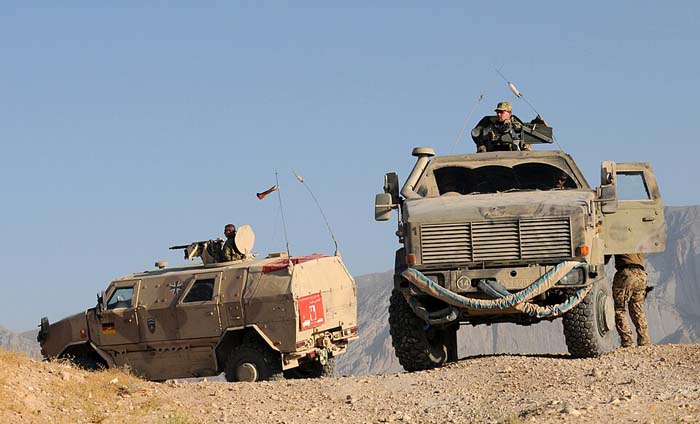
Mazar-e-Sharif, Afghanistan: German Army soldiers conduct surveillance above a hilltop, during a daily foot patrol in the region. The patrols ensure safety, security and foster good relations with the Afghans. Official Photo by Petty Officer First Class Ryan Tabios, ISAF HQ Public Affairs. July 2009.
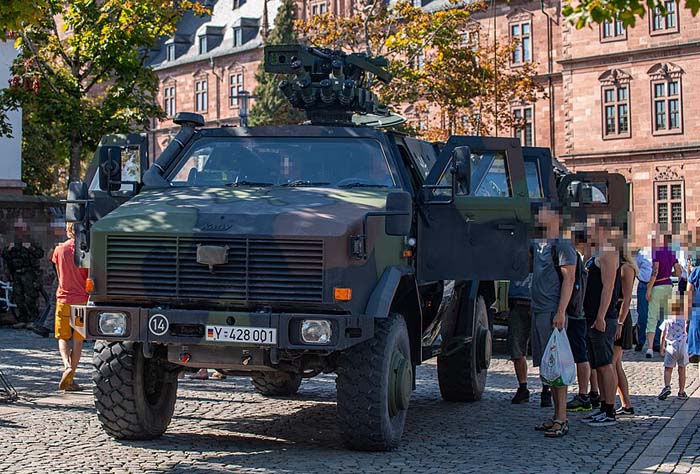
ATF Dingo 2 with GMW grenade launcher
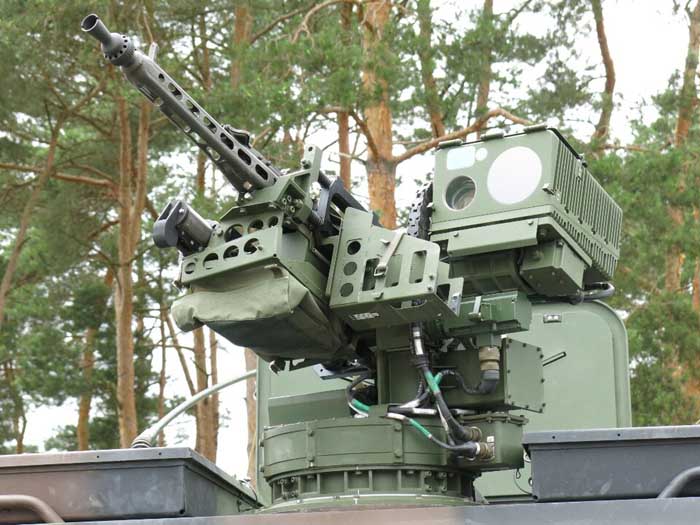
KMW FLW-100 RWS with the MG3
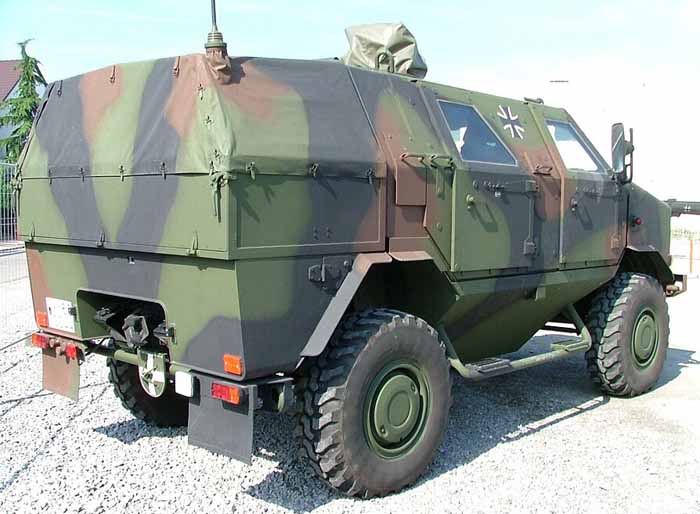
Rea view of the Dingo 2 and its tarpaulin over the cargo bay
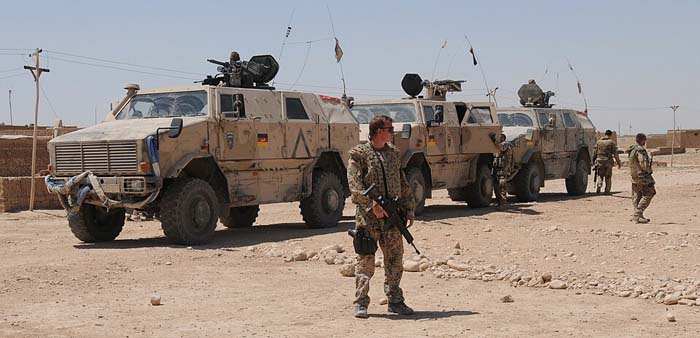
Dingo 2 in Afghanistan, convoy
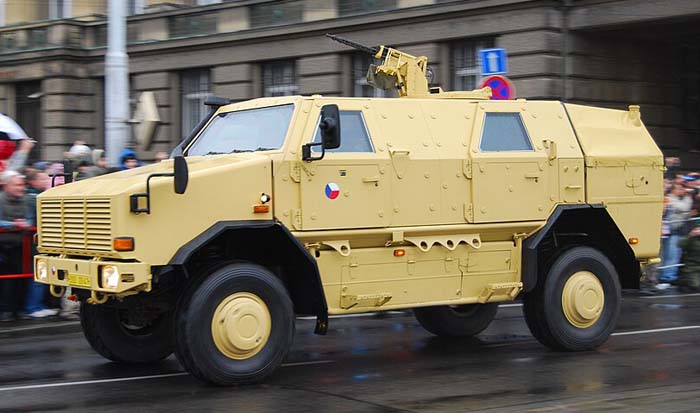
Czech Dingo 2
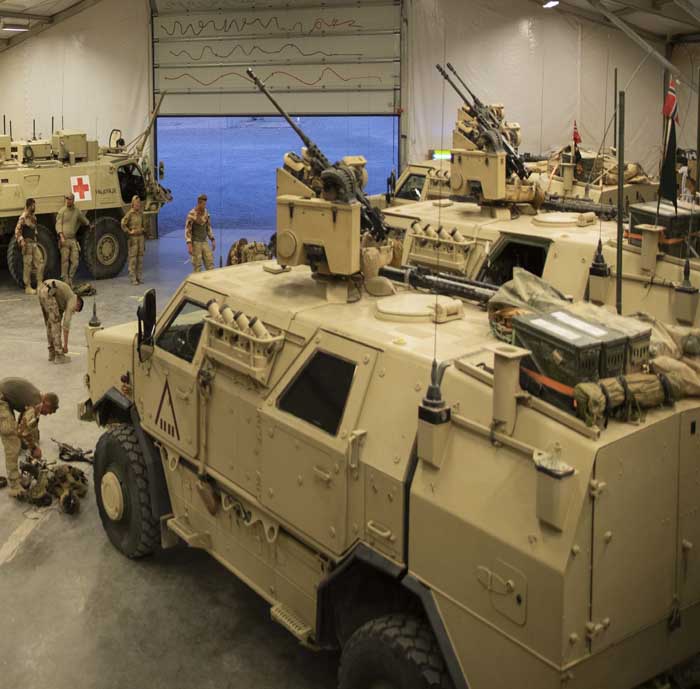
Norwegian AFVs with the QuickResponse Forces
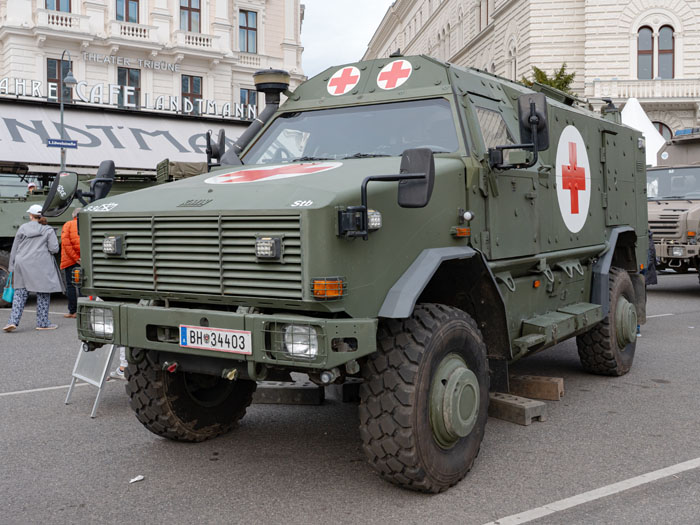
KMW Dingo Ambulance Bundesheer 2023
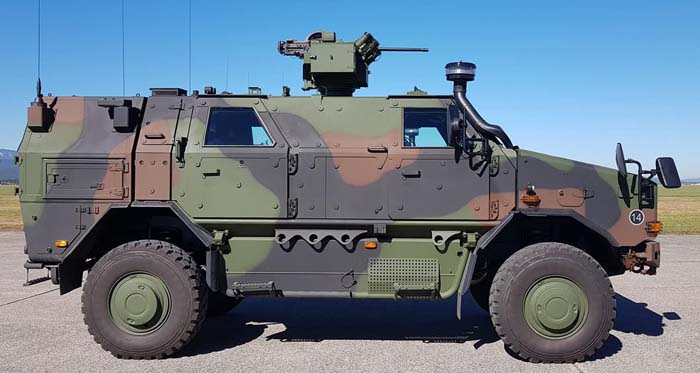
Austrian Dingo 2A3
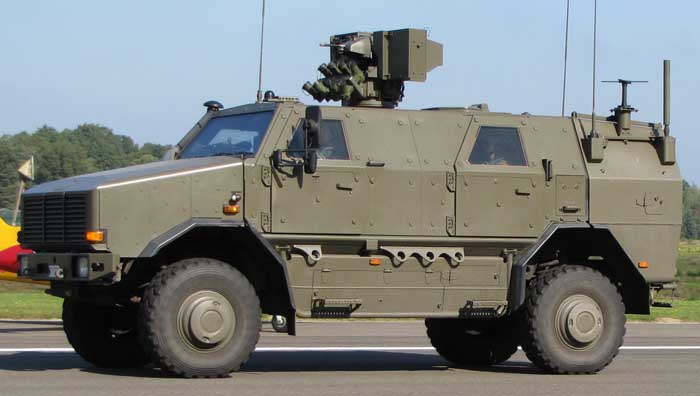
Belgian Dingo 2
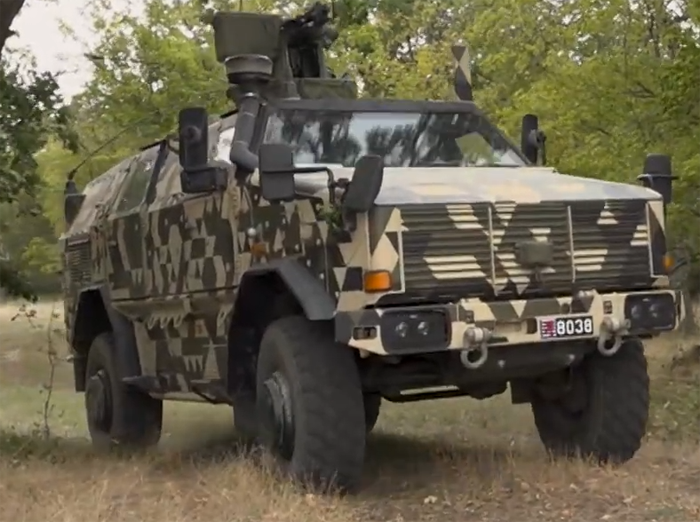
Camouflaged Luxemburgish AT Dingo 2
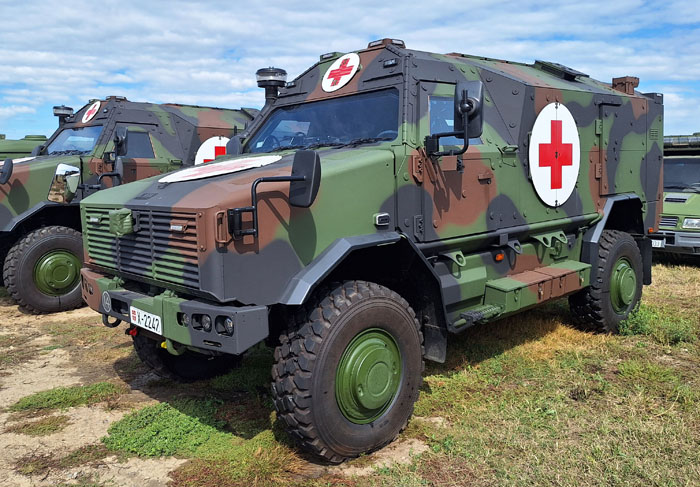
Serbian Dingo Ambulance
Sources/Links about the PzH 2000
The ATF Dingo on Wiki ENThe ATF Dingo on knds.com
The ATF Dingo on army-guide.com
The ATF Dingo on bundeswehr.de
The ATF Dingo on defensearchives.com
The ATF Dingo 2 on army-guide.com
The ATF Dingo on warwheels.net
The ATF Dingo on bundesheer.at
The ATF Dingo on the BDR equipments list
The ATF Dingo on scalemates
Video
Modern Tanks
Modern MBTs posters
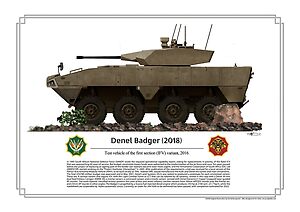
Denel Bagder (2018)
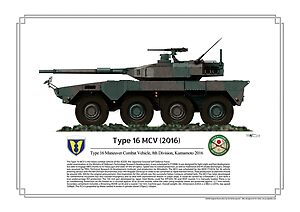
Type 16 MCV (2016)
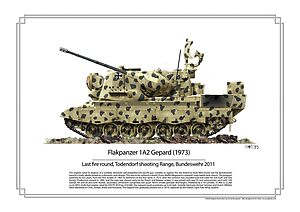
Gepard 1A2 last rounds 2011
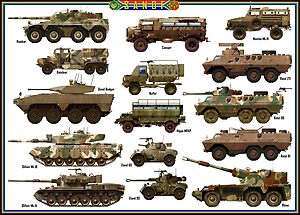
SANDF
Russian AFVs
Main Battle Tanks