Bedford OXA
 Lorry 30 cwt Anti-Tank. Armoured Car, 948 built total 1940-41

Development of the OXA
About the Bedford OX series
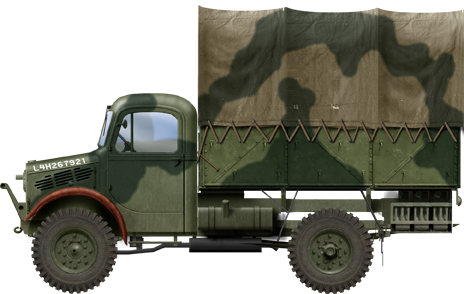
The Bedford OX was a short-wheelbase 1.5 ton payload short wheelbase 4x2 lorry manufactured for the British Armed Forces, presented in 1939 and the OXA as a variant of the chassis, at first not ordered by the Army. The OXD became one of the most common light trucks of World War II with voer 24,000 delivered, including civilian configurations. The main variant was of course the general purpose OXD standard General Service (GS) for cargo and personnel. The OXC was a specialized tractor made for semi-trailers by Scammell. The OXA was, as said above, a proposed improvised armored vehicle conversion. It was accepted for home defense in May 1940. The armoured truck was named also from its 30 cwt (1.5 ton) payload, half the original Bedford OY but it shared most components, including its semi-forward cab idetical to the 15-cwt Bedford MW and the rest with the OYD. It was also powered by the same engine, ensuring the creation of the heavier OXA or "Lorry 30cwt Anti-Tank" developed in 1940.
The post Dunkirk Situation
In May 1940, it was clear after a few days post-Invasion as Belgium crumbled and the Ardennes Offensive broke through, that the allied forces were in dire straits. Soon, the best divisions were trapped in a giant pincer, a gamble at the heart of "Fall Gelb". In this pincer, was soon trapped the elite 1st French Army and BEF, to which many units coming back from the Dyle-Breda front added their dwindling assets. The pocket of Dunkirk became a siege, in which was launched a daring naval operation to try and rescue the bulk of the BEF and significant French Forces. But the men were rescued, those of a precious, small and battered British Expeditionary Force, at the time one of the world's most elite, best equipped. It had been fully motorized. The price of the evacuation was to leave everything behind.
So once these men were back, the next step everyone awaited was the German invasion, which was formulated and prepared, but given the superiority of the Royal Navy, an air battle was necessary to gain full mastery of the air, a key condition to success. Meanwhile as the "battle of Britain" developed in this summer, what left of the BEF prepared to face the Panzerdivisions on the beach and inland across Southern Britain. But these 338,000 Allied troops repatriated were only partially armed. On 10 June 1940, Britain had only 366 operational tanks immediately available for home defence, among those were 292 Vickers Mk VI models and older ones, armed with machine guns. There were still 74 Infantry Tanks like the Matilda I and II and only 173 Cruiser Tanks plus roughly 200–300 additional tanks in various states of disrepair, overhaul, or training in depots. Manufacturing was trying to compensate these loss, still under a peacetime rythm.
By 15 September 1940, the frontline count stood at 684 operational tanks in the UK. This total sat alongside an additional 154 tanks that Britain felt confident enough to ship out as urgent reinforcements to Egypt. In between the Home Guard was organized to support the regular army, now lightened up from French troops sent back to the front for a short while before the fall and armistice. Bacl on 14 May 1940 Anthony Eden made a radio appeal for volunteers aged 17–65 to join the newly created Local Defence Volunteers (LDV) and 250,000 men volunteered. By July 1940 at the request of Winston Churchill, this became the "Home Guard" and by the end of the Month, it grew to 1.5 million men, adding to the regular army that also grew in August over 1.5 million active personnel. They needed armoured vehicles and fast.
Makeshift Armoured Cars
Lord Beaverbrooke for example mobilized existing cars, mostly Austins, to be converted as makeshift armoured cars (The Beaverettes, covered partly with 11mm steel plates backed by thick oak planks) as well as all sorts of conversions. The "Broomstick Army" was short on rifles, but at least it could gradually be motorized with something capable of opposing the Wehrmacht if it landed, slow it back until a defence in depth was established. Because steel armor plating was in critically short supply, these improvised vehicles relied on alternative materials like wood, gravel, boiler plates, and even concrete to protect their crews.Another of these oddities was the Armadillo, the "Gravel-Filled Truck" featuring a double-walled wooden box mounted on the back truck bed and a 6-inch gap between the inner and outer wooden walls willed with gravel to absorb bullets and shrapnel. Several Marks were developed,mostly to defend airfields from paratroopers assaults. The Mark III was based on the larger cousin of the Bedford OX, the OY. And there was the Bison or Mobile Concrete Pillbox. There were also the Malcolm Campbell Car towing the "Smith Gun", the "Tickler Tank" from Maidenhead on a Sunbeam car chassis covered with scrap metal and various Armored Buses.
Development of the Bedford OXA
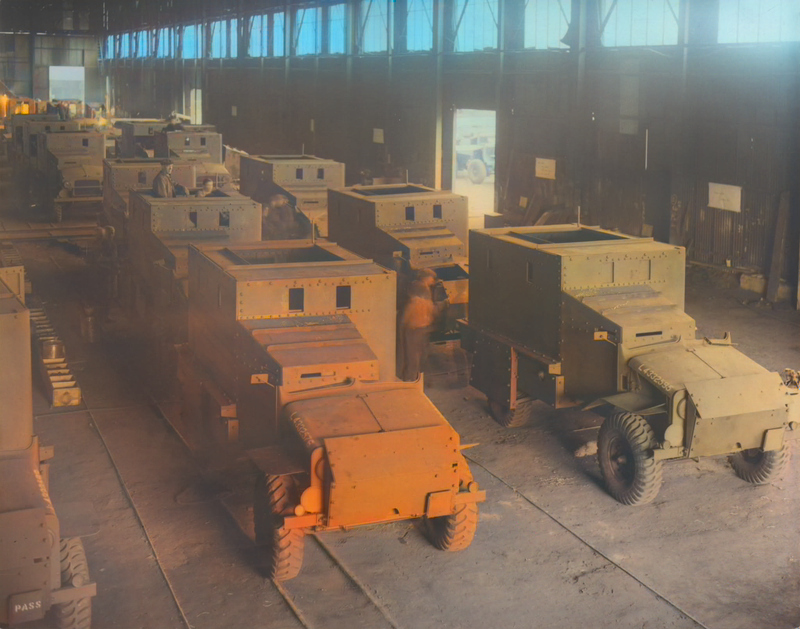
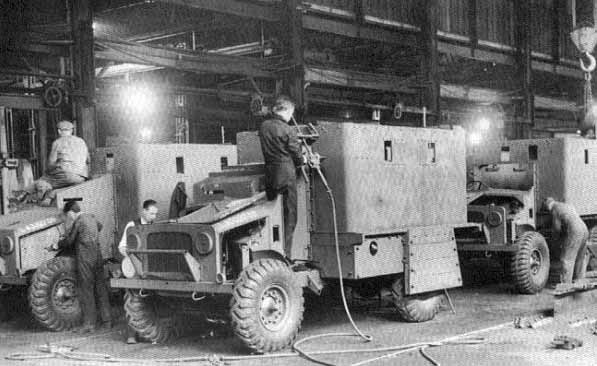
The Bedford OY based Armadillo Mark III showed these recent trucks, which had a lot of torque, could be usable for other roles and an official need emerged for a vehicle that could actually tackled German light tanks that might be landed, the Panzer I and II as well as the Panzer 35(t) and 38(t). At the time, by far the most common antitank weapon deployed with the BEF at organic Company level was the BOYS 12.7 mm (0.5 inches) antitank rifle. For it was developed the "Lorry 30 cwt Anti-Tank". The War Office and its Secretary of State for War, Anthony Eden executive branch Lands Branch.2 worked with the Ministry of Supply (Herbert Morrison) to procure a still untapped, widely available chassis for a dedicated BOYS carrier, armoured, and the OX chassis was chosen given its small size and greater torque compared to the OY.It was indeed designed initially as a motorized casemate with simple armour plating. The casemate was to be placed on the flatbed and dotted with openings to place the BOYS rifle at all angles, a casemate rather than a complicated turret or unprotected ring mount. Once the basic layout was agreed upon, Bedford was contacted to do its part and manufacture directly these vehicles, unlike many previous one-off, crude Home Guard conversions built in local garages. The OXA was standardized, and centrally managed and so a grand total of 948 units were built (from an initial order for 1,000) between 1940 and 1941 by Bedford Vehicles in Luton. Too precious for the home guards, it was distributed to the regular army, and later as new, better designed and proper armoured cars arrived en masse, they were was soon reassigned from the Local Defence Volunteers, to the RAF and Free Polish forces in the West.
Design of the Bedford OXA
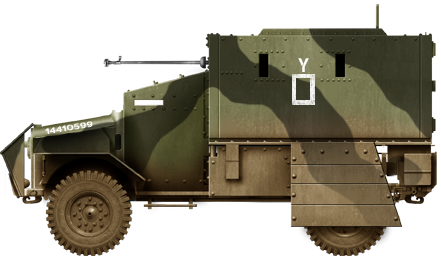
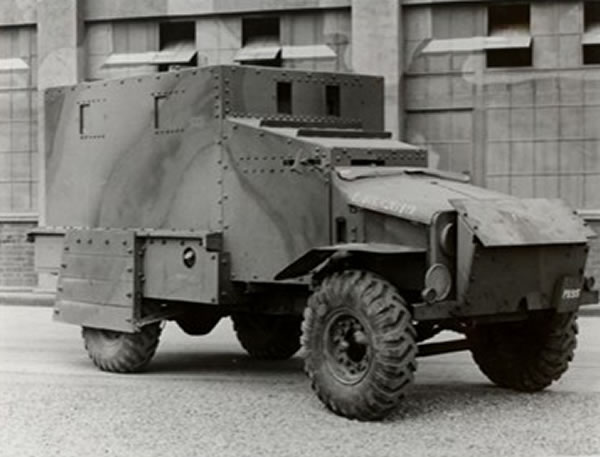
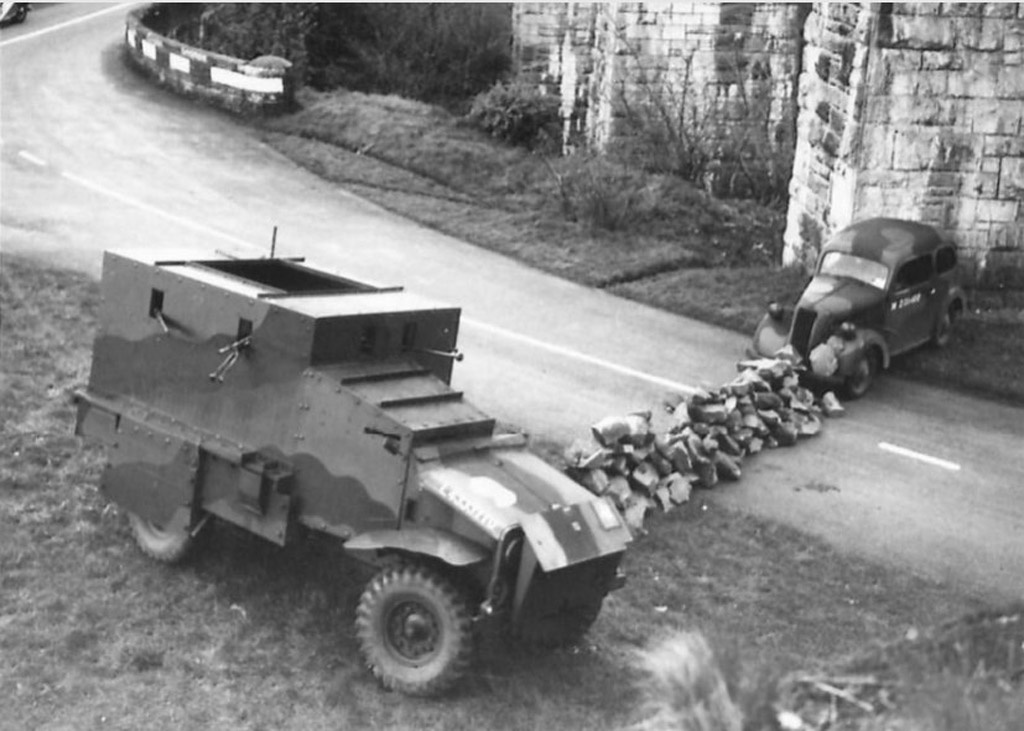
The OXA was based on the regular 1.5-ton (30cwt) commercial utility truck just introduced to the civilian market in 1939. It was then rapidly requisitioned for war. Its design and specifications were drawn in June 1940, and transformed this 2x2 standard civilian truck into an angular, fully enclosed mobile pillbox. The Hull was the greatest change, as the standard wooden cargo bed and civilian cab were stripped down. The chassis was bare as a platform, and on ot, designers mounted a simple, angular and squared open top armoured steel body, directly over the chassis. There was the main casemate over the former flatbed, and a smaller cab for the driver only forward and left of it. This allowed to spare steel but left a massive "shot trap" on its right. In this boxy structure in front of the bonnet, the driver could see through three sight slits. Access was only from the encased right door. On top of its sloped roof were installed two bullet deflectors. The casemate was not completely open top and partially open, to the middle of it for ventilation and potentially defend the vehicle from above threat with a Bren Gun.But there was no pintle mounts. The forward part was only partially protected. The original bonnet upper doors were left, but the side louvres, ventilation and access panels to the engine were removed. The forward flat engine radiator was left, but a sloper, two part nose was now installed for protection at its front, with a gap leaving air circulating behind to the radiator for colling. Instead of the original muguards, the forward driving axle roawdheels, unchanged were now protected by a simpler flat mudguard. The main lights were partially hidden behind the nose armour, so the vehicle relied on smaller convoy lights, with blackout feature (it lighted only the road short ahead) on the bumber by night. The back plate was built above the original one which kept its tailgate and lights. Unlike the forward wheels, the rear axle was protected by armour panels. The side fuel tanks were also protected by plates with an cutout for the filling cap.
The overall design protected its occupants from most angles, the driver forward, two operators at the rear for the BOYS antitank gun and an extra loader and Bren-carrier. Still the open top would be subjected to shrapnel projections. However the steel plates were relatively thin, stock from bedford, only around 5-6mm in hardened steel. They provided protection against small arms rifle fire and shrapnel, but offered zero defense against dedicated German anti-tank weapons or tank shells.
The OXA kept its original power plant unchaged, the standard civilian Bedford engine. The base OXD 3.5 L 72 bhp I6 petrol was mated with a Manual, 4-speed (3 fwd, 1 rev.) transmission for 65 kph on road for the truck lightened to just 2,629 kg (2.59 long tons). Off road this fell rapidly. It kept also the original leaf Spring suspensions, and it original range was c450 km, but only for the lightened truck.
However, due to the massive added weight of the steel armour plating, the OXA rose to roughly 6.5 tons, more than the 4 tonnes of the truck fully loaded. And for this, it ended severely underpowered, slow, struggled on rough, off-road terrain. For its armament the whole vehicle was developed specifically as an "anti-tank lorry" giving it a distinctive weapon profile, the Boys Anti-Tank Rifle as primary weapon. Designed by Captain Henry C. Boys it was approved for production in 1937, and approximately 62,000 were manufactured. This was thus a widely available 0.55 inches caliber anti-tank rifle with a very long barrel giving the required muzzle velocity to defeat moderate protection.
It used a 13.9 mm proprietary cartridge upscaled from the .50 BMG and was essentially a bolt-action fed from a top-mounted 5-round detachable box magazine, weighting 36 lbs (16.3 kg) unloaded and 39 lbs (17.7 kg) fully loaded. It was heavy but also unwieldy for the operator at 63.5 inches (1.61 meters) with a 36-inch barrel. But the latter gave it a very good muzzle velocity of 3,250 feet per second (990 m/s) in order to defeat 25 mm of armor plate at short ranges, thanks to its AP ammunition. This was enough against German light tanks at most angles. This AT rifle could fire through a front-facing gun port, but there was another on the forward plate, two more on each side plates and one at the rear for a full coverage. There was a crude "support" in order for the operator to left the rifle in place when firing. Ammunition magazines were stored nearby. Generally there was a gun chief scanning the horizon for target and a loader when in operations. Obsolete against 1942 tanks it could realistically penetrate early-war German light tanks and armoured cars. But this was not only it. There was also a Bren Gun typically for AA and infantry defence, or in some cases a Lewis light machine gun for close-range and AA protection.
Bedford OX Specs 1940 | |
| Dimensions | 4,68 x 1,63 x 2,14 meters |
| Total weight | 6.5 tons |
| Crew | 1 driver, 3 crew |
| Propulsion | 6-cyl. 3.5L LC Petrol Engine 72 hp/3500 rpm |
| Suspension | Leaf Springs, 4x2 |
| Speed (road) | 64 kph () |
| Range | 380 km () |
| Armament | 13.97 mm Boys AT rifle, 7.7 mm Bren LMG |
| Armor | 9 mm (0.4 inches) |
| Production | 948 |
Combat Service
Because it was built to a standardized blueprint, the Bedford OXA was reliable enough to be issued to regular military forces before trickling down to local militias. It was used by the regular British Army from 1940 for its earliest production batches, assigned to frontline army units stationed along the coastlines. The Home Guard & RAF then obtained the remainder as factory lines finally began producing purpose-built armoured cars like the Humber and Guy.So the OXAs were handed down to the British Home Guard for mobile town defense and the Royal Air Force (RAF) for airfield protection as long as the invasion threat persisted. After 1940 went and the danger of a landing was no longer realistic in early 1941, new vehicles and older ones were passed on in turn to foreign Allies, a small number were given to the Polish Armed Forces in the West, stationed at the time in Scotland, moslty for training. By 1942, with the domestic tank crisis over, and the danger of a German sea invasion definitively out, the remaining Bedford OXAs were fully retired from service and scrapped for their valuable metal.
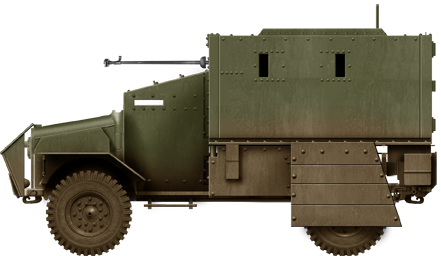
Author's rendition of a Home Guard Bedford OXA in 1940
Free Polish Corps in Scotland, 1941-42

Bedford OXA of the Free Polish Corps in Scotland, 1941-42

IA generated rendition (Pinterest)
Read More
Links
war-book.ru/medium.com/war-is-boring/
keymilitary.com
en.wikipedia.org/wiki/Bedford_OXA
/armorama.com/
hmvf.co.uk
facebook.com/
facebook.com/
emp3d.eu/
ww2talk.com
Videos
WW2 Tanks


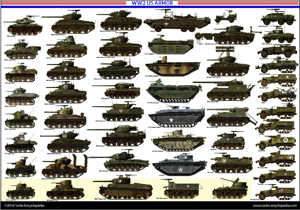
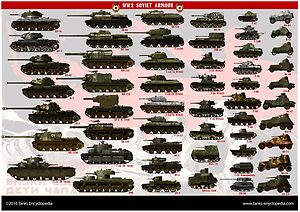
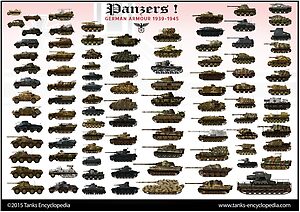
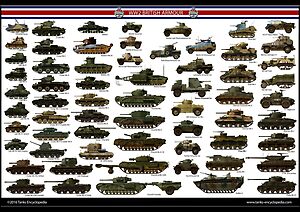
WW2 tanks posters
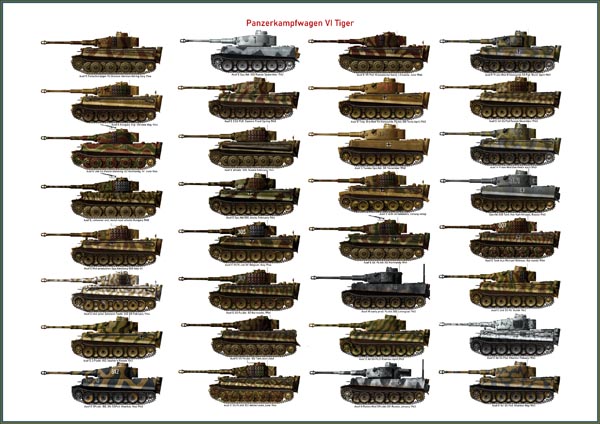
All Tiger tanks liveries.
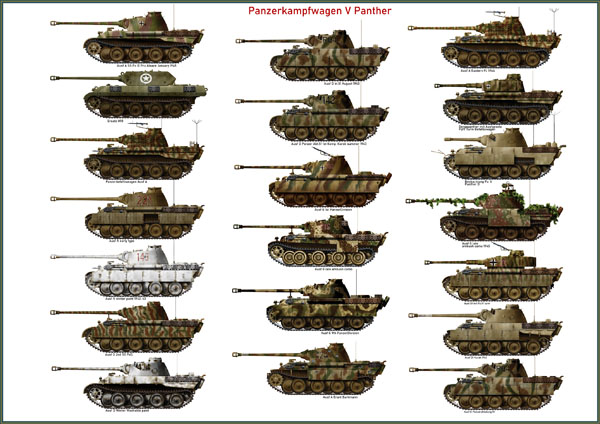
Panther liveries and variants
WW2 Armour - All tanks
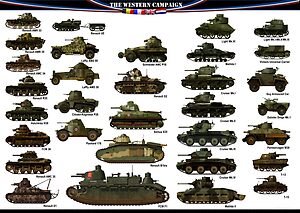
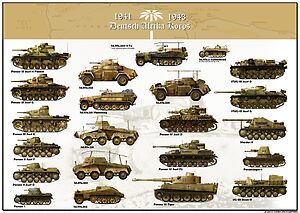

Tanks aces and single tanks series
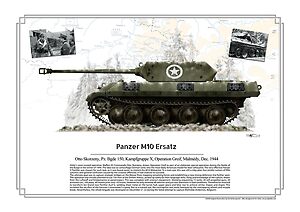
Find more there
Museums, Movies, Books & Games
The Tanks and Armor in pop culture
Tanks and armored vehicles in general are only really grasped when seen first person: The mass, the scale, it's all there. Explore also the way tanks were covered in the movie industry, in books and in video games.Movies:
Best tanks movie on warhistoryonline.com
On imdb.com
On bestsimilar.com/
miltours.com
liveabout.com/
watchmojo.com
Video Games:
pcgamesn.com
historyhit.com
levvvel.com
vg247.com/best-tank-games
mmobomb.com/
alienwarearena.com