M3 Bradley
 Cavalry Fighting Vehicle - 2,000 made 1981-today.
Development History
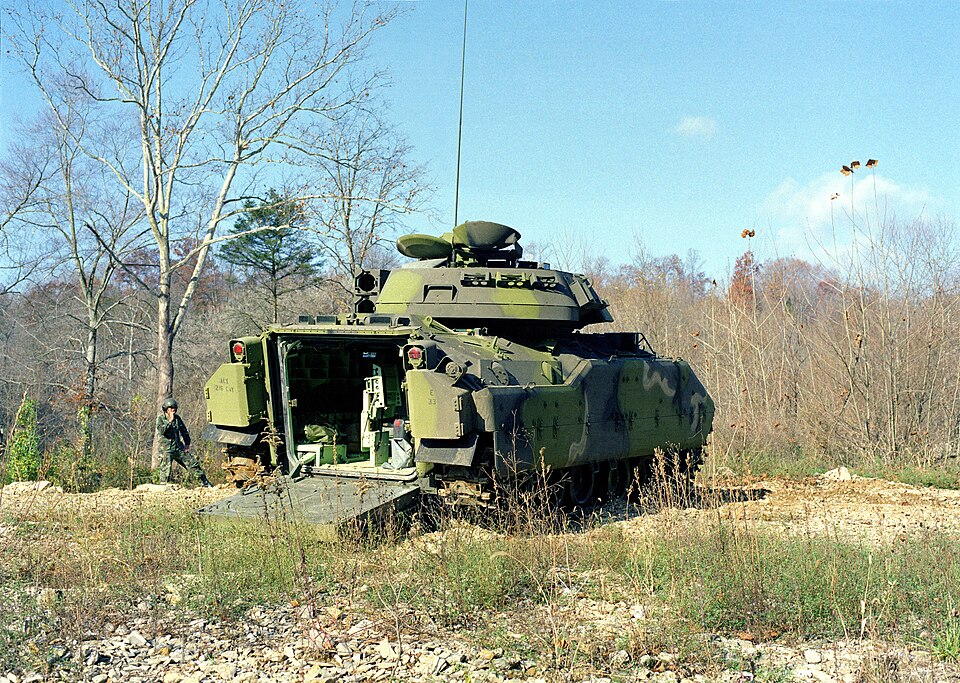
A rear view of an M-3 Bradley Cavalry Fighting Vehicle operated by members of the 3rd Plt., E Trp., 2nd Bn., 6th Cav., participating in maneuvers at the U.S. Army Armor Center Description, 1 January 1983. MERDC Camouflage: Summer, Verdant
The Bradley family (M2/M3) proceeded from one of the longest development in US Army history. Unlike some modern commentaries showing an answer to the Soviet BMP-1 first unveiled in 1966, the development of what would become the Bradley went well before. It emerged in 1963, so before even the BMP-1 was well known to US intel, as an effort to find a successor to the couple M113 infantry carrier/M60 Main battle tank. The recently introduced M113 was just fast enough to cooperate with the M60 in combined mechanized operation. With the announced MBT-70 and XM-1 programs in development in the 1970s (later leading to the Abrams) a faster APC was required.
However alongside was the need for a new cavalry armoured vehicle, not competiting with the M551 Sheridan light tank. Over 33 years of development, this program went through several iterations, the MICV-65 and later MICV-70, the M114, XM701, XM723/765 MICV, and XM800 Armored Reconnaissance Scout Vehicle. Prototypes both for a more advanced, better armed APC (later IFV) alongside a M113-derived fast tracked scout resulted in what became a common platform in the 1970s. Oddly enough, the M3 Bradley development tree is related to the only resulting cavalry vehicle that was actually produced from 1962, the M114 Command and Reconnaissance Carrier. This small vehicle started with a shorterned, lower M113 chassis with only four axles, and a large cupola, plus mounting a variety of armaments, including a 20 mm gun. They proved disappointing in Vietnam and were never deployed in numbers here. In all, 1215 were built, mostly deployed in Europe. Cadillac's M114A2 IFV is generally considered the earliest common ancestor of both the M2 and M3.
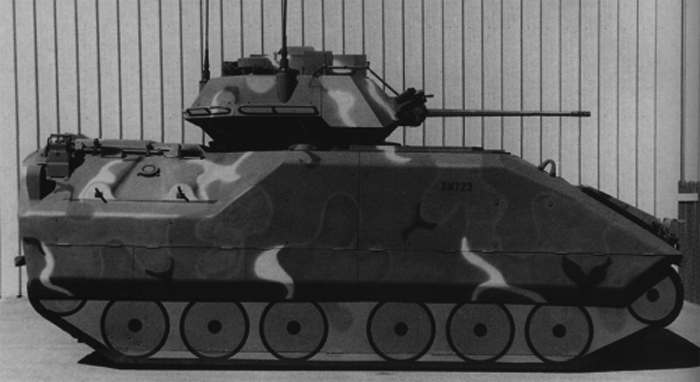
MICV 70 1967 mockup
Then came a series of ICVs or "Infantry Cavalry Vehicles", the MICV65 program's XM701/734/765 which later resulted in the YPR-765 for export. One derivative by FMC, the original makers of the M113 (Food and Machinery Corp.) proposed to General Westmoreland, ex C-in-C in Vietnam and now in 1968 the Army Chief of Staff, its own improved XM723. The program was rebooted as the MICV70, with six companies competing for production. FMC proposed the XM723. Meanwhile the Cavalry wanted iys own replacement for the M114. But with failure of the XM800 in 1974 and the start of cost-cutting measures post-Vietnam, led to add reconnaissance missions to the XM723, further complicating requirements.
What is important is that the Army required then a cavalry organization mirroring an armored division as a light screening force with both tanks and IFVs for an economy of force, fooling the enemy about the true scale of the opposing force. Then in 1978 came the Mehaffey group recommendations through TACOM. The XM-765 was used as base for impovements, notably adding TOW missiles. By 1979 the cancellation of the MBT-70 project almost put an halt to the whole new vehicle. The Mehaffey group indeed by March 1978 recommended to make scale economics, that both programs, the IFV going with the new MTB and a CFV, be merged into a single program, sharing the same mechanical base. It was agreed this new common base will not be based on the M113, unlike previous MICV prototypes, and instead use the new TBAT–II turret that would requied a redical redesign of the chassis, powerplant and protection.
The program evolved into FCM's XM2 and XM3, the latter being the designation for the cavalry vehicle. Indeed, together with the Abrams Main Battle Tank, the renaming of the whole triad M1, M2, M3 was seen as a major reboot of the whole US Army nomenclature. The XM3 was the designated cavalry vehicle prototype. The XM3 adopted a larger two-man turret with the same cannon (and coxial MG) but also two TOW launchers unlike the M2. The space sacrificed inside for infantry was then reserved to the TOW missiles. The final gun system was for both solidified as the 25 mm caliber M242 Bushmaster. This common base both pleased the Congress, and Larkin Task Force recommendations.
There was some controversy in the infantry about the XM3 with its reduced crew, imposing some reorganisation and tactic training. It was argued that M2 crew could still used their own portable ATMs instead of a TOW system. Another gain in the program was to go from 600 to 1200 rounds for the main gun in the M3, so that in exterme logistic cases, the latter could resupply M2s. But it was also in line with the more independent nature of M3 Operations with the Cavalry. In the end, the M2 would also receive the TOW in addition to internal ATGMs, but the supply was reduced to 7 rounds for the BGM-71, versus 12 for the M3. Final dispositions were made for the rearranged rear compartment. The whole design was the same, with a baseline three-men crew, driver, gunner and TC, and aside ammunition taking most space, there were two seats in the rear compartment for two dismounted scouts. Extra space was also taken by better communication suite, longer-range, than on the M2. Having no infantry, the firing ports were also eliminated apart in the doors.
The design was thus solidified when the M2 Bradley saw production commencing in 1982, with the first M3A1s entering production on the same standard as the M2A1, next came the M3A2 which mirrored the improvement of the M2A2s, and was an upgrade for existing M3A1s, and the final M3A3, until it was decided to replaced it by the M2A3 in the reconnaissance role.
Design
General Layout
The general layout was essentially the same as for the M2 Bradley but with some marked differences:Reduced Crew: The M3 eliminates the 6-man infantry squad space. Instead, it carries a 5-man crew: the Commander, Gunner, Driver, and two dedicated scout observers sitting in the rear compartment.
Periscope Array: The rear hatch features a modified periscope array that gives the two scout observers excellent visibility to spot targets and threats without opening the hatches. MRE & Gear Storage: Because scouts operate ahead of main lines for extended periods, the interior provides increased storage space for rations, water, and specialized battlefield surveillance equipment. The M3 does away with the firing ports found in the M2 series as well.
It was theorized that the vehicle could also carry inside a scout motorcycle. This was abandoned when it appeared its unprotected fuel tank could be hazardous to crew members.
Protection
The hull was the same as the M2, Constructed from a high-strength aluminum-alloy (5083 hull, 7039 turret) with layered steel laminate armor to save weight while protecting against heavy machine guns and artillery splinters. The interior features an automatic Halon fire suppression system and internal spall liners to shield the crew from metal fragments if the hull is breached. Additional protection measures were added to the design along the way. The M3A1 for example introduced an NBC gas particulate filter system and the modern automated fire suppression system. As for active protection all vehicles were given two four-barreled M257 Grenade Launchers, forward of the turret. If they could sent smoke screen for concealement, they could also dispense chaff in an ATGM-rich enviromnent but for close infantry combat thay could launch either grenades or flares. This is a backup also, the engine smoke-generating system.Mobility
The M3 Bradley featured the same Cummins VTA-903T 8-cylinder diesel engine (producing 600 hp in upgraded versions) paired with an HMPT-500 hydromechanical transmission. It reaches a top speed of roughly 40 mph (64 km/h). Early M3 models featured a collapsible swim barrier fabric. This allowed the tracks to propel the vehicle through water, though later armor additions largely made this obsolete. The M2A2 and A3 were simply no longer amphibious. The trim vane was eliminated as the pump system. The vehicle could still cross water obstacles down to 1.50 meters. The M3 had a 18 in (45.7 cm) ground clearance, and depending on versions, could negociate a 60% gradient, cross a trench 8.3 ft (2.5 m) or 7 ft (2.1 m) and climb a wall 36 in (0.9 m) or 30 in (0.8 m). Depending of the M2A1 or M2A2, specs diverges a lot (see below). The power to weight ratio varies from 20 hp/ST (16.4 kW/t), down to 19.8 hp/ST (16.3 kW/t). Torque varies from 1,025 lb⋅ft (1,390 N/m) at 2350 rpm to 1,225 lb/ft (1,660 N/m) at 2300 rpm. Ground pressure went from 7.7 psi (53 kPa) on the M3 to 7.8 psi (54 kPa), on the M3A1 and 9.3 psi (64 kPa) on the M3A2.Armament
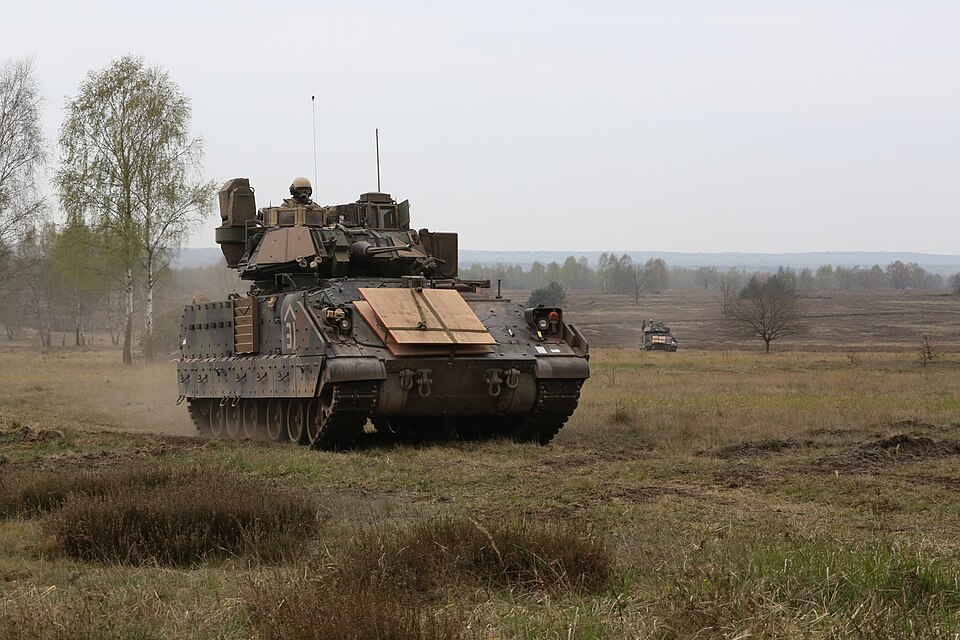 U.S. Army M3 Bradley fighting vehicles of Alpha Company, 3rd Battalion, 69th Armor Regiment maneuver through a field while conducting a water obstacle with opposing forces scenario during exercise Letzlingen Freedom Shock at the GACTC in Letzlingen, Germany, April 25, 2015. Exercise Letzlingen Freedom Shock promotes interoperability between the German and American training organizations while highlighting U.S. Army Europe's rapid deployment capabilities.
M242 Chain Gun
The single-barrel 119 kg (262 lbs) dual-feed chain gun manufactured by Northrop Grumman Innovation Systems (formerly McDonnell Douglas and Alliant Techsystems) is the primary offensive weapon for the M3 Bradley CFV, but is shared with the M2 Bradley IFV and USMC LAV-25. It is operated by an external electric motor driving the loop chain. The Busmaster thus is exceptionally reliable and precise. The electric mechanical drive controls all moving parts of the gun—loading, chambering, locking, firing, unlocking, and ejecting. So it cannot "jam" due to a misfired or dud round, and even if it happen, the chain drive would simply eject the faulty round and automatically feeds the next. Also the the bolt is mechanically held open between rounds, which prevents accidental "cook-offs" (rounds firing spontaneously due to a hot barrel). With the dual feed, the gunner can instantly toggle between two separate ammunition tracks at the flip of a switch. The turret traverses at 6 seconds/360° and the gun mount elevates a 60°/second.Calibre: 25 × 137 mm, Rate of Fire Selectable, Single, 100 or 200 rpm
Effective Range: Up to 3,000 metres depending on the ammunition type used, max paper 6,800 metres.
Ammunitions: • M791 APDS-T (Armour-Piercing Discarding Sabot with Tracer), high-density tungsten penetrator
• M919 APFSDS-T (Armour-Piercing Fin-Stabilised Discarding Sabot with Tracer), depleted-uranium dart round
• M792 HEI-T (High-Explosive Incendiary with Tracer). To deal with unarmoured targets.
In Operation Desert Storm and Operation Iraqi Freedom the M242 using the APFSDS-T proved deadly for the Soviet park of Iraqi APCs and IFVs but it could also disable older Iraqi main battle tanks such as T-55s and T-62s, hitting their rear armour, optics, and engine tracks.
TOW Anti-Tank Missile
Each turret is provided a dual TOW launcher on right side, one above the other in the canister. Its location prevents reload from the turret however. The vehicle must retire to reload externally. The BGM-71 TOW (Tube-launched, Optically tracked, Wireless/Wire-guided) is now a well known legacy ATGM system manufactured by Raytheon Missiles & Defense (now RTX) neabling the cavalry M3 its long-range punch with anough "arguments" to knock out any main battle tank from miles away and from any angle contrary to the more limited M242. With a total of twelve missiles, including the two already in the canisters and ten spares (half for the M2), M3 units could take on any enemy tank formations as they showed in 1991. The long range and precision compensates for their lack of armour against such vehicles.The missile is stored in a sealed fiberglass container that acts as the launch tube. The missile is optically tracked by the gunner. Unlike older CLOS 1st generation, the gunner does not need to steer it manually but hold the crosshairs on his sight directly on the target in SACLOS guidance for Semi-Automatic Command to Line-of-Sight. The targeting computer tracks an infrared beacon on the rear of the missile and calculates flight corrections. The missile is could be also Wire-guided thanks to two ultra-thin spools of copper wire unrolling from its tail. Modern variants such as the TOW 2B Aero RF use an encrypted Radio Frequency (RF) wireless link instead, jamming-proof.
The Operational Range is From 65 metres up to 3,750 or 4,500 metres depending on the variant at a flight speed between 278 to 320 m/s (Mach 0.9 to nearly Mach 1). Handling is trhough as the missile is between 21.5 to 22.7 kg (47 to 50 lbs) depending on model. On the M3 the twin-tube is a retractable arm with some elevation. The M3 could be provided wth the following:
• TOW 2A (Direct Attack): Tandem-charge warhead. Small "precursor" tip explodes first to prematurely detonate an enemy tank's Explosive Reactive Armor (ERA), clearing a path for the main High-Explosive Anti-Tank (HEAT) warhead to burn through the base steel armor.
• TOW 2B (Top Attack): Designed to counter tanks hiding behind ridges or fortifications. Instead of hitting the target head-on, the missile flies just above the tank. Its dual magnetic and optical sensors detect the vehicle below and fire two downward-pointing Explosively Formed Penetrators (EFPs) through the tank’s thin roof armor.
• TOW Bunker Buster (BB): Replaces the anti-armor warhead with a fragmenting blast warhead designed to punch through thick reinforced concrete, urban brick structures, and cave doors. Tactical Role on the M3 Bradley To launch, a M3 must remain stationary or move under 5 mph while launching. Ideally using a "hull-down" position parking behind a hill or dirt berm so that only the retractable TOW launcher and turret optics peek over the crest, keeping the main chassis safely hidden from enemy return fire, making this cavalry vehicle a perfect ambusher.
Coax. M240C
On the forward beak of the turret are located both the M242 25mm gun and coaxial machine gun, to its right. The barrel is protected externally by an all-metal mantlet, fixed. The 7.62 mm M240C machine gun. It fires 7.62×51mm NATO and is on the same class as the "standard medium machine gun", manufactured by FN Herstal (produced by FN South Carolina) as a rapid-fire solution for soft targets. It is physically locked to the same axis as the primary weapon, pointing at the exact same target allowing the gunner to use the advanced thermal sights and laser rangefinder to aim it with great precision.It is a classic Gas-operated, open-bolt, piston-driven capable of 650 to 950 rpm sustained, supplied with 4,400 rounds. Based on the FN MAG (M240B), the M240C features distinct engineering changes like its Right-Hand Feed mirroring the the 25mm chain gun feed system, preventing their own ammo chutes from tangling inside the cramped turret. It uses Solenoid Firing to the gunner’s control handles and manual trigger override. The Ejection Shute is shrouded and located beneath the gun. If ever the main gun optics would fail, this LMG could also fire tracer rounds helping the gunner to vidually aim at any target.
Personal Weapons
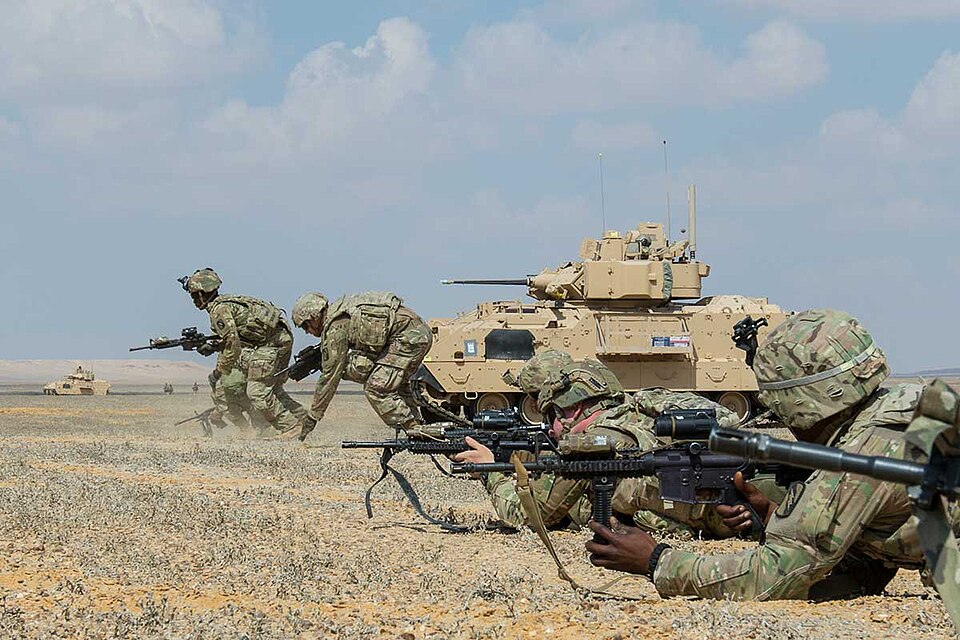
U.S Army Soldiers assigned to Company A, 1st Battalion, 155th Infantry Regiment, 155th Armored Brigade Combat Team, Task Force Spartan, bound toward an objective during a rehearsal for a combined live-fire exercise near Alexandria, Egypt, Sept. 10, 2018. The 155th ABCT took part in exercise Bright Star 18, a multilateral U.S. Central Command training exercise. U.S. Army photo by Sgt. James Lefty Larimer
It should be noted also that the two scouts and the three crewmen had their own small arms. The VC or vehicle commander, driver and gunner had as a baseline had their M17/M18 Modular Handgun System for last resort close defence. In addition the vehicle stores a M4A1 Carbine (5.56×45mm NATO) with the two scouts accessorizing them with optical sights, like the M68 CCO or ACOG, laser designators, and silencers. The scouts could also cover a retrat to the vehicle using a M249 Squad Automatic Weapon (SAW)/M250 (6.8mm). The scouts also sports on their Carbine the 40mm M320 Grenade Launcher Module attached under the barrel, if equipped. If short of TOW, they coukld also have access to a spare portable Javelin anti-tank missile system in the rear cargo area. With drone warfare, recent changes introduced drones in addition to handheld thermal optics and laser rangefinders. Traditionally these scouts acts as a dismounted recce squad.
Ammunition
The ammunition storage as seen above was considerably augmented, as by removing the infantry squad benches, designers repurposed the interior space into a rolling armory, doubling the Bradley's firepower capacity:For example they carried in the final form 1500 rounds instead of 900 of the 25mm Bushmaster cannon,
The M3 carried 12 BGM-71 TOW Anti-Tank Missiles instead of 7,
And for the 7.62mm Coaxial Machine Gun it was doubled from 2,200 to 4,400 rounds.
Variants
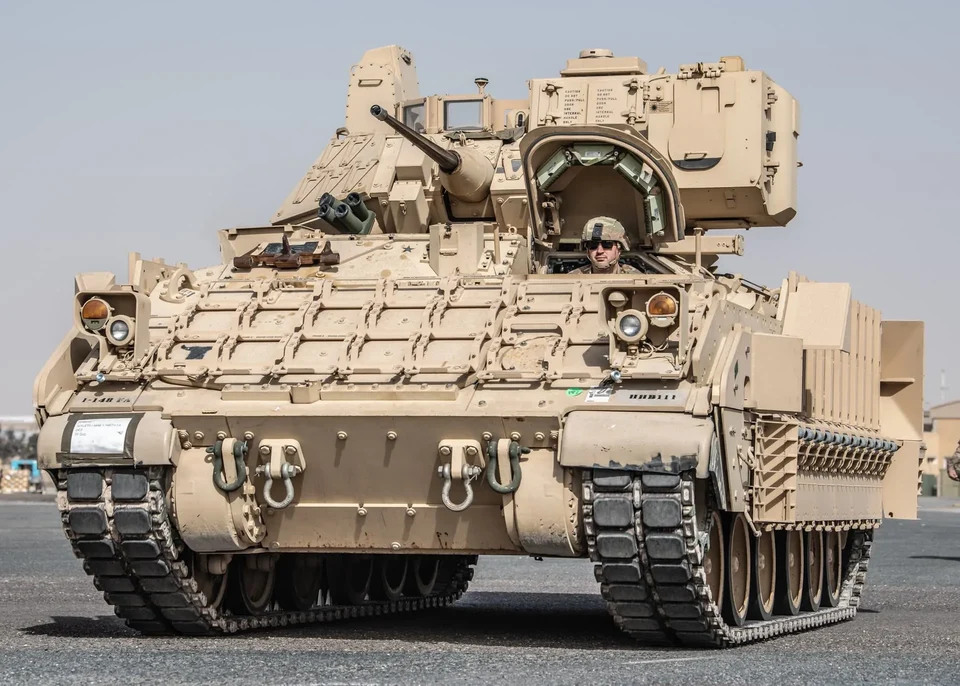 M3A4 Bradley
M3
Also dubbed the A0, this vehicle is a re-stowed M2 Bradley with the passenger compartment modified for two seats and lot more more ammunition and missiles, firing ports covered but still three periscopes between the cargo hatch and entry ramp and along the left side. The one on the right side is covered over (TOW missile stowage rack behind).M3A1
The M3A1 variant as seen above has a gas particulate filter system for NBC threats with NBC masks connected to the central filter for all five crewmen, and it has a new fire suppression system. The three periscopes on the rear deck also are absent, but there are still four periscopes in the cargo hatch.M3A2
The M3A2 incorporates enhanced armor upgrades such as mounting ERA. Same as the M2A2 Bradley. Ammo stowage was changed, the two scouts were swapped to a bench on the left side, missile stowage rearranged for safety. Post 1991 there was an eye-safe carbon dioxide laser rangefinder, GPS and compass added and a missile countermeasure device, plus a combat IFF, thermal viewer for the driver on the M3A2-ODS.M3A3
Enhanced information and communication equipment. There is a better central processing unit, new displays for the TC and squad leader. It is made compatible with the inter-vehicular communication system linking it to the M1A2 Abrams and AH-64D Apache Longbow. The TC has now an independent thermal viewer and the Improved Bradley Acquisition System (IBAS) sight, allowing automatic gun adjustments, automatic boresighting, tracking of dual targets. The roof had titanium armor. Most were converted from M3A2s.M3A4
Current latest upgrade, based around a new power unit, a 675 horsepower (503 kW) engine to regain mobility and provided extra power for improved electronic systems. Deliveries started in 2020 and are ongoing as the successor of the M2/M3 is not there yet.Combat History & Exports
Deployments
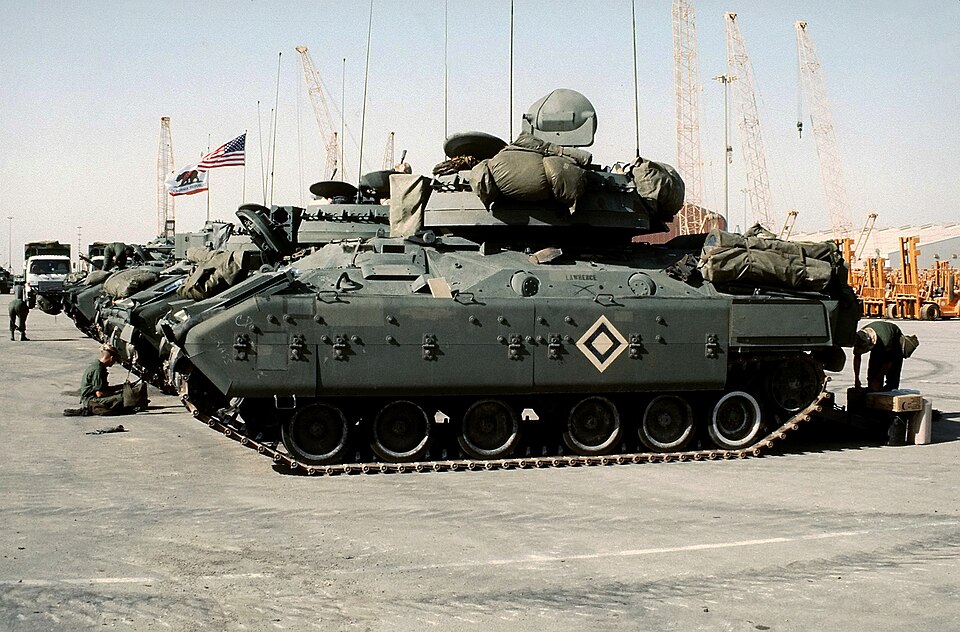
The M3 Bradley Cavalry Fighting Vehicle (CFV) alongside the M2 established a highly successful combat record. It transitioned from a widely criticized, protracted development project engine with a vehicle less impressive than originally designed, albeit it was improved enough to become a into a lethal, battle-proven reconnaissance platform. Famously in 1991, the Bradley (collectively M2+M3) destroyed more Iraqi armored vehicles than the M1 Abrams.
In Operation Desert Storm (1991) both were deployed in vast numbers, with the M3 variant being the primary scout vehicle for armored cavalry regiments, including the 2nd Armored Cavalry Regiment (2nd ACR). At the Battle of 73 Easting: M3 Bradleys led the vanguard, through heavy sandstorms, using their thermal optics to spot Iraqi armor before being seen, and neutralizing them with BGM-71 TOW missiles, among which precious T-72 and Type 69 main battle tanks at long ranges through the sandstorm, at the amazement of the Iraqi which lacked proper infrared equipments.
Like the M2, the M3's 25mm Bushmaster chain gun and twin TOW anti-tank missile launchers plus having more spare missiles than the regular M2 IFV, claimed globally more kills. They could transition between the man gun on lesser armoured vehicles and ATGMs on main battle tank, a powerful combination. The vehicle was also though: Out of approximately 2,200 Bradleys or all types deployed, there only three were lost to enemy fire, but no M3. However, 17 were lost due to friendly fire incidents prompting post-war installation of infrared identification panels on the M3 and M2.
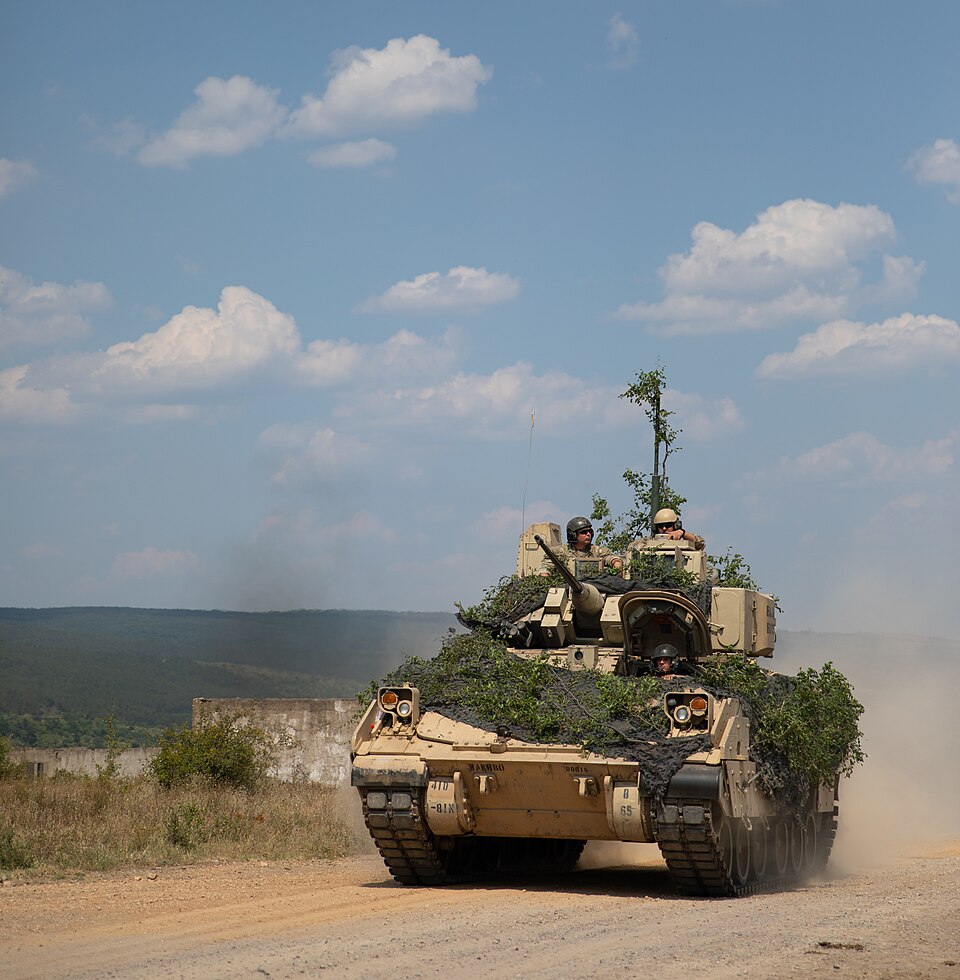
Next in Operation Iraqi Freedom (2003–2011), the invasion of Iraq and counter-insurgency operations, the M3 Bradley adapted from open-desert scouting to high-intensity urban warfare. In "Thunder Runs" M3 and M2 acted as fast, protected firepower assets during the aggressive armored dashes into Baghdad, clearing entrenched infantry and neutralizing ambushes. They faced in common however asymmetric threats, being ill-protected against Improvised Explosive Devices (IEDs) and Rocket-Propelled Grenades (RPGs). If the aluminum hull was susceptible to heavy blast damage, crew survivability rate remained however excellent with a well thhough after interior layout and excellent spall liner. Large hatches and relatively easy access also allowed them to escape even after catastrophic damage. Postwar, the M3 underwent the Operation Desert Storm (ODS) and A3/A4 upgrades, packages adding global positioning systems (GPS) as well as missile countermeasures, battlefield digitization networks and optional Explosive Reactive Armor (ERA).
The M2A3 variant started for example to replace the M3A3 in US Army armored reconnaissance units in 2014, as the increased ammunition loads carried by the M3A3s reduced the number of scouts that could be transported. In 2016, a reorganisation of reconnaissance unit structures saw Humvees replaced by with M2A3s. Overall, as of today, the US still operates an estimated 1,200 M3A2/A3s as of 2025 plus 800 more in storage.
Exports
Unlike the M2A2 Bradley (189 delivered to Ukraine since 2023), the M3 was not exported. M2A2 were also purchased by Saudi Arabia, Croatia and Lebanon. The M3 Cavalry Fighting Vehicle (CFV) however was so specific to the US Army, low numbers and cost conspired against it. In general IFV sold better than a vehicle without proper infantry capacity. The only "M3" user is Croatia, albeit these are some 89 M2A2s reconfigured as M3A3s.M3/M3A1 Bradley specs. | |
| Dimensions | 254 in (6.5 m) x 126 in (3.2 m) x 117 in (3.0 m) |
| Total weight | 50,510lbs, 22,910kg |
| Crew | 5 (3 crew + 2 scouts) |
| Propulsion | Cummins VTA-903T; 8 cyl. 4 cycl turbosupercharged diesel 500 hp (370 kW) at 2600 rpm |
| Maximum speed | 41 mph (66 km/h) |
| Transmission | General Electric HMPT-500 hydromech, auto range selection |
| Suspension | 6 individually sprung dual/track |
| Range | 300 mi (480 km) |
| Armament | 25 mm M242 Bushmaster chain gun, 2x TOW ATGM, coax. GMPG |
| Armor | Basic M2 Bradley |
M3A2/M3A2 Restow specs. | |
| Dimensions | 258 in (6.6 m) x 129 in (3.3 m) x 117 in (3.0 m) |
| Total weight | 60,104lbs, 27,263kg* |
| Propulsion | Cummins VTA-903T V8 TBS Diesel 600 hp (450 kW) at 2600 rpm |
| Maximum speed | 35 mph (56 km/h) |
| Transmission | GE HMPT-500-3 or HMPT-500-3EC hydromech |
| Suspension | same |
| Range | 250 mi (400 km) |
| Armament | Same |
| Armor | Provision for ERA |
Gallery
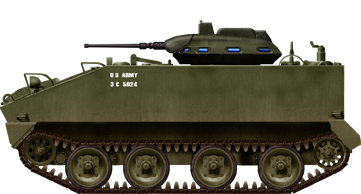
An early ancestor, the 1965 M114, was not a success and needed replacement in 1979 when retired.
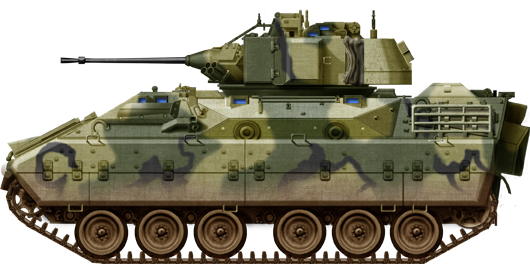
M3 Bradley 1/12 Cav. Fort Knox 1986
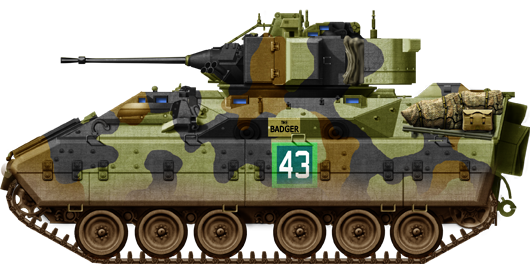
M3A1 HQ Comp. 2/32 Cav. 3th F. Armoured Div. Germany 1989
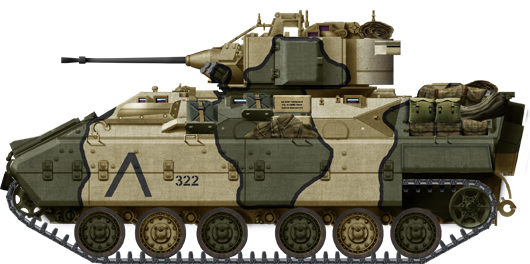
M3 Bradley CRV of a reconnaissance batallion Operation Desert Storm 1991
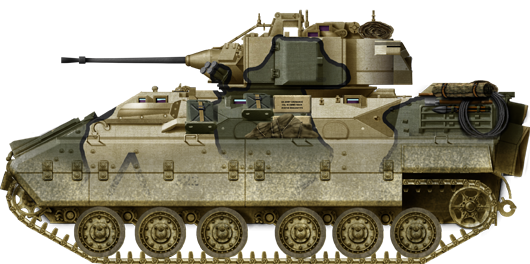
Same under dust.
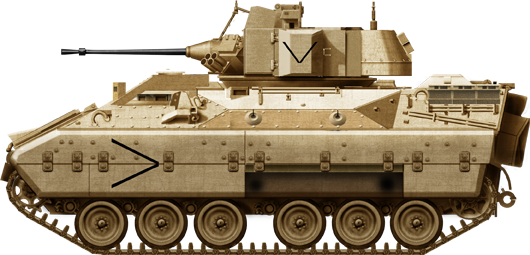
M3A1 desert
M3A2 - In the making
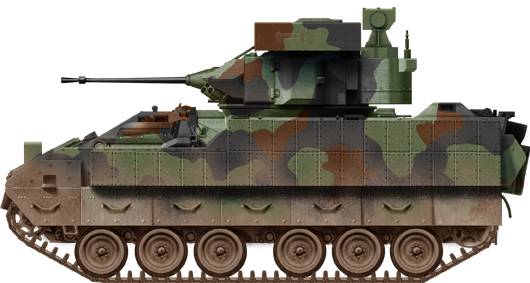
M3A3
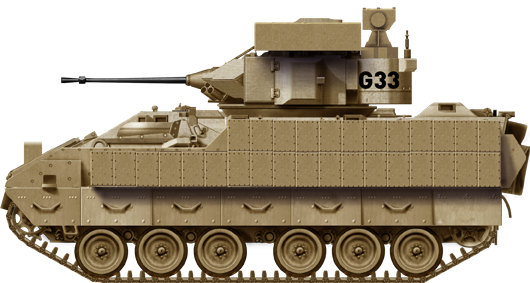
M3A3
M3A4 - In the making
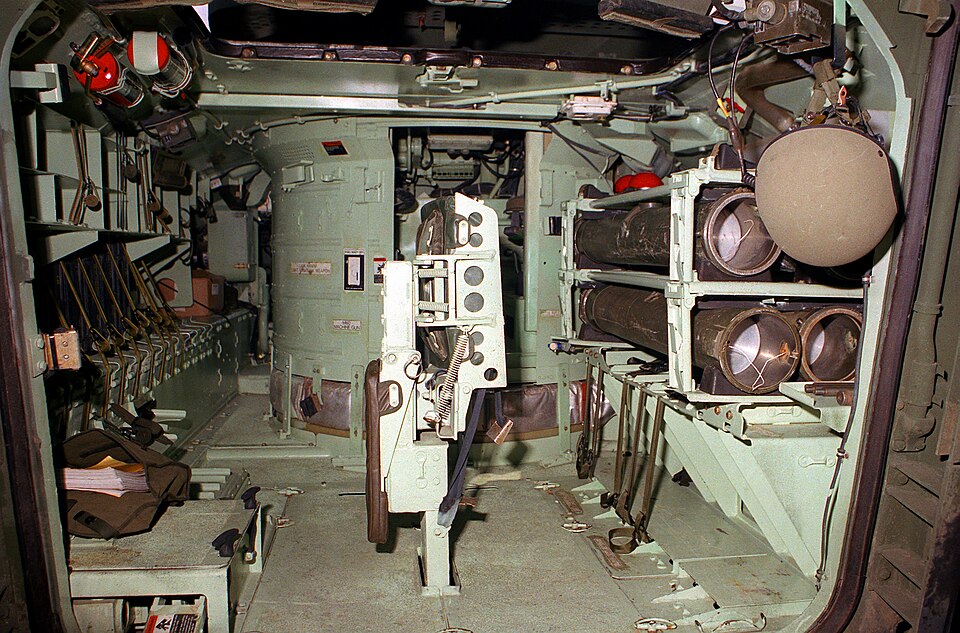
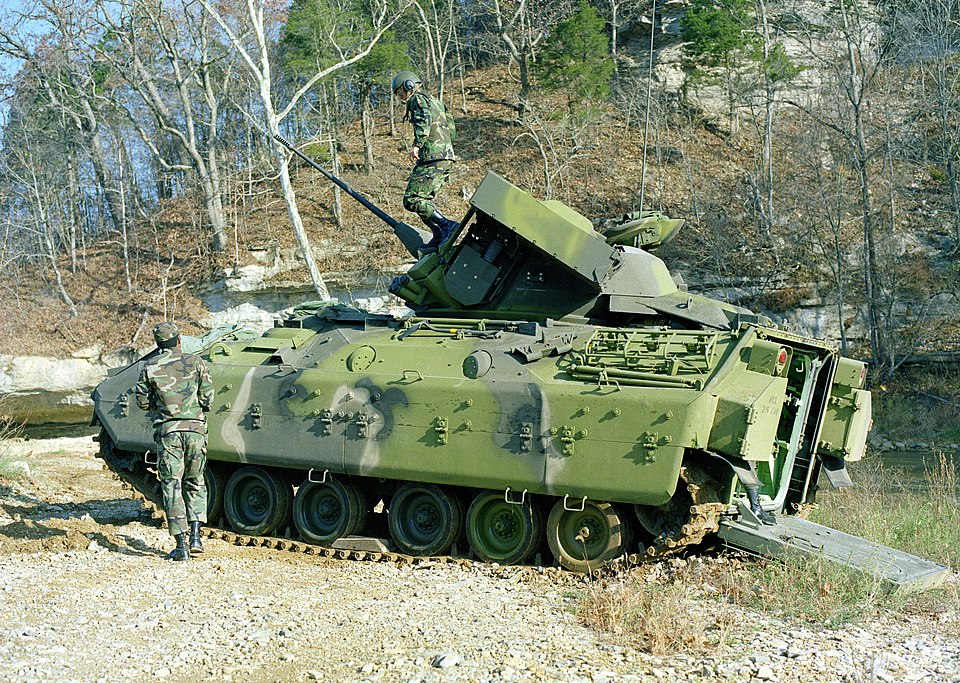
A left side view of an M3 Bradley Cavalry Fighting Vehicle operated by members of the 3rd Plt., E Trp., 2nd Bn., 6th Cav., participating in maneuvers at the U.S. Army Armor Center. 1 January 1983
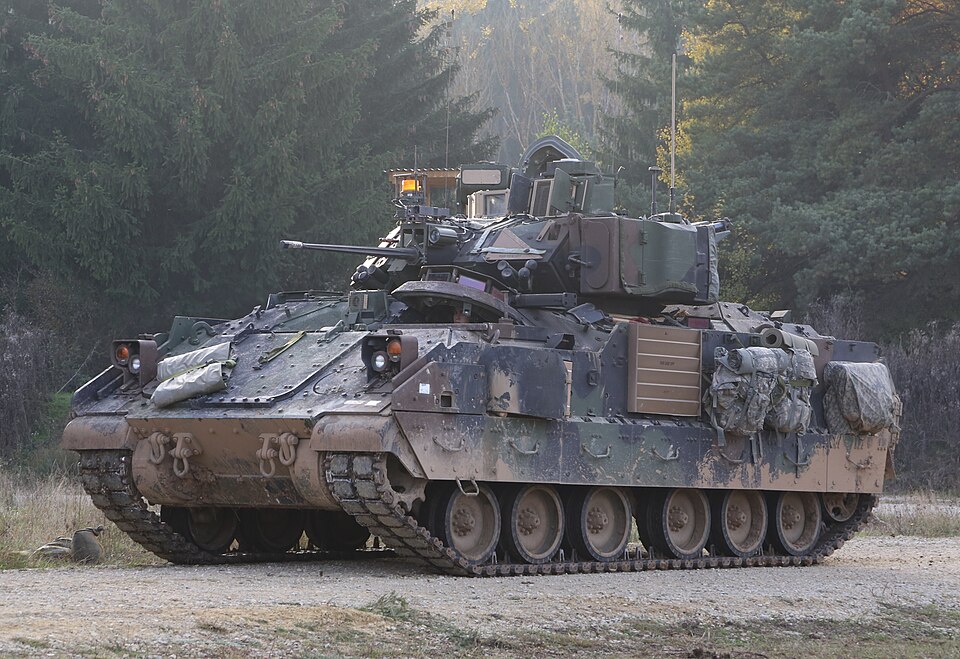
A U.S. Army M3 Bradley fighting vehicle, left, of Alpha Company, 3rd Battalion, 69th Armor Regiment, and a German army Dach engineering vehicle maneuver through a field while conducting a water obstacle with opposing forces scenario during exercise Letzlingen Freedom Shock at the GACTC in Letzlingen, Germany, April 25, 2015. Exercise Letzlingen Freedom Shock promotes interoperability between the German and American training organizations while highlighting U.S. Army Europe's rapid deployment capabilities. November 2014.
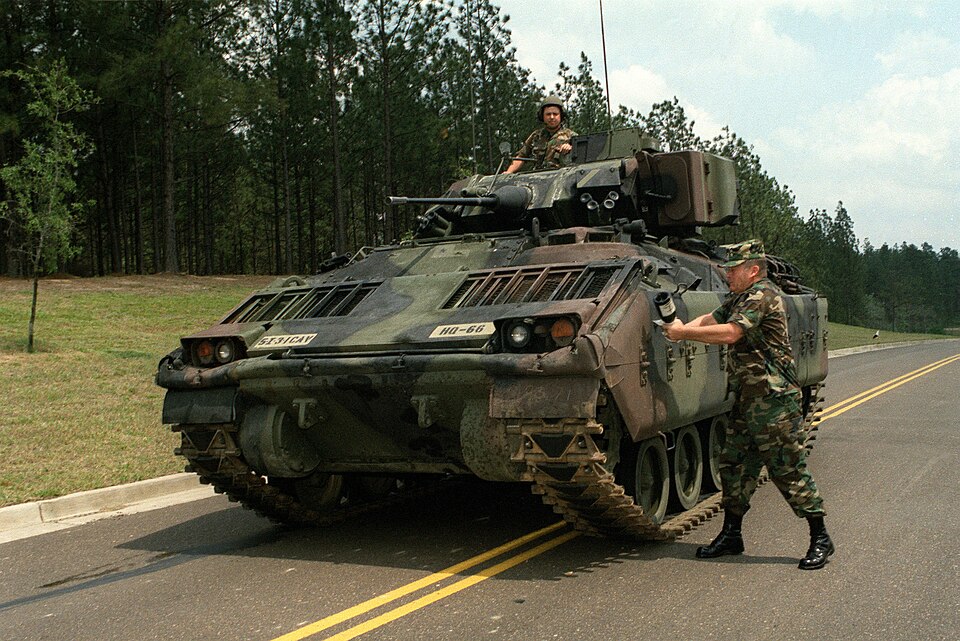
Major General (MGEN) Thomas P. Carney, Commander, 5th Infantry Division (Mechanized), prepares to christen the M3 Bradley fighting vehicle during a ceremony celebrating its arrival at Fort Polk. The M3 will be used by the 3rd Squadron, 1st Cav., 5th Infantry Division (Mech.), 20 April 1990
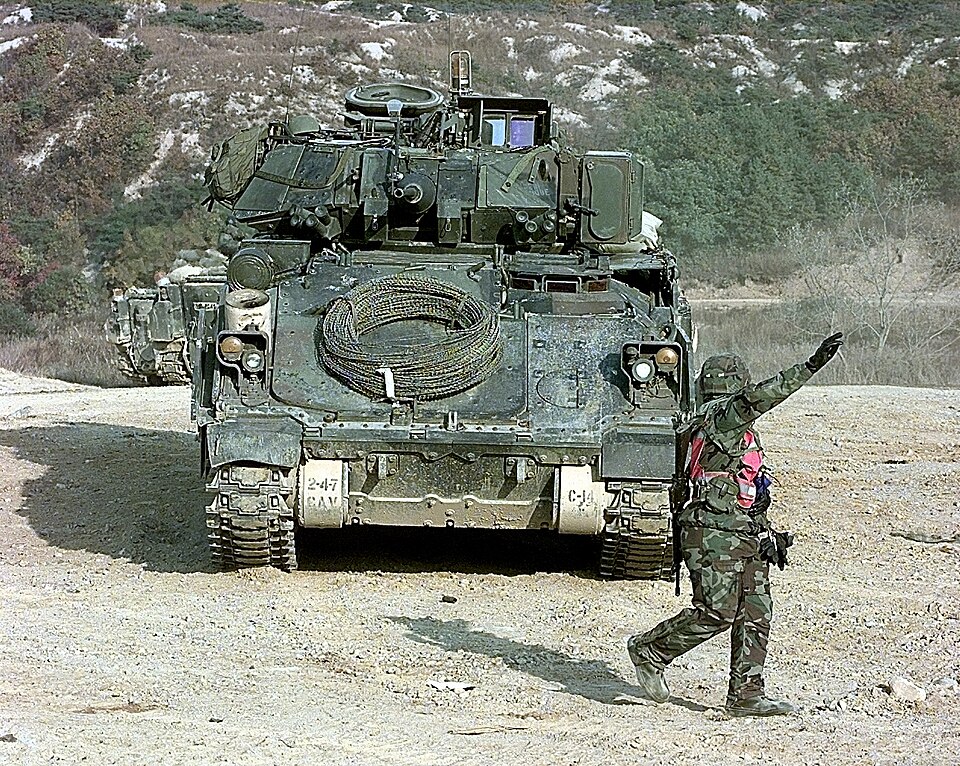
A U.S. Army soldier ground guides a M-3 Bradley Fighting Vehicle to a spot for decontamination after gunnery training at the Korea Training Center, Republic of Korea, on Oct. 25, 1998. Armored units use the range to meet yearly, live gunnery training requirements. The Bradley is attached to C Troop of the 4th Squadron, 7th Cavalry Regiment. 25 October 1998.
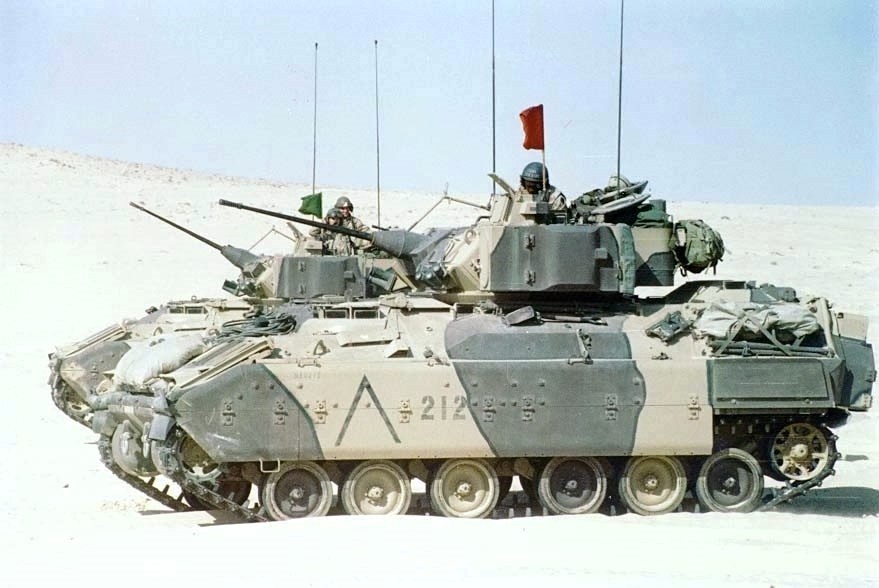
M3 Bradley in Desert Storm 1991
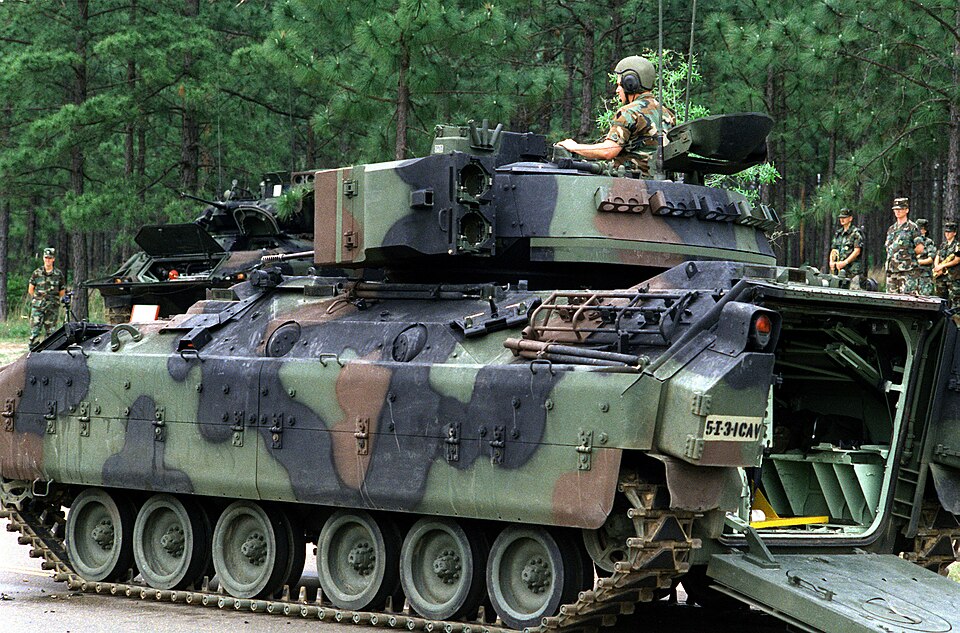
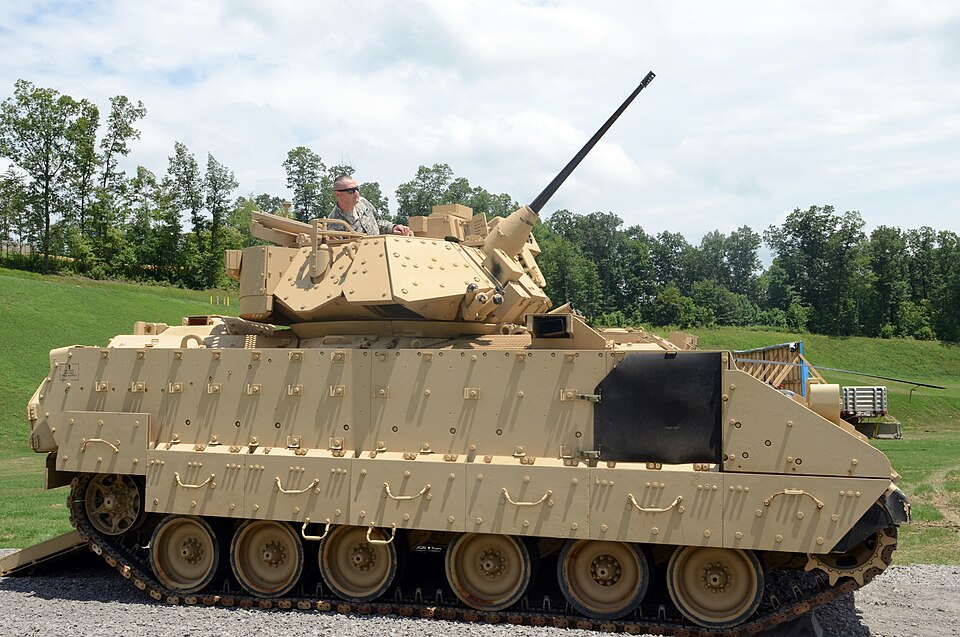
U.S. Army Staff Sgt. Tommy Wolford, a cavalry scout with Alpha Troop, 1st Battalion, 150th Armored Reconnaissance Squadron, 30th Heavy Brigade Combat Team, checks a vehicle in preparation for the 2013 National Scout Jamboree at Summit Bechtel Reserve, W.Va., July 13, 2013.
Src on the M3 Bradley
Hunnicutt, R. P. (1999). Bradley: A History of American Fighting and Support Vehicles.The Military Balance. International Institute for Strategic Studies. 2025.
military-today.com
Assessment of the M2/M3
Army Cap. Integration Center Report
militaryfactory.com
military.com
historyofwar.org
reviews.ipmsusa.org
afvdatabase.com
en.wikipedia.org
Video

Cold War Tanks


Cold war tanks posters
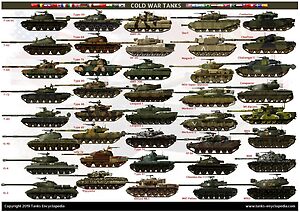
Cold War Main Battle Tanks
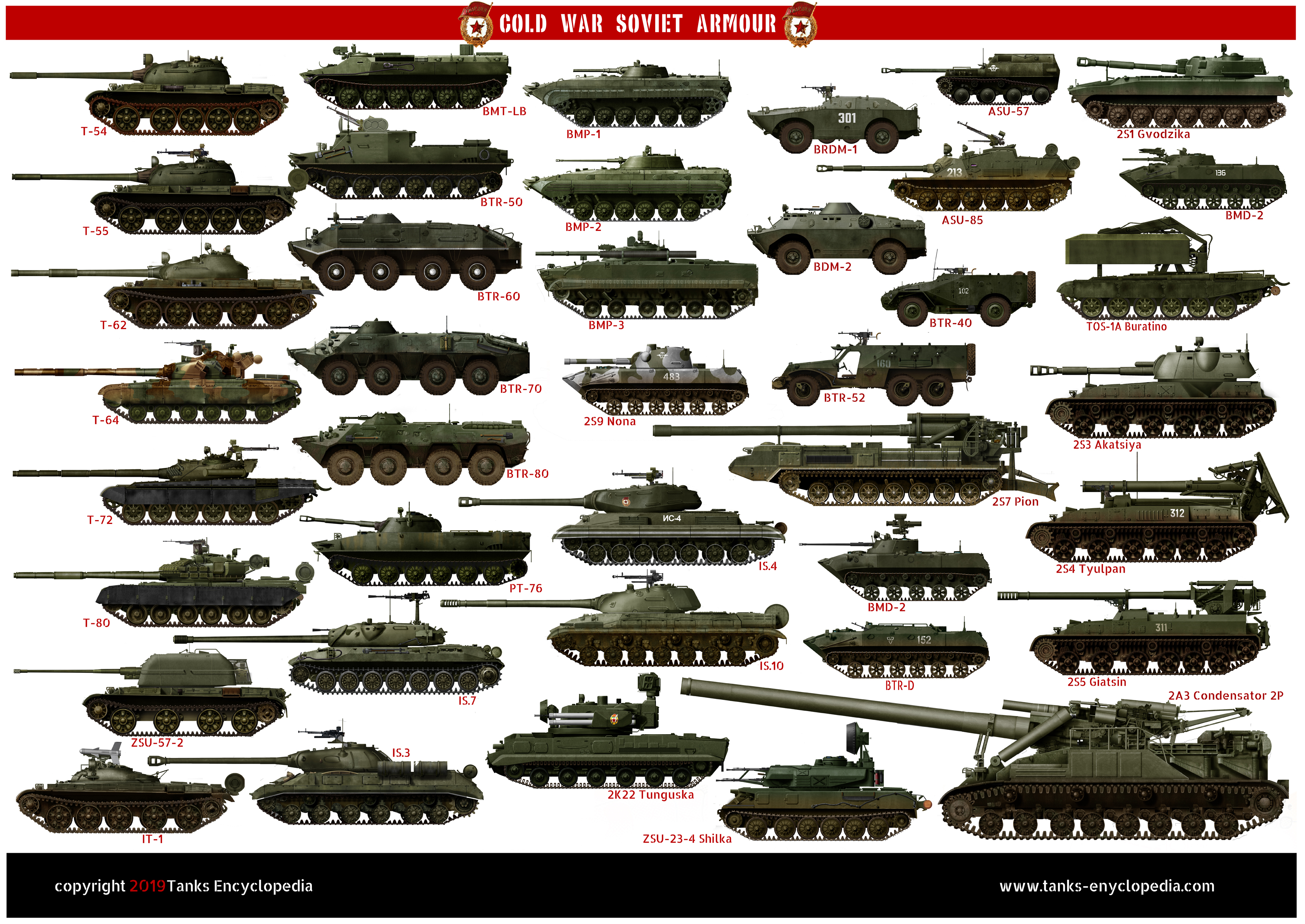
Cold War Soviet Army