Leopard 2A4M CAN (2010)

 Canada, Main Battle Tank - 20 built total
Development
About the Leopard 2A4
The initial Leopard 2 was developed in response to the demand for a new Main Battle Tank, announced by Bundeswehr in the early 1960s to replace the Leopard 1, but initial cooperation with the USA for their own MBT, notably Chrysler with the MBT-70 petered out after few years. Both countries went their own ways, the US developed the M1 Abrams. Final development started in the 1960s ad went on for almost 15 years, when the Leopard 2 was introduced in 1979. Unlike its predecessor for wich armour was optional, the Leo 2 was the best armoured MBT ever while keeping an excellent 120 mm Rheinmetall gun and mobility, far surpassing any Soviet design. In a way the Leo 2 was the first true 3rd generation MBT alongside the M1 Abrams, French Leclerc, British Challenger.Long story short, several versions later, it became the main battle tank of all of Europe and beyond, short of France and UK, the staple of western armies. The last, Leo A4(1985) and A6 (1990) were highly advanced and improved and the A4 became the most widely exported version. To this the A6 addeed a new arour package with its wedgy front, and new 55 caliber Rh-M-120 gun. Today, the A 7 entered service from 2014. Happy customers are new Austria, Chile, Denmark, Finland, Greece, Spain, the Netherlands, Norway and Poland. But also Canada, which purchased the Leopard 1 to replace its ageing Centurions but they too arrived at the end of their rope and in 2007, Canada acquired 100 surplus Leopard 2 main battle tanks from the Netherlands (80 Leopard 2A4s and 20 Leopard 2A6s) for C$650 million as they were needed urgently for Afghanistan.
About the Canadians in Afghanistan
Canada’s military involvement in Afghanistan spanned from October 2001 to March 2014. Over 40,000 Canadian Armed Forces members served in the longest military conflict in Canada's modern history, which cost at least $18 billion and resulted in the deaths of 158 Canadian soldiers and 7 civilians/diplomats. Timeline:In 2001–2003 Canada joined the U.S.-led coalition following the September 11 attacks under Operation APOLLO, deploying special forces and naval components.
In 2003–2005: Troops shifted to Kabul under Operation ATHENA as part of the NATO-led International Security Assistance Force (ISAF).
2005–2011: Canada took a major leadership role in the volatile southern province of Kandahar, running the Provincial Reconstruction Team and fighting a heavy Taliban insurgency, including leading Operation Medusa in 2006.
2011–2014: Combat operations ended, transitioning into Operation ATTENTION to train Afghan national security forces before the final mission closure in March 2014.
Reconstruction and Aid, Infrastructure & Health: Canadian aid funded major development projects, including the rehabilitation of the Dahla Dam, local schools, and multi-million dollar polio immunization initiatives.
Local Support: Scores of Afghan-Canadian cultural advisers and language translators worked side-by-side with troops on the ground.Impact and Legacy
Human Cost: The mission brought severe physical and psychological casualties to thousands of returning veterans, alongside 158 fallen soldiers.
Post-Withdrawal: Following the collapse of the Afghan government and the Taliban's return to power in August 2021, Canada closed its embassy in Kabul and does not recognize the Taliban regime, leading to ongoing domestic debates regarding refugee resettlement and the rights of those who aided the mission.
In between troops fought with their Leopards 2A4 and 2A6s unmodernized since their acquisition by the Netherlands a decade prior. Although none was destroyed in action, many took battle damage to mines, IEDs and RPGs, and both the crew and engine suffered much for heat; The air cooling inside was adapted to NATO NBC standard and made for northern europe. The tanks were also found "blind" in urban combat and needed upgrades. Reports piled up until the Leopards were prvisionally retired from the frontline. An official demand was pade to the manufacturer, KMW (Krauss Maffei Wegmann) for such an upgrade package
Design
The result was the Leopard 2A4M CAN, a much upgraded Canadian version of the Leopard 2A4, specially reworked for the war in Afghanistan, based on experience, and when the prototype was tried and accepted, the first 20 were delivered in October 2010, with 5 deployed to Afghanistan at end of 2010, operated until July 2011 as combat operations stopped. It was at first envisioned to use the new long barrel L55 to match the 2A6M CAN, bt this was less than ideal in Afghanistan. The L44 was kept, and small areas of slat armour were added at the rear, in contrast with the fully caged 2A6M CAN. The protection was further augmented with applique armour close in tech to the one sported by the latest Leopard 2A7+ but modified to fit the 2A4 turret.The Leopard 2A6M used by Canada menawhile was on loan from the German Bundeswehr. They were upgraded to Canadian standards and then airlifted into Kandahar from August 2007. Changes were the massive cage of slat armour and new CF communications equipment, and others equipments, etc. They also hadd add-on belly plates. At first they were be returned to Germany. With experience on the Leopard C2 in Afghanistan, Canada purchased the Leopard 2A6 but they still lacked a proper air conditioning. Gordon O’Connor confirmed the order on April 12, 2007.
In Afghanistan, twenty 2A6 were upgraded to 2A6M, loaned at no cost and assisted by two Leopard 2 Büffel Armoured Recovery Vehicle, the first handed over officially on August 2, 2007, the first arriving in Afghanistan on August 16, last by late September. Canada commissioned KMW to upgrade 20 Leopard 2A4 main battle tanks in July 2009 to be deployed in the colder Hindu Kush, which became the Leopard 2A4M CAN, this one specially designed for operations in Afghanistan. It was done with KMW in collaboration with the German army and Federal Office of Defence Technology and Procurement (BWB) for the development, conversion and overhaul of the first vehicles made in a year and deployed in 2010.
Powertrain
It was unchaged since the original 2A4: For a total weight of 62 t less add-on and bar armour for its Crew of 4 (driver, gunner, loader, cdr.) the leo 2A4M CAN keep its 1100 kW MTU MB 873 hp engine, and is still mounted on seven doubled roadhweels, for a suspension or Torsion Bars and hydrosprings, for a top speed of 70+ km/h (road) governed, 55 km/h (off road). Drivers could disable the governor in emergency and it is said to reach 90 kph or more on road.Protection
The composite armour for the Leopard 2A4M CAN resembles that of the Krauss Maffei Wegmann 'Leopard 2A7+' concept tank, a demonstrator for which KMW claims "unmatched IED and mine protection". The key difference in armour is the gun mantle and turret nose – adapted to the original Leopard 2A4 EMES-15 gun sight position. This results in a noticable 'notch' in the Leopard 2A4M CAN's starboard turret-front armour (as that EMES-15 was raised to roof level on Leopard 2A5/2A6s).Although the Leopard 2A4M CAN's up-armour set looks very similar to IBD Diesenroth's Leopard 2A4 Evolution AMAP, the Leo 2A4M's armour panels were designed by KMW specifically for DND. So, small wonder that the hull add-on armour resembles that of their 'Leopard 2A7+'. [3] Differences are most apparent on the bow armour. Where the demonstrator has thicker bow and glacis, the Leopard 2A4M CAN retains the shape of its origins. However, on the lower bow, a 2A6M-style belly plate is seen. In short, the new Leopard 2A4M CAN features the latest in hull-protection with turret 'add-on' armour scaled more to deal with roadside IEDs than opposing tanks. Considering the CF's only recent combat deployment with Leopard tanks, that seems a sensible compromise.
The Leopard 2A4M CAN has the same Mine Protection kit as the Leopard 2A6M CAN, but lacks the latter’s all-round bar armour. Instead, it features the all-round modular armour package from the Leopard 2A7+ which was also developed by KMW and has been modified to fit the turret configuration of the 2A4. Other safety features include a replacement electrical drive and crew cooling
Armament
Though originally planned to be up-gunned to the L55 for consistency with the 2A6M CAN, the longer barrelled guns (optimized for tank-vs-tank warfare) were found to be less than ideal in Afghanistan, and therefore it was decided to retain the L44 shorter barrel.The decision to retain the older Rheinmetall L/44 gun may have been forced on DND but it, too, is a good compromise. The Rheinmetall L/55 has a performance gain at extreme ranges but that gun also extends the overall length of a Leopard by 1.3m. Not much but the difference can be critical when trying to rotate the turret in narrow streets or other built-up areas. Although little detailed information has been released about the new Leopard 2A4M CAN, this variant appears to be a capable tank well protected for modern, assymetrical warfare.
Protection
These tanks are refurbished with some (20) upgraded to full Leopard 2A6M CAN standards apart the gun, but a level closer to the 2A7+ in realty. Still they can be fitted with full 2A6M armour if needed. The passive armour, modoular and composie is classified but allegedly protects fully against any modern ATGMs including with tandem warheads, and the latest AFPSDS and HEAT rounds. As foractive protecton: In addition to their eigt smke dischargers with autoatic release in case of laser detection or IR illumination warning, there is the the Saab Barracuda MCS covers are said to reduce solar loading by 50 percent. MCS is based on the Barracuda HeaT Reduction (or HTR) system. HTR minimizes heat radiation with a layered approach. The upper layer reflects sunlight while the bottom layer insulates the hull. Leopard 2A6M MCS is similar to those fitted to Australian Leopards. Leopard C2s have a different design of heat-reducing covers. At least one Leopard 2A6M CAN has been knocked out by a large IED. Although this vehicle was so badly damaged that it cannot be returned to Germany, the crew suffered no major injuries. In this case, the 2A6M's mine protection plate worked just as it was designed to.Variants
2A4M CAN
In July 2009, Canada commissioned KMW to upgrade 20 2A4s to the standard of the 2A6M. These 2A4s would be refitted at KMW's Munich facility. They were then delivered to the Canadian Army in October 2010, after which five were deployed to Hindu Kush, Afghanistan where they supported ISAF forces until July 2011 when combat operations halted.Latvian 2A4M CAN
In June 2023, Canadian Minister of Defense Anita Anand announced that 15 of the 2A4M CANs (and the necessary support personnel and equipment) would be deployed to Latvia to bolster NATO's military strength in Eastern Europe. The justification behind this was increasing defensive presence in the region during the Russo-Ukrainian War. These tanks were delivered on November 10 of the same year.
Leo 2A4M CAN specifications | |
| Dimensions | 9.97m (gun fwd.) 7.74m (hull), 3.74m (less skirts), 3.0m |
| Weight | 62 t (less add-on and bar armour) |
| Crew | Crew 4 (driver, gunner, loader, veh cdr.) |
| Propulsion | 1100 kW MTU MB 873 |
| Suspension | Torsion Bars +hydrosprings |
| Speed (road) | 70+ km/h (road), 55 km/h (off road) |
| Range | c600 see Leo 2 |
| Armament | 120mm L/55 main gun, 2 x 7.62mm, MG3s, 16x 70mm smoke dischargers |
| Armor | Same as Leo 2A6M+ 2A7 standards |
| Total production | 20 converted as KMW in 2010 |
Gallery
Illustrations
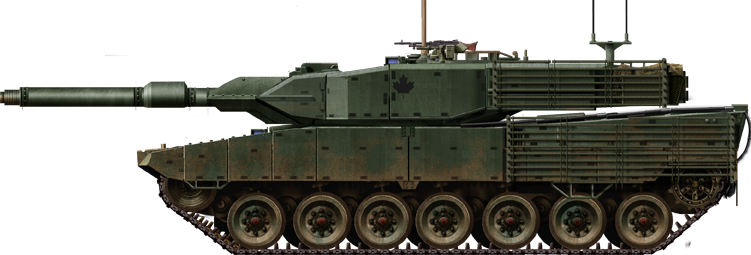
Definitive appearance of the Leopard 2A4M CAN as it appeared in Afghanistan, improved for urban combat, it was combat tested from 2008 to 2013.
Photos

Leopard 2A4M testing a dozer blade

2A4M

2A4M

2A4M

2A4M

2A4M

Leopard 2A6M

2A6M Afgha
Sources/Links about the Leo 2A4M Can
Leopard 2A4M CAN
Modern Tanks


Modern MBTs posters
Denel Bagder (2018)
Type 16 MCV (2016)
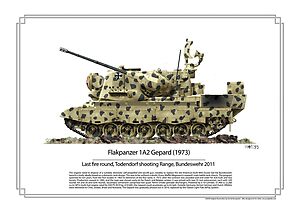
Gepard 1A2 last rounds 2011
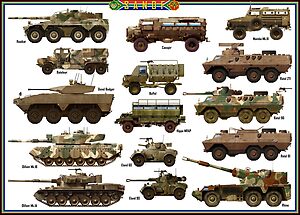
SANDF
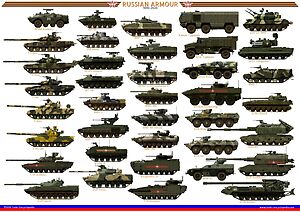
Russian AFVs
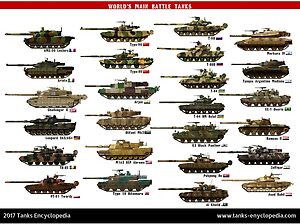
Main Battle Tanks