Schwerer Wehrmachtschlepper mit Behelfspanzerung
 Germany (1945)- c80 built
Introduction
The Schwerer Wehrmachtschlepper (acronym sWS) for "Heavy Military Tractor" was a German WWII half-track manufactured between 1943 and 1945, but designed under orders from Hitler for mass production in May 1942. The present post is about the unprotected model were used to supply the eastern frontline and to haul artillery. However the shortage or armour meant many started to be later converted Armored versions for FLAK or as rocket launching vehicles (Nebelwerfer). Mass production remained a pipe dream and only less than a thousand were built before V-Day. Czechoslovakia designed an improved model, the Tatra T809, which became its early cold war standard APC.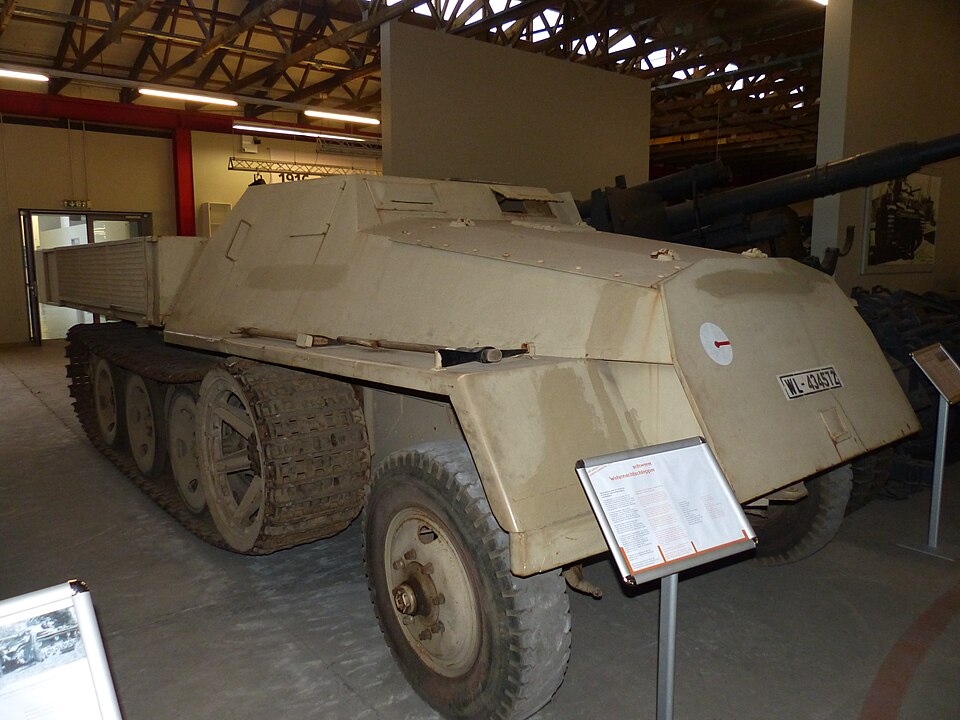
At the panzermuseum Munster
Despite the final limited production of some 825, only a fraction of it was manufactured, especially from 1944 and until the spring 1945 as armoured variants. Back in late 1942 already at development phase the 5th prototype vehicle ordered from Bussing for evaluation was armoured. However it was agreed from the start that production would focus first on unprotected half-tracks first, the original sWS, with the remainder in production being FLAK carriers. However both with the degrading situation on the Eastern front for supplying the frontlines, and from reports of improvized armour made of these vehicles led to a standardization or partially armoured bodies by mid-1944.
Hence the chwerer Wehrmachtschlepper mit Behelfspanzerung and only a partial body and bonnet but unprotected flatbed. The major difference was that the meshed walls of the latter could fold either side, creating an extended "floor" for the use of whatever FLAK ordnance installed there. Both would carry the same 37mm flak 43/1 or 20mm quad Flak-vierling 38. Other tested anti-tank guns and there was a serial armoured rocket launcher carrier, the Panzerwerfer 42 auf sWS. Albeit the FLAK variants were supposed to bring organic AA defence in the constant withdrawal of the Wehmacht they were often used against ground troops as well, with devastating effect.
Approximately 80 of the 3.7 cm Flak 43/1 were mounted on the Schwerer Wehrmachtsschlepper (s.W.S.) chassis featuring improvised armor were produced until February 1945 at Bussing.
Design
The armor, which enclosed the engine compartment and the driver's cab, was made of unalloyed steel or carbon steel. Armor thickness was 16 mm at the front, 12 mm on the sides, and 8 mm on top. A large compartment for ammunition and accessories was located at the rear of the cargo bed. The side walls of the cargo bed were made of mesh and could be folded down to expand the combat platform.Photographic evidence confirms that the 2 cm Flakvierling 38 was occasionally mounted in place of the 3.7 cm Flak 43. The vehicle's low speed proved particularly detrimental to operations in this anti-aircraft configuration, and the troops never accepted it in that role. As a result, some units removed the guns and used the vehicles as prime movers for artillery or as supply transports.
Variants
- Schwerer Wehrmachtschlepper with improvised armor as a self-propelled mount for the 3.7 cm Flak 43/1 (main)
- Schwerer Wehrmachtschlepper with improvised armor as a self-propelled mount for the 2 cm Flakvierling 38 (occasional)
- Schwerer Wehrmachtschlepper with improvised armor – unarmed, as a transport vehicle
- Schwerer Wehrmachtschlepper with improvised armor for the 15 cm Panzerwerfer 42: At least 1 vehicle (photographic evidence suggests 2) experimentally converted in a manner similar to the Sd.Kfz. 4/1 (Panzerwerfer 42).
- Schwerer Wehrmachtschlepper with improvised armor for the 15 cm Panzerwerfer 42 Ammunition vehicle: According to various sources, a version without the launcher turret was built as a supply vehicle (similar to the Sd.Kfz. 4/1), though photographic evidence is lacking
- Schwerer Wehrmachtschlepper with improvised armor for the 15 cm Panzerwerfer 42 "Uhu" IR battlefield illumination – according to some sources, a vehicle equipped with a 60 cm infrared searchlight mounted on the Panzerwerfer 42's launcher mount was designed for night combat illumination; however, the existence of a prototype has not yet been proven
sWS m/bfs.Pz specifications | |
| Dimensions | 6.675 mm x 2.500 mm x 1.90 mm w/tload |
| Weight | Est. 12 tonnes w/t load |
| Crew | 2 (+ FLAK crews) |
| Propulsion | Maybach HL 42 TRKMS 4198 cm³ 100 PS (74 kW) 2.800/min |
| Suspension | Torsion Bar, Interleaved wheels |
| Maximum speed | c20 kmh |
| Range | 240L, 200-250 km |
| Armament | Standard 3.7 cm FLAK 43, see notes |
| Armor | See notes, 6-12mm fwd |
| Total production | c80 |
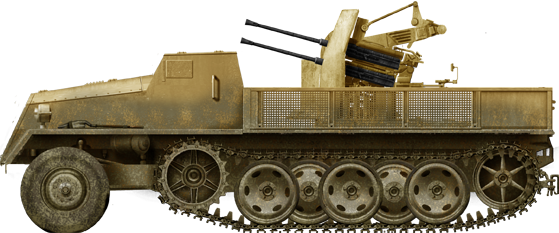
Vehicle not camouflage, with swapped Flakvierling
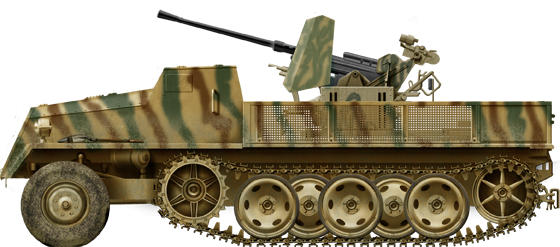
Standard version camouflaged, with the 3.7 cm FLAK
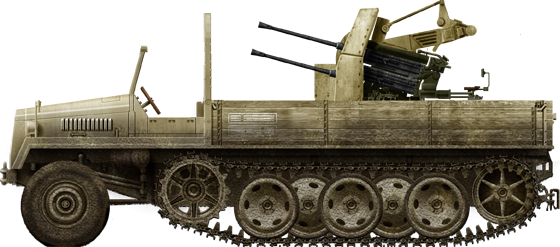
Unprotected earlier sWS with the Flakvieling
Gallery

Chassis

Naked chassis
Links
kfzderwehrmacht.defacebook.com/panzerarcheology
nevingtonwarmuseum.com
de.wikipedia.org
panzernet.net
armedconflicts.com
WW2 Tanks


WW2 tanks posters
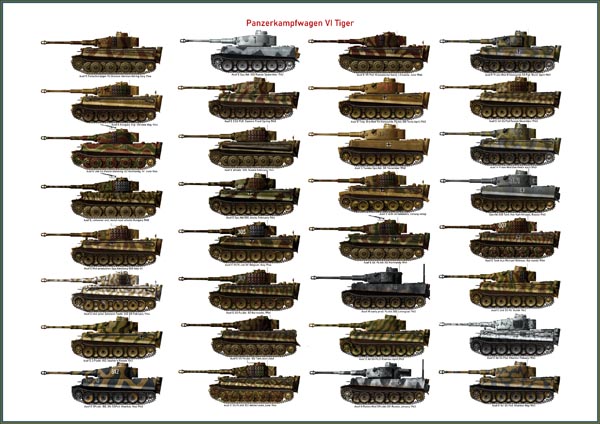
All Tiger tanks liveries.
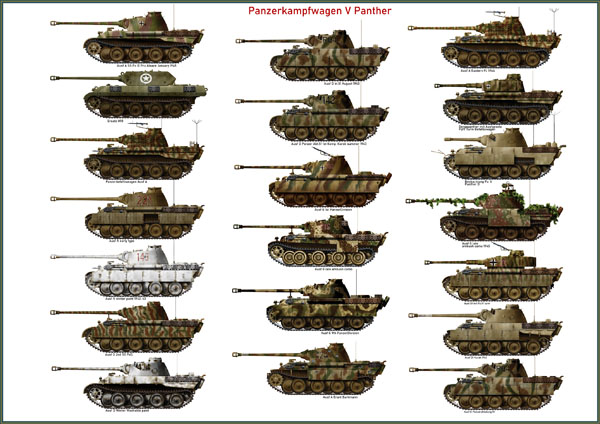
Panther liveries and variants
WW2 Armour - All tanks
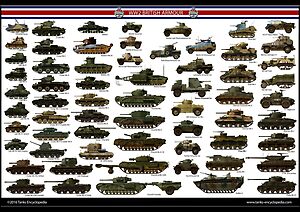
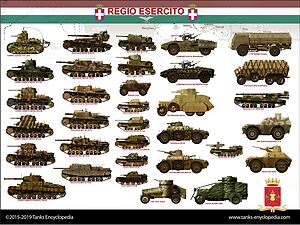
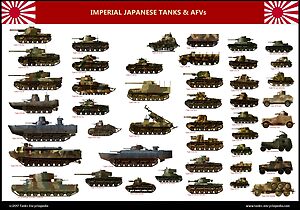
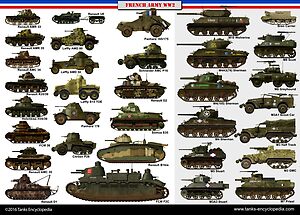

Tanks aces and single tanks series
Find more there
Museums, Movies, Books & Games
The Tanks and Armor in pop culture
Tanks and armored vehicles in general are only really grasped when seen first person: The mass, the scale, it's all there. Explore also the way tanks were covered in the movie industry, in books and in video games.Movies:
Best tanks movie on warhistoryonline.com
On imdb.com
On bestsimilar.com/
miltours.com
liveabout.com/
watchmojo.com
Video Games:
pcgamesn.com
historyhit.com
levvvel.com
vg247.com/best-tank-games
mmobomb.com/
alienwarearena.com