3.7 cm Flakzwilling auf Panther Fahrgestell 341
 Germany (1945), 1 mockup built
The Flakpanzer Coelian in short

In 1944, the Luftwaffe lost control over the skies over Germany. This also hampered any armoured counter-attacks in Italy on France due to the complete dominance by day of Allied aircraft. Panzer divisions duffered a lot already by the last stage of the Tunisian Campaign, and rlied mostly on various brands of half-tracked Self-Propelled Anti-Aircraft Guns such as theSd.Kfz.10/4, Sd.Kfz.6/2, Sd.Kfz.7/1, which had limited or no armor, especially from the air.
To better protect the crew a new Flakpanzer was required. Attmps were made of now obsolescent Panzer III and IV chassis, like the famous Flakvierling. They offered an open shield protection when a fully enclosed turret was obvious. Under WaPruf 6 in May 1943 already Oberleutnant Dipl.Ing von Glatter-Götz started working on such fully enclosed turret. Since the Panzer I and II already in short supply had ben all recycled, as was the Panzer III chassis now used for the STUG-IV only the Panzer IV chassis remained, and became the primary platform for new FLAKpanzer systems, with the Panzer V kept as a backup, until production ramped up enough.
With air defence stats analysis, it became soon clear that the best answer was still the 20 mm MG 151/20, in large supply. However as the project went on in 1944, it was now obsolete. By December 1943 already the team examined the use of a 3.7 cm FLAK gun instead as a first step before the 5.5 cm Gerät 58 guns then in R&D. Daimler-Benz was chosen for the turret and it too, proposed many configurations and armor thicknesses. The first even was protected by 100mm frontally, but it was not retained.
Aware of the project, Rheinmetall-Borsig already started working on its own vehicle and in early 1944 presented the “341” design. Unlike WaPruf 6 Flakpanzer team it was based instead on the Panther, which solved a number of issues. Eventually a mockup was completed by June 1944 with a pair of 3.7 cm guns, which was presented on a Panther chassis to Wa Prüf 6 at Kummersdorf in early 1945. Long story short, it was not accepted for production so not to tax the already overburdened Panther production line and changing priorities.
Tech Details

The Flakpanzer 341 was to be produced by Rheinmetall-Borsig (Turm/Waffe) & Daimler-Benz (Turret assembly) for a crew of 4-5 men (Commander, Gunner, Loader(s), Driver, Radio Operator) and a combat Weight of Approx. 43,000 kg (43 metric tonnes). In Length for the Hull only it was Total 6.87 m long and 8.86 m overall including guns. In Width it was 3.27 m up to 3.4 m. Height was approx. 2.80 m to 2.95 m and more with the guns raised at max elevation.
The Flakpanzer 341 was armed with a pair of 3.7 cm Gerät 341, experimental L/77 high-velocity automatic cannons, evolving from the FlaK 43 architecture. As secondary Armament it had a 7.92 mm MG 34 machine gun in the bow ball-mount like the original, just kept. The Turret Traverse was 360° with continuous rotation via a hydraulic drive mechanism. Gun Elevation and Depression was -5° to +90°.
Rate of Fire was Approx. 250 rounds per minute per barrel (combined cyclical rate of 400-500 RPM) for a muzzle Velocity or approx. 1,040 m/s using specialized high-velocity ammunition. Maximum Effective Range was approx. 4,300 metres against aerial targets. Ammunition Supply was planned for 1,500 rounds of 37 mm ammunition inside the hull below the turret ring.
Mobility was largely unchanged from the medium Panther tank. The Engine remained the same Maybach HL 230 P30, 12-cylinder, liquid-cooled, petrol engine generating 700 hp at 3,000 rpm. The transmission was the ZF AK 7-200 gearbox featuring 7 forward gears and 1 reverse gear. Maximum Road Speed: 46 to 55 km/h depending on track configuration and final combat weight. Fuel Capacity: 730 litres stored in multi-tank arrangements. Operational Range: Approx. 200–250 km on roads, up to 100 km cross-country.
Armour & Hull Protection offered significantly better crew survivability compared to open-topped anti-aircraft platforms like the Wirbelwind or Ostwind. The Standard Panther chassis offered a 80 mm upper glacis plate sloped at 55° to provide heavy front protection. Fully enclosed, the turret was of sloped cast and welded steel construction, 100 mm plate angled steeply to deflect incoming ground strafing or anti-tank fire on the front and Sides and Rear: 40 mm to 60 mm thick plating. The roof was 30 mm thick to guard against vertical cannon bursts from low-flying aircraft.
Flakpanzer 341 specifications | |
| Dimensions | 6.87 x 3.27 x 2.8 m |
| Total weight | c40 tons |
| Crew | 4-5 depending on final conf. |
| Propulsion | Same as Panther |
| Suspension | Same as Panther |
| Maximum speed | Same as Panther |
| Range | Same as Panther |
| Armament | 2x 3.7 cm Flak 341 guns +7.62mm MG34 ball mount |
| Armor | Same as Panther, + 30-100mm turret |
| Total production | Mockup Prototype |
Fate
On 13 January 1945, the Generalinspekteur der Panzertruppen officially shut down development. The military determined that the complex 3.7 cm twin turret arrangement added excessive weight to the tank chassis without providing a high enough firepower-to-weight ratio. German focus shifted toward larger systems, such as the twin 5.5 cm Flakzwilling design.Gallery
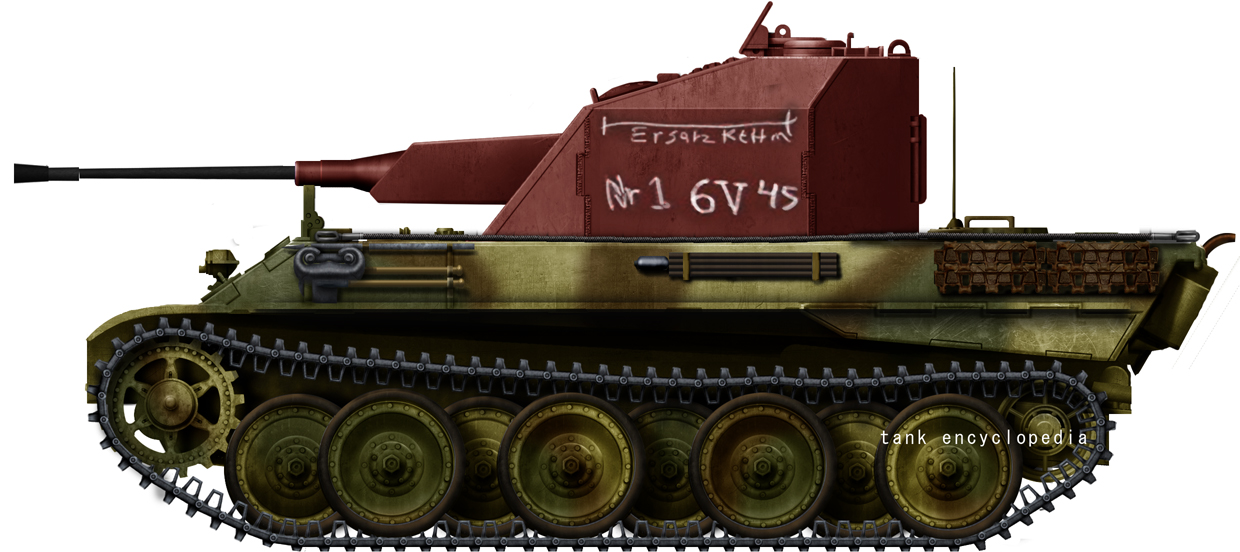
Author's Illustration, click for HD


Links

tanks-encyclopedia.com
en.wikipedia.org
panzernet.net
facebook.com/TankHistoria
WW2 Tanks


WW2 tanks posters
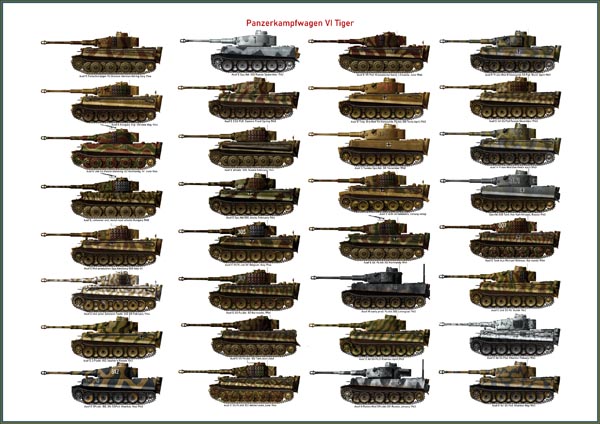
All Tiger tanks liveries.
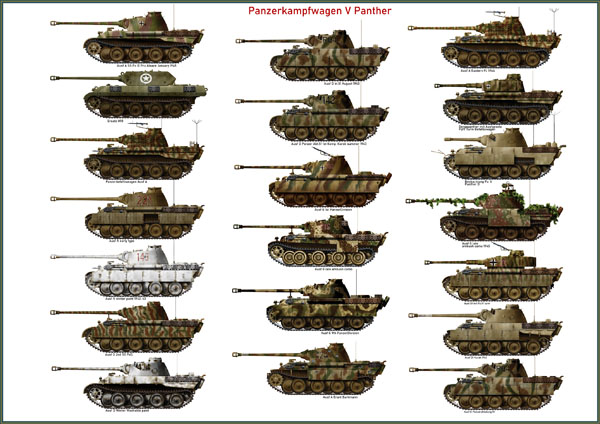
Panther liveries and variants
WW2 Armour - All tanks

Tanks aces and single tanks series
Find more there

Museums, Movies, Books & Games
The Tanks and Armor in pop culture
Tanks and armored vehicles in general are only really grasped when seen first person: The mass, the scale, it's all there. Explore also the way tanks were covered in the movie industry, in books and in video games.Movies:
Best tanks movie on warhistoryonline.com
On imdb.com
On bestsimilar.com/
miltours.com
liveabout.com/
watchmojo.com
Video Games:
pcgamesn.com
historyhit.com
levvvel.com
vg247.com/best-tank-games
mmobomb.com/
alienwarearena.com